
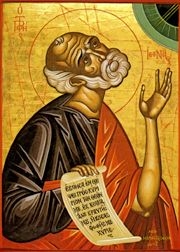
 The American poet and Presbyterian minister, Thomas John Carlisle, wrote a short collection of poems in a volume, “You, Jonah” – a poetic commentary on each chapter of the Book of Jonah. Here is one of his poems, rather summarizing the book to this point:
“I know a better way to circumvent your silly streak of mixing love with righteous judgment,
All I need to do is take the next flight west beyond Your jurisdiction.
This will give you time for sober, second thoughts to swear off this kick of simpleminded kindness. Inside the monster I was as low as I could get when I remembered God,
odd, that my distress impressed me with His apparent absence
when his premised daily presence hadn’t meant a blessed thing.
Finding myself in that hole with my soul fainting and rolling with the swell of my swollen ego.
It was a good enough to kill me.
Good.
Instead, I saw stars in the dark and started home on a welcome water spout.”
 One of the most common things one hears in the Sacrament of Reconciliation is the sin of gossip. It has been said that the act of gossip is like buying a chicken in the marketplace, feathers and all, and then walking through town, plucking the feathers one by one. As a priest, how do I direct a person to undo all the damage caused by gossip. It is akin to asking the person to return and pick up all the feathers. Such is the nature of gossip and its redress.
 When last seen Jonah had just hit bottom, swallowed alive. Up to this point, despite lots of opportunities, Jonah had not prayed, even when commanded by the ship’s captain in the midst of the raging tempest at sea – even as all the crew around him offered prayers to a pantheon of gods. But now it is different. He is alone, his choices and their consequences have “consumed” him, and … and what?
 Today’s gospel is short, sweet with many good points. Let me muse upon just one: “Be merciful, just as your Father is merciful.” One way to consider this admonition is to ponder what are the consequence of withholding mercy.
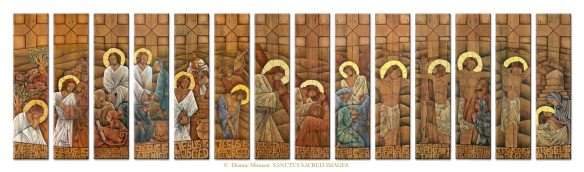 The Traditional Stations of the Cross have long been celebrated in many forms with the 14 Stations familiar to us a relatively recent form. Several of the stations arise from long-held traditions among the Christians of the Holy Land, but they are not necessarily Scriptural. In 1991, Pope John Paul II instituted a form of the Stations that are based solely on Scripture. This too forms a wonderful means of reflecting upon the events of the Holy Week which put the love of Christ in the forefront of our hearts and minds.
  Today’s thoughts were occasioned by a Mass for the school children of St. Francis of Assisi School in Triangle, VA
 Perhaps you have come across this cartoon show from the early 1960 on the Cartoon Network or If you are old enough perhaps you saw it in the original broadcast – Magilla Gorilla.
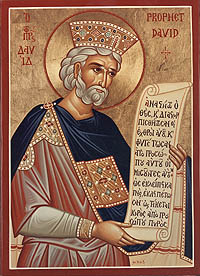 David, son of Jesse – the one who became King of Judah and Israel – anointed as a young lad, the one who defeated Goliath, the one who established Jerusalem as the holy city and brought the Ark of the Covenant to reside. King David of whom the Books of Kings and Chronicles hold up as favored of God, as the high-water mark of all the kings – it is his voice who cries out to the Lord. “A heart contrite and humbled, O God, you will not spurn” (Ps 51:19) Such is the refrain from the Responsorial Psalm from
  friarmusings