
 This weekend we celebrate the visit of the magi to the child Jesus. It is often referred to and celebrated as “Three Kings Day” especially in Latino and Mediterranean cultures. Its official name is Epiphany, from the Greek epiphania, meaning that which is revealed, unveiled. The meaning in Greek is reflected in our English language definition: (1): a usually sudden manifestation of the essential nature or meaning of something (2): an intuitive grasp of reality through something usually simple and striking (3): an illuminating discovery, realization, or disclosure. There is a certain excitement and energy that accompanies the moment of epiphany. Continue reading
What are you seeking?
Reply
 How many of you, in a fit of anger, in the moment you dropped some heavy thing on your foot, mistook your thumb for a nail, watched a souffle collapse, or any one of a number of things that exasperated, exhausted, miffed, frustrated, irritated, annoyed, incensed or _______ (please fill in your descriptive state of mind) you – have taken the Lord’s name in vain? I suspect that the percentage is quite high. Perhaps approaching 99%?
  Unless you happen to be like my muse, Calvin, in the comic strip, I suspect you are about to make some New Year’s resolutions. How did you do on last year’s resolutions? About the same as the rest of us? One ad hominem wisdom saying defines “insanity” this way: to keep doing the same thing and expect a different result. Perhaps 2020 is a time to consider changing the way resolutions are considered, made, and hopefully, kept.
  Stores, offices, and all kinds of places are filled with the sound of familiar and heartening Christmas carols. Some local radio stations are all Christmas music all the time with classic and modern renditions of the secular and religious carols and songs – sometimes recorded by singing chipmunks. It becomes part of the ambiance of our Advent season; part of what readies us for the celebration of Christmas.
  So far this Advent, every pastor’s column has explored one of the many gifts that await us under the tree, that is, the cross of Christ. And there are some awesome gifts – to name the ones mentioned in previous weeks – forgiveness and mercy. Now we have arrived at the Third Week of Advent, Gaudete Sunday! The name comes from wording in Philippians 4:4 – Rejoice in the Lord always. I shall say it again: rejoice! It is another week, and another gift awaits. Like any kid in the days leading up to Christmas you have begun to peer under the tree, assessing the shapes, sizes and weight of gifts – and guessing what could possibly be under wraps. You have to wonder what other awesome gift is waiting right there under the tree, the cross of Christ. Let’s open up another gift! But wait…it’s not Christmas yet. What’s the rush? Christmas is only over a week away. Of course, when I was 7 years old, “only a week” seemed liked a lifetime. Now that I am 67, “only a week” is but the blink of an eye. I am much more patient about most things…. Not all things, most things. So, what’s the rush? Maybe we should practice a little patience?
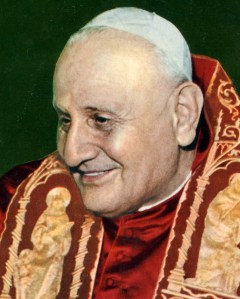 There was a 1964 paperback floating around the seminary library called “Wit and Wisdom of Good Pope John,” written by a man named Henri Fesquet. Inside was a compilation of humorous stories about John XXIII, who died the year before the book was published. I jotted several down and recently found them during my “purging of old files” episode.
 Several years ago I was putting together a series of posts that never went anywhere. It had more in common with an academic tome than blog post. Anyway… in cleaning up file on my hard drive, I ran across a document which might be of interest to folks…but then again, maybe not. In any case, here it is: an abbreviated glossary of the most common types of documents issued by the Holy See, and terms associated with them. (I will be curious to see the “open” statistics on this one!)
 friarmusings