
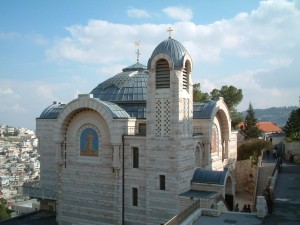
 Last weekend was the first since my return from a pilgrimage to Israel. In addition to the “welcome back” greetings, there were lots of questions in the category of “what was it like?” That encompasses questions of weather, geography, culture, cuisine, accommodations, crowds, places, history, and a myriad of other inquiries. Perhaps the inquiry that was most common was something akin to, “What did you find most surprising?” And there are several responses to that question. But let me share one with you. Continue reading
Knowing Jesus
1
 In medieval Europe, a bell rang every evening at a fixed hour, and townspeople were required by law to cover or extinguish their hearth fires. It was the “cover fire” bell, or, as it was referred to in Anglo-French, coverfeu (from the French verb meaning “to cover,” and the word for “fire”). By the time the English version, curfew, appeared, the authorities no longer regulated hearth fires, but an evening bell continued to be rung for various purposes—whether to signal the close of day, an evening burial, or enforcement of some other evening regulation. This “bell ringing at evening” became the first English sense of curfew. Not infrequently, the regulation signaled by the curfew involved regulating people’s movement in the streets, and this led to the modern senses of the word.
 A panorama of the gorge at Petra – on the way to the Treasury
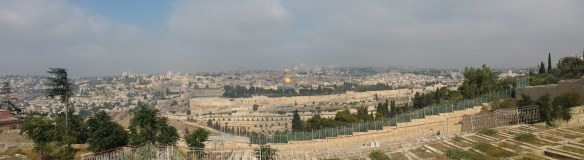 July is the traditional time for vacations, holidays, and trips as families and households visit relatives, relax, and take in different parts of our great nation. Normally I am around the whole summer, preferring to take time off in the autumn when temperatures are more moderate, but this year I had an opportunity to travel to the Holy Land with friends. I had never been and so it seemed an opportune moment that might never come around again. And so, on July 6th off I went, landing in Tel Aviv some 26 hours later.
  If you have been following the last several pastor’s columns, you might have thought “this seems to be a series!” And you would not be wrong. The series is not headed where I first thought, but such is the nature of creative writing. Two weeks ago, I wrote about “change.” There is perhaps nothing more intrinsic to Christian life than change. In spiritual circles we use the term metanoia, a Greek work taken directly into English: a transformative change of heart; especially a spiritual conversion (Merriam-Webster). If you think about the full Sermon on the Mount, there is a basic theme of change evident when Jesus says, “You have heard it said, but I say to you…” This is repeated several times as He explains that what you thought you knew about the 10 Commandments and the Law, is not what God intended. And then Jesus explains how God intended it to be. In that moment, Jesus offers a moment of metanoia, of change. Change can be challenging. But the Christian life is meant to be one of change, ever drawing closer to God in holiness, in wholeness, in teleois.
  Last week I mused about change: Change is not easy. It takes conscious effort and we are hard-wired to resists it. Last week’s column went on to describe adjusting our own attitude toward change. But what about we want someone else to change?

 I have no problem with change — if I have initiated it and get to control it. I think most people are that way. Such change can be exciting and energizing. And then… there is most change: we probably have not initiated it, can’t control it, do not prefer the uncertainty of it all, and have a tendency to resist it. It can be uncomfortable or anxiety-provoking as it interrupts our patterns and habits. The expression that humans are “creatures of habit” is a true representation of how our brains work. Our basal ganglia in the primitive brain are responsible for “wiring” our habits. This cluster of nerve cell bodies is involved in functions such as automatic or routine behaviors that we are familiar with or that make us feel good. So, when we need to do something new (or even harder — to do something old in a new way), it takes conscious effort.
  friarmusings