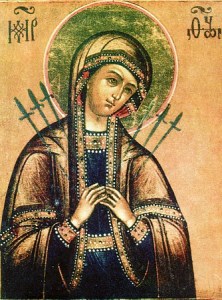
 Our Lady of Sorrows is celebrated on September 15th in the western Catholic Church. It is a devotion on Mary’s experience of the way in which the prophecy of Simeon came to be:
When the days were completed for their purification according to the law of Moses, Mary and Joseph took Jesus up to Jerusalem to present him to the Lord… Now there was a man in Jerusalem whose name was Simeon. This man was righteous and devout, awaiting the consolation of Israel, and the Holy Spirit was upon him. It had been revealed to him by the Holy Spirit that he should not see death before he had seen the Messiah of the Lord. He came in the Spirit into the temple; and when the parents brought in the child Jesus to perform the custom of the law in regard to him, he took him into his arms and blessed God, saying: “Now, Master, you may let your servant go in peace, according to your word, for my eyes have seen your salvation, which you prepared in sight of all the peoples, a light for revelation to the Gentiles, and glory for your people Israel. The child’s father and mother were amazed at what was said about him; and Simeon blessed them and said to Mary his mother, “Behold, this child is destined for the fall and rise of many in Israel, and to be a sign that will be contradicted and you yourself a sword will pierce so that the thoughts of many hearts may be revealed.” (Luke 2:25-35)
In Catholic religious imagery, the Blessed Virgin Mary is portrayed in a sorrowful affect, with seven daggers piercing her heart. These represent the seven traditional sorrows:
- The prophecy of Simeon (Luke 2:25-35)
- The Flight into Egypt (Matthew 2:13)
- The loss of the child Jesus in the Temple (Luke 2:34-45)
- Mary meeting Jesus on the way to Calvary (John 19:26-27)
- Jesus dying on the cross (John 19:30)
- The piercing of the side of Jesus and Mary’s receiving the body of Jesus in her arms (Matthew 27:57-59)
- The body of Jesus placed in the tomb (John 19:40-42)

 Over the last two pastor’s columns I have been talking about stories: sharing your story with God as part of the Sacrament of Reconciliation and just last week, sharing your stories of God with your family. And I continue to think about our stories of faith and this life of grace.
 Stories carry the lifetime of wisdom, experience, reflection, and all manner of insight – a true treasure trove. When I am at the bedside of a dying patient at TGH, with the family gathered, if it seems appropriate, I will ask them to tell me stories of their loved one. It is often difficult to be the first one to offer an account, but when they do, the floodgates open and the stories pour out. They are stories that make you laugh, cry, roll your eyes, and remember all the impish delight and love this one person brought into the world. As I said, a true treasure trove.
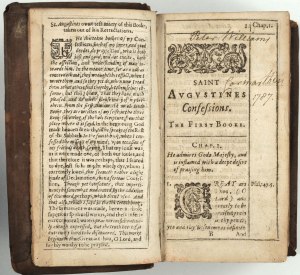 St. Augustine of Hippo begins his great work “Confessions” with a question: “How shall I call upon my God and my Lord, when by the very act of calling upon him I would be calling himself into myself? Is there any place within me into which my God might come? How can God who made the heaven and earth come into me? Is there any room in me for you, Lord, my God?” (I:2)
 Last weekend was one in which there was an intersection of what is best and worst about the Catholic Church. We had a mission cooperative weekend scheduled in which we hosted Fr. Machado from St. Rita’s in Dade City. The parish was welcoming, listened to his message, responded generously with financial assistance, and asked “What can we do to help?” Already parishioners are in dialogue with the staff at St. Rita’s seeking to organize some help programs for the school children. It is Church and community at its best when a people sustained and nourished by the Eucharist, spontaneously reach out to help nourish others.
  Last week I wrote about Catholic men’s movements in the United States during the last 10-plus years. “Men also need support from other men and mentors. Catholic conferences, retreats, seminars, and parish groups provide a supportive and prayerful context for the emotional and spiritual support men need, but usually won’t ask for on a personal level. And so, groups of ordinary men of all ages, from every social and ethnic group, who simply want more out of their Catholic faith, are coming together to make it happen.” I then went on to note that our own parish has several groups that support the spiritual life of men: Men’s Prayer Group and the Knights of Columbus.
 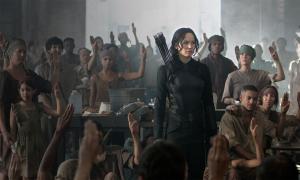 Every year there are many apocalyptic, post-apocalyptic, dystopian movies that make the big screen — and a whole lot more that make Netflix, Amazon Prime, and all the other outlets for cinematic entertainment. These are just a few I thought of over the last several years: “The Hunger Games,” “The Matrix,” “Serenity,” “Blade Runner,” “The Book of Eli,” “Children of Men,” “Divergent,” “Maze Runner,” “The Postman,” “Terminator” — and you will note several of these were series of multiple movies.
  Cue the music marking the entry of Indiana Jones on horseback (replete with leather jacket, hat tilted at a rakish angle, whip at the ready) accompanied by skilled Bedouin horsemen all at a mad-dash gallop – and all we need is an amazing backdrop. The Nabatean world historical site at Petra, Jordan was happy to supply the setting for Indiana Jones and the Last Crusade. Part of my summer pilgrimage was a two-day excursion into Jordan visiting the place of Jesus’ baptism, Mt. Nebo, where Moses overlooked the Jordan River into the Promised Land; and Petra. Petra is an amazing place for which my photographs do not do justice. But other than “how I spent my summer vacation,” why would I bring it up in this column?
  friarmusings