This coming Sunday is the 5th Sunday in Ordinary Time. In today’s post we continue to explore Jesus’ “Sermon on the Mount” which as we discover is more than the Beatitudes of the previous Sunday’s gospel. By paying attention to the text, in Matthew’s telling, we also discover that Jesus is speaking, not to a crowd, but to a select group of disciples. As well we will discover, Jesus is beginning to prepare them for the distinctiveness of Christian discipleship. Continue reading
Category Archives: Scripture
Relationship of The Two Stanzas of the Beatitudes
The people described in the first stanza are those who lack dikaiosynē. The people described in the second stanza are those dedicated to bringing dikaiosynē. Thus the people in the second part provide what the people are lacking in the first part. Ironically, by seeking to provide dikaiosynē, the virtuous may find themselves in the position of lacking dikaiosynē. With Jesus as an example: he proclaimed justice to those deprived of justice, and he became one who was unjustly executed. Continue reading
The Second Stanza – Promises of Reward to the Virtuous
This coming weekend is the Fourth Sunday in Ordinary Time. The gospel is the beginning of Matthew’s well known “Sermon on the Mount.” In yesterday’s post we drilled deep into the nature of the first part of the Sermon known as the Beatitudes. In today’s post we considered the first stanza of the beatitudes (vv.3-6). Today we look at the second stanza (vv.7-10)
7 Blessed are the merciful, for they will be shown mercy. 8 Blessed are the clean of heart, for they will see God. 9 Blessed are the peacemakers, for they will be called children of God. 10 Blessed are they who are persecuted for the sake of righteousness, for theirs is the kingdom of heaven. Continue reading
The First Stanza – Promises of Reversals to the Unfortunate
This coming weekend is the Fourth Sunday in Ordinary Time. The gospel is the beginning of Matthew’s well known “Sermon on the Mount.” In yesterday’s post we drilled deep into the nature of the first part of the Sermon known as the Beatitudes. In today’s post we consider the first stanza of the the beatitudes (vv.3-6)
3 “Blessed are the poor in spirit, for theirs is the kingdom of heaven. 4 Blessed are they who mourn, for they will be comforted. 5 Blessed are the meek, for they will inherit the land. 6 Blessed are they who hunger and thirst for righteousness, for they will be satisfied. Continue reading
Beatitudes: structure
This coming weekend is the Fourth Sunday in Ordinary Time. The gospel is the beginning of Matthew’s well known “Sermon on the Mount.” In yesterday’s post we covered the nature and alternative outlines of the Sermon. Today we go a little deeper into the nature of the first part of the Sermon known as the Beatitudes.
Internal Structure
Altogether there are nine beatitudes in 5:3–12, the ninth (5:11–12) is really an expansion of the eighth (5:10). Some scholars opt for a structure with three sets of three, the first eight exhibit such a tightly knit parallel structure that it is more likely that we should understand them as two sets of four. This is most consistent with Hebraic poetry forms which seem to be the literary background of the Beatitudes. Still there is an internal consistency within each “stanza/verse” as seen in the form of each pronouncement
Blessed are they who… (a quality/activity in the present tense)
for they will be…. (a verb in the future; except vv. 3 and 10)
This form is repeated each time with minor variations. The first and last beatitude have the same ending: “for theirs is the kingdom of heaven.” Some see an internal chiastic structure of the poetic based on the grammar of the text:
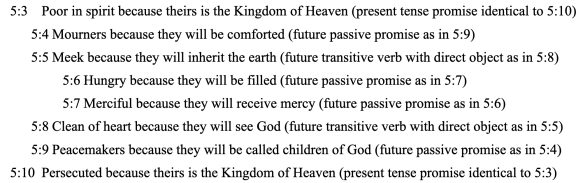
However interesting, this perhaps is a bit over analyzed. It would seem a simpler model (vv. 3 and 10 in the present with the intervening verses in the future) is adequate to point to a “realized eschatology” and the “two-groups of four” is adequate to retain the underlying poetic.
Mark Allen Powell (119-38) suggests that the text can be outlined in the following way:

This outline is simpler and retains a central idea that the kingdom has begun to break into the world but will only be complete (fulfilled) in a future time.
Image credit: Cosimo Rosselli Sermone della Montagna, 1481, Sistine Chapel, Public Domain

Beatitudes: scripture, culture and theology
This coming weekend is the Fourth Sunday in Ordinary Time. The gospel is the beginning of Matthew’s well known “Sermon on the Mount.” In yesterday’s post we covered the nature and alternative outlines of the Sermon. Today we go a little deeper into the nature of the first part of the Sermon known as the Beatitudes. Continue reading
Sermon on the Mount: nature and outline
This coming weekend is the Fourth Sunday in Ordinary Time. The gospel is Matthew’s well known “Sermon on the Mount.” In yesterday’s post we covered the context for the Sermon as well as some overarching views of the Sermon regarding its context and audience. Today we consider the nature and alternative outlines of the Sermon. Continue reading
Sermon on the Mount – context and audience
This coming weekend is the Fourth Sunday in Ordinary Time. The gospel is Matthew’s well known “Sermon on the Mount.” In today’s post we cover the context for the Sermon as well as some overarching views of the Sermon regarding its context and audience. Continue reading
A Summary of Jesus’ Activities
This coming Sunday is the 3rd Sunday in Ordinary Time. In the previous post we discussed the phrase: “the kingdom of heaven is at hand.” Today we summarize the gospel as a prelude to the Sermon on the Mount – the gospel for the 4th Sunday. “His fame spread to all of Syria, and they brought to him all who were sick with various diseases and racked with pain, those who were possessed, lunatics, and paralytics, and he cured them. And great crowds from Galilee, the Decapolis, Jerusalem, and Judea, and from beyond the Jordan followed him.” (Mt 4:24-25) Continue reading
The Kingdom of Heaven
This coming Sunday is the 3rd Sunday in Ordinary Time. In yesterday’s post discussed some insights about fishing in the first century as well as being “caught” in our time. Today we will consider the phrase: “the kingdom of heaven,” a phrase unique to Matthew’s gospel. He often uses it in place of Mark’s “kingdom of God.” Perhaps, if we assume a Jewish background for Matthew, it is a way of avoiding saying and thus possibly misusing the name of God. Continue reading