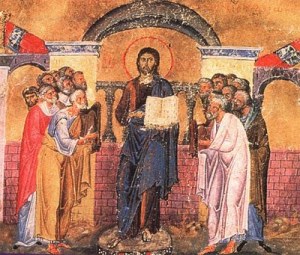
20 Now there were some Greeks among those who had come up to worship at the feast. 21 They came to Philip, who was from Bethsaida in Galilee, and asked him, “Sir, we would like to see Jesus.” 22 Philip went and told Andrew; then Andrew and Philip went and told Jesus. 23 Jesus answered them, “The hour has come for the Son of Man to be glorified. 24 Amen, amen, I say to you, unless a grain of wheat falls to the ground and dies, it remains just a grain of wheat; but if it dies, it produces much fruit. 25 Whoever loves his life loses it, and whoever hates his life in this world will preserve it for eternal life. 26 Whoever serves me must follow me, and where I am, there also will my servant be. The Father will honor whoever serves me. 27 “I am troubled now. Yet what should I say? ‘Father, save me from this hour’? But it was for this purpose that I came to this hour. 28 Father, glorify your name.” Then a voice came from heaven, “I have glorified it and will glorify it again.” 29 The crowd there heard it and said it was thunder; but others said, “An angel has spoken to him.” 30 Jesus answered and said, “This voice did not come for my sake but for yours. 31 Now is the time of judgment on this world; now the ruler of this world will be driven out. 32 And when I am lifted up from the earth, I will draw everyone to myself.” 33 He said this indicating the kind of death he would die. Continue reading
Category Archives: Scripture
Everyone who believes: a reflection
A Reflection from Gail O’Day [554-56]
In interpreting John 3:1–21, then, it is not enough to say on the basis of the discourse in vv. 11–21, for example, that this text is about faith, decision, and judgment, because that way of interpreting diminishes the full impact of the text. One needs the preceding dialogue, with Nicodemus’s misunderstanding and Jesus’ repeated offer of new images, to understand what the words of vv. 11–21 are really saying. The interpreter must attend to how John tells this story of Jesus and Nicodemus, how he moves the reader through the give and take between the two characters and thus affords the reader the chance to understand what Nicodemus can only misunderstand. Because the reader has participated in the dialogue between Jesus and Nicodemus, the words in vv. 11–21 are heard with more immediacy. Moreover, the reader has read the Prologue and attended to the witness of John, so that he or she has a wider theological context in which to place those words. Continue reading
Everyone who believes: living the truth
19 And this is the verdict, that the light came into the world, but people preferred darkness to light, because their works were evil. 20 For everyone who does wicked things hates the light and does not come toward the light, so that his works might not be exposed. 21 But whoever lives the truth comes to the light, so that his works may be clearly seen as done in God. These three verses portray this intricate balance between judgment and decision in the metaphorical language of light and darkness. This language recalls the language and imagery of the Prologue (1:5, 9-10). To love darkness more than light is the same as not believing, and it results in judgment (v. 19). Continue reading
Everyone who believes: given
Given. For God so loved the world that he gave his only Son, so that everyone who believes in him might not perish but might have eternal life. Verse 16 provides the link between the two parts of the discourse. It sums up vv. 14-15 by reiterating the salvific dimensions of Jesus’ death, but moves the argument forward with its reference to God’s love. God gave Jesus to the world because God loves the world. Continue reading
Everyone who believes: lifted up
Lifted up to Eternal Life. This section of the Gospel concludes with an impressive statement of the purpose of the death of Jesus. Jesus recalls the incident wherein, when fiery serpents bit the Israelites, Moses was told to make a snake of bronze and set it on a pole (Num. 21). Whoever looked at the bronze snake was healed. And, just as that snake was “lifted up” in the wilderness, so, Jesus says, “so must the Son of Man be lifted up.” Continue reading
Everyone who believes: context
14 And just as Moses lifted up the serpent in the desert, so must the Son of Man be lifted up, 15 so that everyone who believes in him may have eternal life.” 16 For God so loved the world that he gave his only Son, so that everyone who believes in him might not perish but might have eternal life. 17 For God did not send his Son into the world to condemn the world, but that the world might be saved through him. 18 Whoever believes in him will not be condemned, but whoever does not believe has already been condemned, because he has not believed in the name of the only Son of God. 19 And this is the verdict, that the light came into the world, but people preferred darkness to light, because their works were evil. 20 For everyone who does wicked things hates the light and does not come toward the light, so that his works might not be exposed. 21 But whoever lives the truth comes to the light, so that his works may be clearly seen as done in God. Continue reading
My Father’s House: clarity
Clarity. 21 But he was speaking about the temple of his body. 22 Therefore, when he was raised from the dead, his disciples remembered that he had said this, and they came to believe the scripture and the word Jesus had spoken.
Verse 21 makes the second level of meaning of Jesus’ words is now made explicit. The Evangelist tells the reader that Jesus speaks of “the temple of his body.” Since for Judaism the Temple is the locus of God’s presence on earth, v. 21 suggests that Jesus’ body is now the locus of God. Verse 21 recalls 1:51 where the Son of Man replaces Jacob’s ladder as the locus of God’s interaction with the world. Continue reading
My Father’s House: misunderstanding
Which Temple? 17 His disciples recalled the words of scripture, “Zeal for your house will consume me.” In v. 17, the focus shifts to the disciples and their recollection of these events. They are interpretive witnesses (see v. 22). John, like many other NT writes sees Psalm 69:10 as pointing to Jesus’ death (e.g., Matt 27:34, 48; Mark 15:23, 36; John 19:28; Rom 15:3). Verse 17 alters Ps 69:10 slightly, however, and that alteration is theologically significant. In the Hebrew and Greek versions of Ps 69:10, the verb “consume” refers to past events, but in the disciples’ recollection of the verse, the verb is translated as a future tense (“will consume me”). Psalm 69:10 thus functions as a prophecy of the time when Jesus will be consumed—that is, his crucifixion. This use of Ps 69:10 gives the temple cleansing a christological emphasis. In the synoptic Gospels, the OT quotations draw attention to the Temple, but Ps 69:9 fixes the reader’s attention on Jesus. John’s temple story is ultimately about Jesus’ fate, not the Temple’s. Continue reading
My Father’s House: what clutters
13 Since the Passover of the Jews was near, Jesus went up to Jerusalem. 14 He found in the temple area those who sold oxen, sheep, and doves, as well as the money-changers seated there.
The Temple and Money Changers. The “temple” signifies the whole of the Temple precincts, including the various courts as well as the holy place. It is most certain that the area of action occurred in one of the courtyards. It is certain that the selling mentioned took place in the outer courtyard, the court of the Gentiles. The reason for the practice was, of course, the convenience of having at hand a supply of animals required for the prescribed sacrifices. Continue reading
My Father’s House: context
13 Since the Passover of the Jews was near, Jesus went up to Jerusalem. 14 He found in the temple area those who sold oxen, sheep, and doves, as well as the money-changers seated there. 15 He made a whip out of cords and drove them all out of the temple area, with the sheep and oxen, and spilled the coins of the money-changers and overturned their tables, 16 and to those who sold doves he said, “Take these out of here, and stop making my Father’s house a marketplace.” 17 His disciples recalled the words of scripture, “Zeal for your house will consume me.” 18 At this the Jews answered and said to him, “What sign can you show us for doing this?” 19 Jesus answered and said to them, “Destroy this temple and in three days I will raise it up.” 20 The Jews said, “This temple has been under construction for forty-six years, and you will raise it up in three days?” 21 But he was speaking about the temple of his body. 22 Therefore, when he was raised from the dead, his disciples remembered that he had said this, and they came to believe the scripture and the word Jesus had spoken. 23 While he was in Jerusalem for the feast of Passover, many began to believe in his name when they saw the signs he was doing. 24 But Jesus would not trust himself to them because he knew them all, 25 and did not need anyone to testify about human nature. He himself understood it well. Continue reading
