
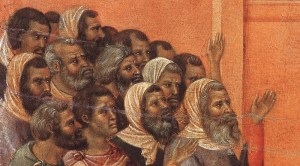
Say and Do: yoke

4 They tie up heavy burdens (hard to carry) and lay them on people’s shoulders, but they will not lift a finger to move them.

By saying and not doing (v. 3) they imposed rules on other people but gave them no help in coping with them. So in contrast with the “kind yoke” and “light burden” of following Jesus (11:30), those who follow the scribes and Pharisees find themselves toiling and heavily loaded (11:28) struggling under the weight of a hugely expanded legal code which enslaves rather than liberates those who follow it. Continue reading
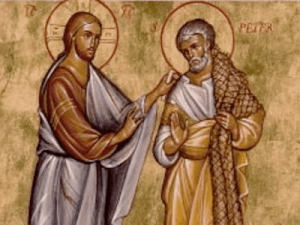
Say and Do: context

1 Then Jesus spoke to the crowds and to his disciples, 2 saying, “The scribes and the Pharisees have taken their seat on the chair of Moses. 3 Therefore, do and observe all things whatsoever they tell you, but do not follow their example. For they preach but they do not practice. 4 They tie up heavy burdens (hard to carry) and lay them on people’s shoulders, but they will not lift a finger to move them. 5 All their works are performed to be seen. They widen their phylacteries and lengthen their tassels. 6 They love places of honor at banquets, seats of honor in synagogues, 7 greetings in marketplaces, and the salutation ‘Rabbi.’ 8 As for you, do not be called ‘Rabbi.’ You have but one teacher, and you are all brothers. 9 Call no one on earth your father; you have but one Father in heaven. 10 Do not be called ‘Master’; you have but one master, the Messiah. 11 The greatest among you must be your servant. 12 Whoever exalts himself will be humbled; but whoever humbles himself will be exalted. Continue reading

Love’s Demands: meaning

What’s love got to do with it?  In commentaries and in Bible studies, I often encounter the variety of words, in the Greek, used for the English word “love.” People ask lots of questions about the meaning and use of them in Scripture. At the same time they are also asking about a “hierarchy” of love – “is there a word that means ‘God love?'” There are perhaps several questions that can also be asked:
  1. How do modern-day Christians use and interpret the various Greek words for “love”: eros, philos, and agape? The answer is often given as a hierarchy of love ascending to God-love in the word
  2. How did the first century Scripture writers understand the differing words? How did they intend to use them?
  3. How does OT and NT scriptures use the words.

Continue reading

Love’s Demands: context

34 When the Pharisees heard that he had silenced the Sadducees, they gathered together, 35 and one of them (a scholar of the law) tested him by asking, 36 “Teacher, which commandment in the law is the greatest?” 37 He said to him, “You shall love the Lord, your God, with all your heart, with all your soul, and with all your mind. 38 This is the greatest and the first commandment. 39 The second is like it: You shall love your neighbor as yourself. 40 The whole law and the prophets depend on these two commandments.” Continue reading

Testing a King: Imagio Dei

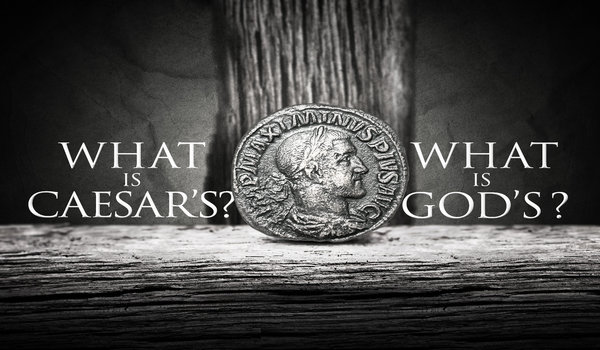
Coinage1An Underlying Thought. Jesus’ answer calls into question the basic presupposition behind their question, that there is an essential incompatibility between loyalty to the governing authority and loyalty to God. This was precisely Judas the Galilean’s position as explained by Josephus (War 2.118 and Ant. 18.23): to pay the tax was to tolerate a mortal sovereign in place of God. It was loyalty to God which was the basis for Zealot objections to Roman taxation, but Jesus, without reducing the demands of loyalty to God, indicates that political allegiance even to a pagan state is not incompatible with it. This is not a rigid division of life into the ‘sacred’ and the ‘secular’, but rather a recognition that the ‘secular’ finds its proper place within the overriding claim of the ‘sacred’. Continue reading

Testing a King: why?

Coinage1Matthew 22:15–22 15 Then the Pharisees went off and plotted how they might entrap him in speech. 16 They sent their disciples to him, with the Herodians, saying, “Teacher, we know that you are a truthful man and that you teach the way of God in accordance with the truth. And you are not concerned with anyone’s opinion, for you do not regard a person’s status. 17 Tell us, then, what is your opinion: Is it lawful to pay the census tax to Caesar or not?” 18 Knowing their malice, Jesus said, “Why are you testing me, you hypocrites? 19 Show me the coin that pays the census tax.” Then they handed him the Roman coin. 20 He said to them, “Whose image is this and whose inscription?” 21 They replied, “Caesar’s.” At that he said to them, “Then repay to Caesar what belongs to Caesar and to God what belongs to God.” 22 When they heard this they were amazed, and leaving him they went away. Continue reading

Testing the King: context

Coinage1Matthew 22:15–22  15 Then the Pharisees went off and plotted how they might entrap him in speech. 16 They sent their disciples to him, with the Herodians, saying, “Teacher, we know that you are a truthful man and that you teach the way of God in accordance with the truth. And you are not concerned with anyone’s opinion, for you do not regard a person’s status. 17 Tell us, then, what is your opinion: Is it lawful to pay the census tax to Caesar or not?” 18 Knowing their malice, Jesus said, “Why are you testing me, you hypocrites? 19 Show me the coin that pays the census tax.” Then they handed him the Roman coin. 20 He said to them, “Whose image is this and whose inscription?” 21 They replied, “Caesar’s.” At that he said to them, “Then repay to Caesar what belongs to Caesar and to God what belongs to God.” 22 When they heard this they were amazed, and leaving him they went away. Continue reading

Many are invited…

cast out13 Then the king said to his attendants, ‘Bind his hands and feet, and cast him into the darkness outside, where there will be wailing and grinding of teeth.’ 14 Many are invited, but few are chosen.”

The Elect of God. The judgment seems harsh, but Matthew is thinking not of an actual wedding party, but of the last judgment. The language “weeping and gnashing of teeth” corresponds to 8:12; 13:42, 50; 24:51; 25:30, an apocalyptic expression (cf. Luke 13:28) that became a favorite of Matthew’s to picture the terror of condemnation at the last judgment. Continue reading