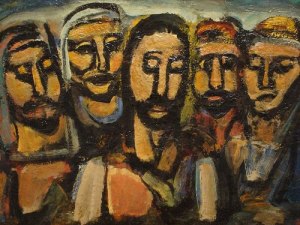
Jesus Arrives at Bethany. Upon their arrival in Bethany, Jesus’ assertion about Lazarus’ death (v.14) is confirmed. The four-day period underscores the finality of death. According to the popular belief, the hovered around the body for three days after the death, hoping to reenter the body. But after the third day, when the soul “sees that the color of its face has changed,” the soul leaves the body for good (Gen. Rab. 100). When Jesus arrives fellow mourners had already arrived to console the grieving sisters – but they will also serve another purpose: witness. Continue reading
Category Archives: Scripture
Raising Lazarus: should Jesus go?
Commentary. In a key and important way, John 11 continues the central narrative about the signs that Jesus performed in order to people might believe and because of that belief have life. The sign given in John 11 is the raising of Lazarus – technically a resuscitation, i.e., being restored to the life that was before. Too quickly people move to point forward to Jesus’ own resurrection as though Lazarus only served to point to that event. As all the other signs (semeia) in John, the raising of Lazarus points to Jesus who is the source of life – both here and in the “last days.” John has already introduced us to the “life” theme when speaking of rebirth (Nicodemus) and living water (Samaritan woman); in reference to the life-giving word; in context of the life-giving bread (Jn 6); in Jesus’ self description as the “light of life” (8:12); as well as the previous chapter’s assertion “I have come that they might have life and have it to the full” (10:10). All of these accounts continue to remind us that meeting Jesus always operates on the physical and spiritual level – and often the miracle (sign/semeia) serve as the vehicle to make this point clear. Continue reading
Raising Lazarus: context
John 11:1-45. 1 Now a man was ill, Lazarus from Bethany, the village of Mary and her sister Martha. 2 Mary was the one who had anointed the Lord with perfumed oil and dried his feet with her hair; it was her brother Lazarus who was ill. 3 So the sisters sent word to him, saying, “Master, the one you love is ill.” 4 When Jesus heard this he said, “This illness is not to end in death, but is for the glory of God, that the Son of God may be glorified through it.” 5 Now Jesus loved Martha and her sister and Lazarus. 6 So when he heard that he was ill, he remained for two days in the place where he was.
The remainder of the gospel reading can be found here. Continue reading
A man born blind: faith or disbelief
Being Lead to Decision: Faith or Disbelief. Where the authorities drive the man away (v.34), here Jesus finds the man (cf. 6:37) and asks: “Do you believe in the Son of Man?” Just as the Samaritan woman was confronted by Jesus with the possibility of the anticipated Messiah’s being already present (4:25-26), so also the healed man is confronted by Jesus with the possibility that the future judge is already present. To this point in John 9, the theme of the judgment evoked by the light of the world (9:5; cf. 3:17-21; 12:31-36) has largely been implicit. Jesus’ question makes this theme explicit as he asks the man whether he recognizes in his healer the one who brings of salvation. As v.36 indicates, the man is ready. Continue reading
A man born blind: more questions
A second interrogation of the man by the Jews (9:24-34). In the third and final interrogation scene, the authorities are identified only with the pronoun “they.” They are clearly the same group identified as the Pharisees who interrogated the man in vv. 13-17, but the motivation for the second interrogation is also clearly linked to the parents’ testimony and their rebuttal: “…he is of age.” The man is recalled before the elders.
Twice in this interrogation scene the authorities hold their knowledge up to the man and expect him to accept their positions (vv24, 29). Each time, however, the man counters with his own experience (vv.25, 30-33). Continue reading
A man born blind: interrogation
The Interrogations. If there is a “typical” pattern to any miracle account it is: (a) the situation of need, (b) the miracle, and (c) the attestation/witness to the miracle. It is here that John’s telling of the story has unique features – patterns outlined in the introductory comments of miracles and sin (in John’s writing). Be attentive to simple categories such as true witness, equivocating witness, unbelievers, accommodator, or similar categories that are other that one who believes and is willing to live/act based upon that belief. Continue reading
A man born blind: healing
Commentary. If you wanted a one sentence summary – here it is: “I came into this world for judgment, so that those who do not see might see, and those who do see might become blind”(v.39). Or: as a sign that he is the light, Jesus gives sight to a man born blind. But there is a richness to be gained in a detailed looked at the text and narrative. The Johannine scholar, Fr. Raymond Brown suggests the following outline:
- A. Setting (9:1-5)
- B. Miraculous healing (9:6-7)
- C. Interrogations of the blind man (9:8-34)
- 1. Questioning by neighbors and acquaintances (9:8-12)
- 2. Preliminary interrogation by Pharisees (9:13-17)
- 3. The man’s parents questioned by the Jews (9:18-23)
- 4. A second interrogation of the man by the Jews (9:24-34)
- D. Jesus leads the man born blind to that spiritual sight which is faith (9:35-41) Continue reading
A man born blind: sin
Sin in the Gospel according to John. John seems to understand sin in a way that accents a singular aspect in a way that deserves mention. Words for “sin” occur often in our text: hamartano = “to sin” (9:2, 3; elsewhere in John: 5:14 & 8:11); hamartia = “sin” (9:34, 41); hamartolos = “sinner” (9:16, 24, 25, 31 — all the occurrences in John). The question is does John’s discussion match the discussion of hamartia in the other gospels?
In our passage, the concept of sin will be quickly introduced via the disciples’ question in v.2 : “Rabbi, who sinned, this man or his parents, that he was born blind?” This reflects traditional Jewish speculation on the relationship of illness and sin (cf. 5:14). In 1st century Palestine, people commonly assumed that disease and disorders on both the personal and national level were due to sin, as summarized in the rabbinic saying from around 300 CE that “there is no death without sin and there is no suffering without iniquity” (b. shabbat 55a). Continue reading
A man born blind: miracles
A Man Born Blind: John 9:1-41 1 As he passed by he saw a man blind from birth. 2 His disciples asked him, “Rabbi, who sinned, this man or his parents, that he was born blind?” 3 Jesus answered, “Neither he nor his parents sinned; it is so that the works of God might be made visible through him. 4 We have to do the works of the one who sent me while it is day. Night is coming when no one can work. 5 While I am in the world, I am the light of the world.” (the remainder of the gospel can be read here).
Our narrative begins with the simple phrase “As he passed by…” It lacks the general markers (time, geography, etc.) that indicate a break in continuity, suggesting that John intends the story of the blind man to be read in continuity with the preceding chapters. So what was in the preceding chapter? The primary narrative in Chapter 8 is the “woman caught in adultery,” Jesus’ self-identification as the “light of the world,” and a long discussion between Jesus and the “Jews” about the very nature of what it means to be of the covenant people – a dialogue that occurs in the context of the Feast of Tabernacles. Continue reading
The Samaritan Women: we have heard for ourselves
Jesus’ words overflow with metaphor: living water, the hour, food, harvest. Each of these metaphors attempts to open reality in fresh ways for his conversation partners. Jesus wants to open the eyes of the Samaritan woman and his disciples so that they can see what is being offered to them in the present instead of continuing to view everything through the lens of old realities. Jesus wants the Samaritan woman to see who is speaking with her at this moment and the gifts that he offers (4:10). He wants her to see that the present moment is the time of eschatological fulfillment (4:23-24). Jesus wants his disciples to see that the harvest is ready now, contrary to popular understandings (4:35). In both conversations (4:7.26, 31-38), Jesus takes familiar images and fills them with new meaning in order to open up for his listeners the possibilities of a life defined by God’s gifts. The metaphors of these verses keep the terms of the conversations always fresh, always suggestive, always open to new meanings in changing circumstances. Continue reading