This coming Sunday is the 4th Sunday of Advent. Elizabeth’s joy at her own pregnancy after so many years of barrenness is overshadowed by the joy at Mary’s visit – or rather that the unborn Lord would honor her with his presence. How wonderful it would be if we had that same attitude concerning the presence of our Lord in our gathering together, and in the Word, and in the Supper: “Blessed be God who has come to us this day.” I think that too often we think of worship as our good deed of bringing ourselves to God, when, in fact, it is a time and place where God comes to us. Continue reading
Category Archives: Scripture
Two Stories
Today’s first reading is part of the story of Samson, one of the Judges of Israel in the time before the kings of Israel were established. The account is part of the birth narrative of the last of the Judges, perhaps well described as an “annunciation.” It stands in comparison (or contrast) with today’s gospel, the annunciation of the birth of John the Baptist, the last of the Old Testament prophets. There have been some writers that hold Samson to be a messianic figure, but today’s reading set seems to compare Samson, not to the Messiah, but to the herald. Granted there are similarities in the accounts, but apart from the stories of notable strength, Samson is not someone upon whom one should model their life. Read the story of Samson and you’ll find he murders 30 men for their garments because he lost a wager. Not exactly your model citizen. Still, the narratives share some notable similarities but also some differences. Perhaps a comparison will reveal a larger purpose at hand.
Continue readingThe Holy Spirit
This coming Sunday is the 4th Sunday of Advent and the story of the Visitation when Mary went from Nazareth to the hill country near Jerusalem to visit Elizabeth and her husband Zechariah, who for many years, had prayed to conceive and have a child. During the Annunciation, the Angel Gabriel had informed Mary: “And behold, Elizabeth, your relative, has also conceived a son in her old age, and this is the sixth month for her who was called barren.” (Luke 1:36) And so Mary sets out in haste to visit. Continue reading
Who is this Child?
“This is how the birth of Jesus Christ came about…” What follows in today’s gospel, provides a wonderful answer to the Advent question: who is coming? The gospel reading provides its contribution to the larger answer: Jesus Christ (v.18), son of Mary (v.18), adopted son of Joseph (v20), son of David (v.20), named Jesus (v.21), the one who will save his people from their sins (v.21), and Emmanuel…God with us (v.22).
Continue readingLuke’s Narrative leading to the Nativity
This coming Sunday is the 4th Sunday of Advent. In previous posts we explored the background of the first reading from the Prophet Micah: “But you, Bethlehem-Ephrathah too small to be among the clans of Judah, From you shall come forth for me one who is to be ruler in Israel” But before delving into our gospel text, it is good to recall the flow of Luke’s narrative: an interweaving of the stories of births of the herald of the Messiah, John the Baptist, and the Messiah, Jesus to tell a single story of redemption. Continue reading
Bethlehem and the Prophet Micah
This coming Sunday is the 4th Sunday of Advent. In the previous post we explored how the village of Bethlehem was viewed in the time of Jesus’ birth. Today, we consider Bethlehem and the Prophet Micah, an eighth century BC figure (and a contemporary of the prophet Isaiah). Micah prophesied during the reign of Ahaz of whom 2 Chronicles 28 records: “He did not do what was right in the sight of the LORD as David his father had done” – and then recounts his many sins and transgressions. Micah shared his people’s disillusionment with the king but encouraged them to hope for a future, worthy messiah. Rather than tolerate the sins of the leaders the Word of the Lord came to Micah to announce that the messiah would end the corruption of the judicial system, idolatry in the Temple and inauthentic worship and establish righteousness for all. Continue reading
An Odd Story of Blessing
The first reading today probably strikes you as an odd one to choose leading up to Christmas – at least until you arrive at the final verse of the reading: “A star shall advance from Jacob, and a staff shall rise from Israel” (Num 24:17). I suspect most people read that and think, “Oh, makes sense now, Balaam is talking about the Star of Bethlehem.” Maybe. Let’s consider the backstory that brings us to this verse.
Continue readingCloser to the Nativity
The Season of Advent offers us readings that begin with apocalyptic scenes of Jesus’ prediction of the coming destruction of the Temple and the signs of “end times.” It is a gospel taken from Holy Week and seemed a bit out of place in Advent. But one message of the readings was “pay attention” for the signs of a promised age to come. The Season of Advent is a season in preparation of the “three comings of Christ” – in history past with his birth in Bethlehem, in history future at his second coming, and in the present at our reception of Him into our hearts. The gospels for Advent have moved us from the promise of a Messiah to the herald’s ministry of announcing his arrival via John the Baptist in the readings from the 2nd and 3rd Sundays of Advent. We then come to the 4th Sunday of Advent in lectionary cycle C. Continue reading
Agnus Day’s on 3rd Advent
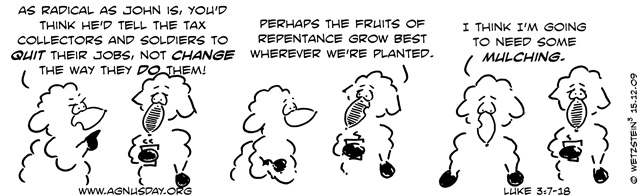
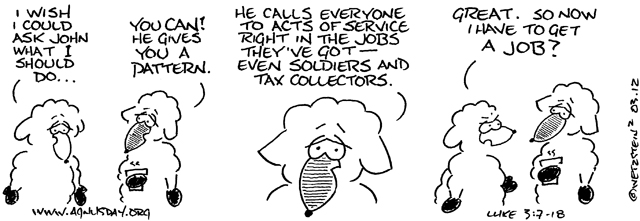
Today is the 3rd Sunday in Advent in Year C of the Lectionary cycle. Following upon John the Baptist’s stern warning of the coming day of judgement, people cry out “Teacher, what should be do?” (Luke 3:12). There are lots of commentaries on this passage, but here on Guadete Sunday, let me offer a bit of “joy” from the folks at Agnus Day and their perspective.


The Theology of History
In Christian biblical studies, “the theology of history” refers to the understanding of history as shaped by God’s purpose and action. Unlike secular views of history, which may see events as random or solely influenced by human actions and natural processes, the theology of history views events within the context of God’s overarching plan, especially as it is revealed in Scripture. This perspective assumes that history unfolds according to God’s will and that each event has theological significance as part of a divine narrative. The key aspects of the theology of history in Christian thought are: Continue reading