The Season of Advent offers us readings that begin with apocalyptic scenes of Jesus’ prediction of the coming destruction of the Temple and the signs of “end times.” It is a gospel taken from Holy Week and seemed a bit out of place in Advent. But one message of the readings was “pay attention” for the signs of a promised age to come. The Season of Advent is a season in preparation of the “three comings of Christ” – in history past with his birth in Bethlehem, in history future at his second coming, and in the present at our reception of Him into our hearts. The gospels for Advent have moved us from the promise of a Messiah to the herald’s ministry of announcing his arrival via John the Baptist in the readings from the 2nd and 3rd Sundays of Advent. We then come to the 4th Sunday of Advent in lectionary cycle C. Continue reading
Category Archives: Scripture
Agnus Day’s on 3rd Advent
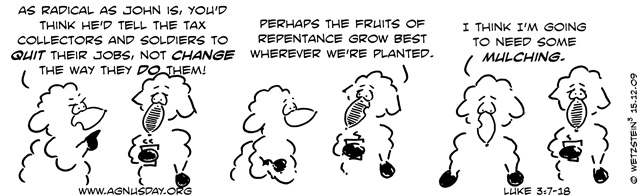
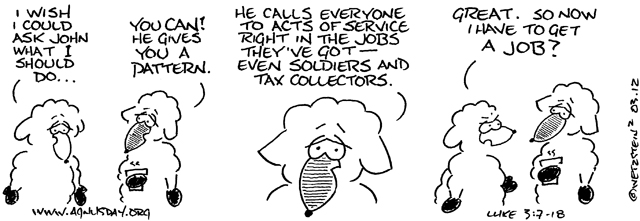
Today is the 3rd Sunday in Advent in Year C of the Lectionary cycle. Following upon John the Baptist’s stern warning of the coming day of judgement, people cry out “Teacher, what should be do?” (Luke 3:12). There are lots of commentaries on this passage, but here on Guadete Sunday, let me offer a bit of “joy” from the folks at Agnus Day and their perspective.


The Theology of History
In Christian biblical studies, “the theology of history” refers to the understanding of history as shaped by God’s purpose and action. Unlike secular views of history, which may see events as random or solely influenced by human actions and natural processes, the theology of history views events within the context of God’s overarching plan, especially as it is revealed in Scripture. This perspective assumes that history unfolds according to God’s will and that each event has theological significance as part of a divine narrative. The key aspects of the theology of history in Christian thought are: Continue reading
Questions about the Messiah
15 Now the people were filled with expectation, and all were asking in their hearts whether John might be the Messiah.16 John answered them all, saying, “I am baptizing you with water, but one mightier than I is coming. I am not worthy to loosen the thongs of his sandals. (Luke 3:15–16a) After inquiring how they might prepare themselves for coming judgment, now, they ask whether John is the Messiah. Green [180] notes: “Recognizing in John’s mission the first hints of eschatological consolation (Isaiah 40; cf. Luke 3:4–6), they wonder if he is God’s agent of salvation. For them, the meaning of “Messiah” is manifestly fluid at this point; hope is present but ill defined. They do not know if John and the anticipated messianic figure fit the same profile, and this allows John to begin the process of outlining what to expect of the Messiah. At the same time, he is able to identify his own relationship to the coming one. According to the narrator, John’s answer is to all the people; everyone receives the invitation to accept his baptism and receive the baptism ‘with the Holy Spirit and fire.’” Continue reading
John’s Instructions
7 He said to the crowds who came out to be baptized by him, “You brood of vipers! Who warned you to flee from the coming wrath? 8 Produce good fruits as evidence of your repentance; and do not begin to say to yourselves, ‘We have Abraham as our father,’ for I tell you, God can raise up children to Abraham from these stones. 9 Even now the ax lies at the root of the trees. Therefore every tree that does not produce good fruit will be cut down and thrown into the fire.” (Luke 3:7–9) Continue reading
John’s Baptism
“…the crowds who came out to be baptized by him.” (Luke 3:7)
At this point in the narrative there are no baptismal actions, but there is an emphasis on the interpretation of the ritual action itself. As Joel Green [173] notes: “ baptism is seen as an initiatory rite of passage as people (1) come away from their normal lives to participate in John’s ministry through baptism, (2) undergo a repentance-baptism signifying their (re)new(ed) allegiance to God’s purpose, and (3) return to their normal lives having accepted the challenge to reflect in their lives ways of living appropriate to true children of Abraham. John’s proclamation ensures that his baptism is understood as an assault on the status quo, that to participate in his baptism is to embrace behaviors rooted in a radical realignment with God’s purpose.” Continue reading
John: Prophet and Herald
The gospel for the 3rd Sunday of Advent in Year C continues the Advent theme of John the Baptist as the herald of the promised good news. In last Sunday’s gospel (Luke 3:1-6), Luke has already connected the ministry and actions of John to the proclamation of the “good news” by the prophet Isaiah:
“ 4 as it is written in the book of the words of the prophet Isaiah: “A voice of one crying out in the desert: ‘Prepare the way of the Lord, make straight his paths. 5 Every valley shall be filled and every mountain and hill shall be made low. The winding roads shall be made straight, and the rough ways made smooth, 6 and all flesh shall see the salvation of God.’” (Luke 3:4-6)
Our reading finds John in the wilderness, baptizing people as he proclaims that his was a “baptism of repentance for the forgiveness of sins” (Luke 3:3). All of this was part of last week’s gospel for the 2nd Sunday of Advent. Yet, there are several verses that fall between the Advent gospels. Continue reading
For whom the Word came
The opening of our 2nd Advent gospel passage is a list of whos-who for the time: emperors, governors, kings, and even the high priest of the Jerusalem Temple: In the fifteenth year of the reign of Tiberius Caesar, when Pontius Pilate was governor of Judea, and Herod was tetrarch of Galilee, and his brother Philip tetrarch of the region of Ituraea and Trachonitis, and Lysanias was tetrarch of Abilene, during the high priesthood of Annas and Caiaphas.
But to none of those did the Word of God come. Continue reading
The Call of the Prophet
4 as it is written in the book of the words of the prophet Isaiah: “A voice of one crying out in the desert: ‘Prepare the way of the Lord, make straight his paths. 5 Every valley shall be filled and every mountain and hill shall be made low. The winding roads shall be made straight, and the rough ways made smooth, 6 and all flesh shall see the salvation of God.’”
Luke casts the call of John the Baptist in the form of an Old Testament prophetic call with reference to the prophet Isaiah (Isaiah 40:3-5). Continue reading
Mission of the Baptist: Repentance
“He went throughout (the) whole region of the Jordan, proclaiming a baptism of repentance for the forgiveness of sins” (Luke 3:3)
The basic meaning of the verb baptizo is “to wash,” which is how it is translated in Luke 11:38 (re: ritual washing before meals). The word often also carries, in context, ritual or purifying aspects to the washing. This image is used by Luke in Acts 22:16: “Get up, and have yourself baptized (baptisai) and your sins washed away (apolouo), calling on his name.” When one surveys the reports in the Gospels concerning John’s baptism (Mark 1:2–6), the origin and significance of which was debated (Matt 21:25; Mark 11:30; Luke 20:4), one notices: Continue reading