This coming Sunday is the 30th Sunday. These gospel verses are the last healing and miracle in the Gospel of Mark. It is easily passed over as another miracle among many, but the story of Bartimaeus (bar-Timeaeus; lit. Son of Timeaus) is in some ways the most significant since the restoration of sight is the one miracle not recorded in the Hebrew Scriptures. There are general promises in Isaiah that promise healing and deliverance (Isaiah 29:1; 32:1-3; 35:1-10) along with specific promises that in the day of the Messiah the blind will have their sight restored (Is 42:18; 61:1-4), but there is no account of sight being restored. (Note: the restoration of sight to Tobit is recorded in a Deuterocanonical book) Continue reading →
This coming Sunday is the 30th Sunday in lectionary cycle B. The gospel is the story of Bartimaeus, a blind man, who cries out to Jesus for pity. Despite the rebuke of the bystanders, Bartimaeus calls out even more vigorously. And in so doing he encounters Jesus who asks, “What do you want me to do for you?”At first glance it might seem that this is another miracle story in which Jesus reaches out to the marginal. It is indeed a miracle story, in fact it is the final healing miracle in the Gospel of Mark. But it is also an account that is part of a mosaic that Mark has been constructing. Continue reading →
As the disciples will discover in the Passion of the Christ and in their own experience of mission, the power of the world is quite real. Throughout the millennia of Christianity many of those who have given witness to Jesus (the true meaning of martyrs) have also given their lives. And while death remains a primal fear and thus we fear those who wield its power, Jesus tells the disciples: “do not be afraid of those who kill the body but after that can do no more. I shall show you whom to fear. Be afraid of the one who after killing has the power to cast into Gehenna; yes, I tell you, be afraid of that one.” (v.4 in the same chapter) After all, if we are people who believe in the Resurrection, then the power of mortal death is rather limited, but the authority that extends into immortal life is the real power, without limit. Continue reading →
45 For the Son of Man did not come to be served but to serve and to give his life as a ransom for many.” As a follow on to Pheme Perkin’s discussion about ransom (lytron) and its meaning as the price paid to free a slave, Matt Skinner offers additional insight:
Jesus’ mention of a “ransom” indicates that his death will be more than just an inspiring example or a martyr’s tragic protest against an unjust system. The word in question (in Greek, lytron) indicates that his death does something; it secures a release. This verse often sparks lively debates, and it has a history of, in my opinion, being misunderstood by those who take the notion of a “ransom” to mean a specific type of payment. In those readings, Jesus’ death is transactional, a payment made to satisfy the penalties accrued by human sin or to repay something owed to God. Continue reading →
This coming Sunday is the 29th Sunday in Year B of the lectionary cycle. In previous posts we have explored the request for glory from the Apostles James and John, Jesus answer, the reaction of the other disciples and a subsequent teaching from Jesus on servant leadership: Rather, whoever wishes to be great among you will be your servant; 44 whoever wishes to be first among you will be the slave of all. Continue reading →
The gospels for these daily Mass readings have been taken from Luke 11:37-54. The context is found in the opening verse:
37After he had spoken, a Pharisee invited him to dine at his home. He entered and reclined at table to eat. 38 The Pharisee was amazed to see that he did not observe the prescribed washing before the meal.
Awkward!
Growing up we were taught that “polite conversation” at the dinner table did not include sex, politics or religion. Clearly, the Pharisee – even as host – did not feel the same restrictions applied to him. I don’t recall any specific life lessons about what to do, when as a guest, the host transgresses against the rules of “polite conversation.” What did Jesus do? Continue reading →
This coming Sunday is the 29th Sunday in Year B of the lectionary cycle. In previous posts we have explored the request for glory from the Apostles James and John: ““Grant that in your glory we may sit one at your right and the other at your left.” (Mark 10:37). Jesus has questioned if they really understand what they are asking and its consequences: “Can you drink the cup that I drink or be baptized with the baptism with which I am baptized?” To which the two apostles respond: “We can.” Continue reading →
This coming Sunday is the 29th Sunday in Year B of the lectionary cycle. It is a familiar story in which James and John seek glory: ““Grant that in your glory we may sit one at your right and the other at your left.” (Mark 10:37). In our previous post, Jesus has answered them “You do not know what you are asking. Can you drink the cup that I drink or be baptized with the baptism with which I am baptized?”Continue reading →
This coming Sunday is the 29th Sunday in Year B of the lectionary cycle. It is a familiar story in which James and John seek glory: 35 Then James and John, the sons of Zebedee, came to him and said to him, “Teacher, we want you to do for us whatever we ask of you.” 36 He replied, “What do you wish (me) to do for you?” 37 They answered him, “Grant that in your glory we may sit one at your right and the other at your left.”
Even before the request is revealed, the very sound of the question seems brash: “whatever we ask.” It is as though they want a “blank check” from Jesus. Is it enthusiasm? Is it brazenness? Is it coming from a sense of “I deserve a reward for having followed you these many, many months?” Is it arising from a sense of “I have looked at the other 10 and we are the ones you should pick?” Hard to know, but in any event, Jesus simply asks them what they desire. Continue reading →
This coming Sunday is the 28th Sunday in Ordinary Time. Earlier (3:35) Jesus had redefined his family. “(For) whoever does the will of God is my brother and sister and mother.” For many of the first believers, following Jesus meant leaving everything behind. What one gained by leaving the biological family behind was the faith-community, those who were doing the will of God
28 Peter began to say to him, “We have given up everything and followed you.” 29 Jesus said, “Amen, I say to you, there is no one who has given up house or brothers or sisters or mother or father or children or lands for my sake and for the sake of the gospel 30 who will not receive a hundred times more now in this present age: houses and brothers and sisters and mothers and children and lands, with persecutions, and eternal life in the age to come. 31 But many that are first will be last, and (the) last will be first.”
Peter again acts as the spokesman for the Twelve. His response stands in stark contrast to the refusal of the rich man to follow Jesus. The Twelve had abandoned everything in order to follow Jesus (Ch. 1:16–20; 2:14). Lane [371-2] notes that “Jesus’ response defines Christian existence in terms of promise and persecution, and history as the interplay of blessedness and suffering. The contrast between the present age and the age to come is thoroughly Palestinian in character and expresses the tension between promise and fulfillment in the life of faith. The frank recognition of the loss that allegiance to Jesus and the gospel may entail (cf. 13:12f.) is conditioned by the promise that all that is lost in one society (v. 29) will be regained a hundredfold in the new society created by the dynamic of the gospel (v. 30). This reassurance is addressed to any man who suffers loss for Jesus and the gospel. God takes nothing away from a man without restoring it to him in a new and glorious form. Jesus’ reference to the new family which will compensate for the loss sustained in one’s own family finds its preparation in 3:31–35.”
A Final Thought From Brian Stoffregen:
A dictionary definition of “sacrifice” is: “an act of giving up something valued for the sake of something else regarded as more important or worthy.” A key to a sacrifice is giving up something valued. We seldom are confronted with giving up things that we value for the sake of Christ who should be regarded as more important or worthy. How often are things donated to the church, things a family wants to get rid of — something they no longer value? Such giving can’t be called a “sacrifice”.
Frequently testimonies talk about giving the worst things in one’s life in order to follow Jesus, e.g., addictions, swearing, promiscuity, etc. In contrast, Paul’s testimony in Philippians 3:4-11 indicates that he gave up the very best things in his life, the most righteous things in his life, for the sake of the gospel.
What are some things that we value that Christ might ask us to give up in order to follow him? Soccer practices on Sunday? Watching football games on Sunday? Buying a new car?
However, if we are giving such things up only because we expect even greater things from following Christ, then we have probably haven’t given up our most important possession, the control of our own lives and destinies.
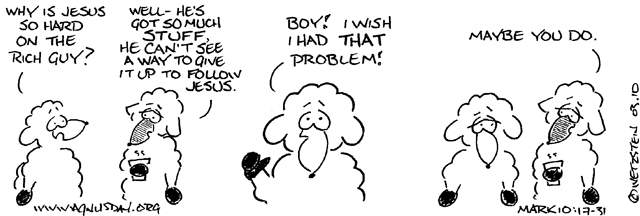
Image credit: Heinrich Hofmann | 1888 | Christ and the Rich Young Ruler | Brigham Young University Museum of Art | PD-US —- cartoon from AgnusDay.org