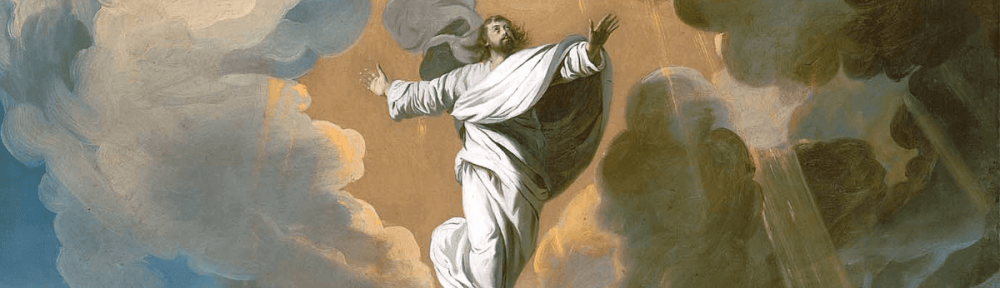
There is something special about when the Church celebrates solemnities. Christmas is tangible. Good Friday is emotional. Easter is triumphant. The Ascension is … is … to be honest it can sound like Jesus simply “going away.” It is easy to hear it as a kind of spiritual farewell: Jesus finished his work, returned to heaven, and now we wait until we join him someday. But the Church celebrates the Ascension as a central moment of the Paschal Mystery because it tells us something essential about Christ, about ourselves, and about the meaning of daily life right now.
Often I give three reasons why things should matter, but it is a solemnity, so seven seems like a good number to explain why the Ascension still matters deeply in 2026.
1. The Ascension means humanity now has a place in the life of God
The Ascension is not Jesus escaping the world. It is humanity entering into the glory of God. The risen Jesus ascends with his human nature still united to him. The wounds remain. The Incarnation is permanent. Human life, our humanity, is now taken into the communion of the Trinity. That means heaven is no longer merely a distant spiritual realm. In Christ, human life itself has been brought into the heart of God.This matters because many people today experience life as fragile, disposable, or meaningless. The Ascension proclaims the opposite:
- human life matters eternally,
- the body matters,
- history matters,
- our struggles and sufferings matter.
Our destiny is not annihilation or absorption into nothingness. Our destiny is communion with God.
2. Christ is not absent. He is present differently
One of the misunderstandings about the Ascension is the idea that Jesus “left.” But in the New Testament, the Ascension is not about absence. It is about a new mode of presence. Before the Ascension, Jesus was physically present in one place at a time. After the Ascension and the gift of the Spirit, Christ becomes present to the whole Church across the world and through time: in the Eucharist, in Scripture, in prayer, in the poor, in the gathered Church, and through the Holy Spirit to mention a few. The Ascension prepares for Pentecost. Christ does not abandon the Church; he fills it with his own life. For everyday life, this means Christianity is not merely remembering someone from the past. Christ is alive and active now.
3. The Ascension gives meaning to ordinary earthly life
The Ascension does not tell Christians to ignore the world while waiting for heaven. In fact, the opposite is true. Just before ascending, Jesus sends the disciples on mission: “You will be my witnesses.” The disciples do not stand staring at the sky forever. They return to Jerusalem and begin the life of the Church. The Ascension teaches that holiness is lived in ordinary human life: work, family, service, relationships, acts of justice and mercy, and daily faithfulness. Christ reigns not apart from human life, but over it. Therefore ordinary life becomes the place where discipleship happens.
In 2026, many people feel caught between anxiety, division, exhaustion, distraction, and uncertainty about the future. The Ascension reminds Christians that history still belongs to God and that faithful daily living still matters.
4. The Ascension changes how we understand power
In the world, power is often measured by dominance, wealth, visibility, popularity, projection of power or control. But the Ascended Christ still bears the wounds of crucifixion. The one seated at the right hand of the Father is the same one who washed feet, forgave sinners, welcomed the marginalized, and suffered on the Cross. The Ascension reveals that sacrificial love is not failure. It is the deepest form of glory. This matters because modern culture often rewards self-promotion and strength without compassion. The Ascension proclaims that humility, mercy, truth, and love participate in the reign of Christ.
5. The Ascension says we already live between earth and heaven
The Ascension creates a tension at the center of Christian life. We still live in the world with all its beauty and pain: wars continue, people suffer, injustice persists, and death remains real. Yet Christ is risen and glorified. Christians therefore live with hope without denying reality. The Ascension teaches us to live with our feet firmly on earth while our hearts remain anchored in God. This prevents two extremes: despair, as if evil has the final word, or escapism, as if earthly life does not matter. The Christian lives in hope-filled engagement with the world.
6. The Ascension means the Church has responsibility now
After the Ascension, the disciples cannot simply wait passively. The Church becomes the visible sign of Christ’s presence in the world. This means Christians are called to continue Christ’s work: feeding the hungry, defending human dignity, forgiving, proclaiming the Gospel, building peace, caring for the vulnerable, and living as witnesses to hope. The Ascension is therefore not the end of Christ’s mission but the beginning of the Church’s participation in it.
7. The Ascension reminds us where history is going
Modern life often feels fragmented and directionless. Many people experience history as chaos with no larger meaning. The Ascension says history has a destination. The final word over humanity is not violence, death, fear, or division, but the reign of the risen Christ. This does not remove suffering from the present moment, but it changes how Christians endure it. Hope becomes possible because Christ has gone before us.
A bonus spiritual insight
The disciples at the Ascension stand between memory and mission: They remember what Jesus has done but they are also sent forward into the future. That remains the Christian condition today. The Ascension invites believers not to stare upward waiting to escape the world, but to live differently within it – with hope instead of despair, courage instead of fear, purpose instead of aimlessness, and love rooted in the living presence of Christ.
The Ascension is not simply about where Jesus went. It is about what we are called to become.
Image credit: Jesus’ ascension to Heaven depicted by John Singleton Copley in Ascension (1775) Public Domain
Discover more from friarmusings
Subscribe to get the latest posts sent to your email.
 friarmusings
Perhaps your most anointed writing yet Fr. George. Many thanks!