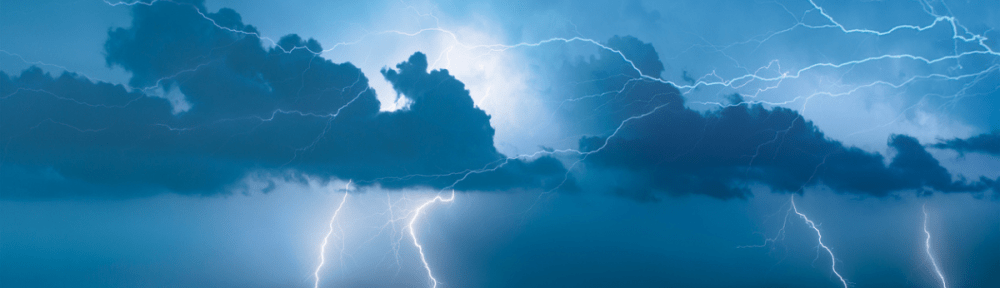
Now at the cusp of the Stanley Cup Finals, you might think this is going to be an article about my beloved Tampa Bay Lightning. Were that it was, but alas the Lightning lost in the first round to the Montreal Canadians. No worries. I have a backup team: Carolina Hurricanes. I trust you see the weather connection from my home state, Florida. Tampa is “the lightning capital of the world” and the State is often the target of tropical storms and hurricanes.
But this musing is about the natural phenomena, lightning. Take a moment to ponder what causes lightning. Do you remember the basic explanation we learned as young inquiring minds? If my memory serves me, after a discussion about Benjamin Franklin’s kite experiment, we were offered an explanation similar to the basic one still offered today.
According to the National Oceanic and Atmospheric Administration (NOAA), lightning is a massive burst of static electricity caused by the separation of positive and negative charges within a storm cloud. As updrafts and downdrafts crash ice and water particles together, negative charges build up at the bottom of the cloud and positive charges gather at the top. When the charge becomes strong enough to overcome the air’s natural insulation, it releases a spectacular electrical discharge. That matches up with what I remember from elementary school science and memories of Van de Graaff generators – a device that causes the accumulation of very high-voltage, low-current electricity on a hollow metal globe. When the charge reaches a critical level lightning bolts emerge in a mesmerizing display.
But lightning, it seems, is far more interesting.
NASA’s Wind Satellite is a space-based laboratory for long-term solar wind measurements. It monitors solar flares that shoot out from the sun allowing scientists to analyze the particles that stream from the sun’s surface. It is a phenomenon not that dissimilar from lightning, or so it seemed to scientists living in lightning-rich areas of the world… such as Florida and other locales across the globe. By the way, it is estimated that there are 2,000 lightning strikes per hour each day across the planet. There’s a lot to study.
The Wind Satellite results pointed to an avenue of research that said there was more going on than just separating positive and negative charges like a planetary Van de Graaff generator. Astrophysicists began to take their space-focused instrument built to study violent cosmic events and began to use them to study thunderstorms and lightning. These new studies have recorded X-rays emanating from lightning and flickering patterns of gamma rays resident in thunderclouds. The scientific world began to question if lightning was more than super-sized electrostatic sparks. Electricity has a role to be sure, but the question was what was the spark that initiated the spark that initiated the lightning. Typical thunderstorms have just a tenth the electric juice needed to spark, and the strongest fields ever measured reach just a third of the critical intensity. It turns out that the entire physics toolbox might have a role – from particle physics to cosmic events such as supernovas and black holes.
The basic idea is that an electron in the storm cloud collides with an atom amidst an already underway stream of atoms in what might be termed an avalanche, The electron ricochets and emits a gamma ray. That gamma ray transforms into an electron and its antimatter twin, a positron. The cloud’s electric field would push the positron backward close to where the avalanche began. There it could crash into another atom, setting off another avalanche, which would make more gamma rays, more positrons, more avalanches, and so on, until you get lightning.
Of course that just leads one to ask, why the avalanche in the first place. There are several competing theories, I am partial to the one that speculates (based on solid field research) that cosmic-ray showers are the initiator. “These showers are the end result of violent events in deep space, such as the expulsion of particles from feeding black holes or stellar explosions that fire off a piece of atomic shrapnel. Perhaps a proton from an exploding star, or a denuded iron atom expelled from a supermassive black hole. After their cosmic travel across the universe, they slam into Earth’s atmosphere.” [Wood] The violent collision sprays a jet of electrons, positrons, and other particles down into a cloud with enough energy that the resulting electrons and positrons could have enough kinetic energy to separate the electrons from their molecules and get an avalanche going, even if the electric field stays well below the critical threshold.
Ancient civilizations thought lightning was an indication of warfare among the gods. In a way they weren’t all together wrong. Lightning may well be an indication of cosmological events “way up there” millions of light years away.
As for the Tampa Bay Lightning…. there is always next year.
Source credit: What Causes Lightning, Quanta Magazine, Charlie Wood, May 2026.
Image credit: murat4art | iStock photo ID:2274303724 | downloaded May 16 2026 | standard iStock licensing
Discover more from friarmusings
Subscribe to get the latest posts sent to your email.


We just had a massive lightning storm this week. We spoke about God when it happened. It was incredible.