18 Amen, I say to you, until heaven and earth pass away, not the smallest letter or the smallest part of a letter will pass from the law, until all things have taken place.” It is notable that “the prophets” are not mentioned again in Matthew 5; the focus seems to now be on the law alone. The statement is striking and perhaps somewhat puzzling. It is clearly a statement of the permanence of the law. The preservation of every least mark of the pen is a vivid way to convey that no part of it can be dispensed with. But the saying is complicated by two “until” clauses. It is not clear how these two clauses relate to one another, or whether they are making the same or different points. “Until heaven and earth pass away” is the equivalent of our modern “until hell freezes over” – a colloquial way of saying “never.” The phrase about “heaven and earth” appears as a positive in Jeremiah (cf. Jer 31:35-36; 33:20-21, 25-26) and Job 14:12. The expression is also used positively in Ps 72:5, 7, 17. The repetition of the verb “pass away” (parerchomai) links the law to the earth/heavens as equally permanent. Note that in Mt 24:35 Jesus’ own words are stated to be more permanent than heaven and earth.
The puzzling part comes with the use of the second “until.” Some see the repetition as just that, a repetition for emphasis. But the second “until” is contextualized by something happening, whereas the first is in the context of something that will not happen. The majority of scholars see the phrase “until all things have taken place” as typical Matthean use of eschatological fulfillment (as he does later in 24:34). If this is correct then fulfilling the law and the prophets is in terms of a future situation to which the law pointed. Then the text could be saying that the smallest detail of the law would be valid until the fulfillment arrived – and only valid until then.
This is the point at which some insist that Jesus is that fulfillment and since Jesus is there in their midst, then the law passes away. But in the light of Jesus claiming not to abolish the law (v.17), his insistence that even the least of the commandments remains important (v.18) and that the community is to “obey and teach these commandments” (v.19) – that understanding seems improbable.
The double “until” is perhaps awkward but is paraphrased by RT France (2007, p.186) as: “The law, down to its smallest details, is as permanent as heaven and earth, and will never lose its significance; on the contrary, all that it points forward to will in fact become a reality.” The new reality is present in Jesus, but not fully present as the kingdom of heaven. Still the law (smallest detail and all) have to be seen in a new light, but they still cannot be discarded. Matthew will make clear in 5:21-47 how the law will function in a new situation where they are not halakah but are pointers to a greater righteousness (relationship) in the family kinship (covenant).
Image credit: Sermon on the Mount (1877) by Carl Heinrich Bloch | Museum of National History | Frederiksborg Castle, Public Domain
The readings today place us inside a tension that is as old as faith itself: the tension between tradition and obedience, between familiar worship and a living relationship with God.
In the first reading, Solomon stands before the newly built Temple and prays with remarkable humility. He acknowledges something important: “The heavens cannot contain you; how much less this house I have built.” The Temple is sacred. It is a mark of permanence. Where God once traveled with the Exodus people and was present in the Tent of Meeting. Now God is present to them in Jerusalem Temple. Solomon knows it is not a way to contain God, but it is meant to be a place that draws the people’s hearts back to the covenant. A place where they can listen and then find repentance and mercy.
The Temple is sacred. The danger comes when sacred things become substitutes for conscious and active fidelity.
That danger is exactly what Jesus addresses in the Gospel. The Pharisees are not villains who dislike God. They are deeply religious people, devoted to tradition that they consider sacred in some sense.. But Jesus says something unsettling: it is possible to honor God with the lips while the heart remains far away. When tradition is treated as an end in itself, it can quietly replace the command of God rather than serve it.
The danger comes when traditions are assigned the aura of “sacred.” The Catholics only have one “Sacred Tradition.” The Catechism describes Sacred Tradition as the transmission of the Word of God, which has been entrusted to the Church (CCC 80). Catholics have lots of traditions (with a small “t”). Jesus is not rejecting tradition. He is rescuing the properly understood role of traditions. Traditions are meant to guide us to holiness, remind us of ways to right and true worship. We might find comfort in tradition, but that is not their purpose. They should lead us into deeper love of God and neighbor, not give us ways to avoid that love.
And this is where the risk of familiar worship enters. When prayer, ritual, and religious language become routine, they can lose their power to challenge us. We know the words. We know the gestures. We know what is expected. But familiarity can dull the sharp edge of the Gospel.
We may still be worshiping, but are we listening?
Solomon’s prayer reminds us that God cannot be contained by buildings, customs, or habits. God desires hearts that are open, teachable, and responsive. Jesus reminds us that faith becomes dangerous when it is used to protect ourselves rather than to convert us.
The question these readings place before us is not whether we are faithful to tradition, but whether tradition is keeping us faithful to God’s command—to love, to forgive, to act justly, to remain humble.
Familiar worship becomes holy again when it leads us back to obedience of the heart.
It would be a herculean task to consider all the elements and forces in the boiling pot that was the Asia Pacific region in the summer of 1937. And even then to understand the levers available to the U.S. to affect the military action in China and Manchuria that was initiated by Japan. Historians argue for or against financial leverage, military leverage, diplomatic leverage and a host of other factors. A book has been written that argues a coalition of merchant shipping companies could have been assembled that could have been effective in controlling Japan because of Japan’s dependence on foreign-flagged merchants to deliver even basic food items. Perhaps the most often discussed topic is that the United States missed a window of opportunity to broker peace between China and Japan that would have set in motion a chain of events so that the United States was never drawn into the war against Japan.
Background: US Foreign Policy
The priority of the President of the United States and the State Department was Europe and the rise of fascism in Italy and Germany, as well as the ongoing Spanish Civil War which was seen as a proxy for the coming conflict in Europe. It was also the priority for Britain and during this period they exerted diplomatic pressure to ensure the U.S. kept Europe as the priority. Nonetheless, the U.S. needed to pay attention to the Asia-Pacific region because of interests in China, the Philippines, Guam and elsewhere.
Some of the key players at the U.S. State Department were: Cordell Hull, Secretary of State; Stanley Hornbeck who headed the Far East Department; Nelson Johnson, Ambassador to China; Joseph Drew, Ambassador to Japan; and key advisors to Hull – J. Pierpoint Moffat and Hugh Wilson. Moffat was the son-in-law of Joseph Drew. Wilson had served in Japan in the mid-1920s.
Hull shared a view with Hornbeck: Japan was not trustworthy given their history of vague diplomacy, military aggression apart from civilian control, and a habit to ask specific current action of the U.S. while pinning their commitments to future events that might or might not happen. By the 1930s they were not considered to be forthright in their diplomacy. In the 1920s, when there was a strong current of liberal democracy, Japanese diplomats were effective – perhaps because the western nations (i.e., U.S. and Britain) achieved their goals. Meanwhile, at home, the military/nationalist parties considered the diplomats to have harmed Japan in strategy and in honor. By the 1930s, it was this latter group that dominated internal and external politics and policy, even as Japan’s diplomatic core retained career people from the 1920s.
It must be noted that even at this point in history (1937), the U.S. had already broken the Japanese diplomatic cables and traffic (not the military). The U.S. was often reading diplomatic correspondence before the intended Japanese recipient. The distrust was rooted, not only in experience with Japan’s diplomacy of the 1930s, but also with evidence of current intentions revealed in the diplomatic cables.
Perceptions within the State Department
While Hull and Hornbeck agreed it was appropriate to be very cautious in dealing with Japan, where they were not on the same page as regards to “the next steps.” Hull was very much a diplomat who was pragmatic but at the same time was more interested in a lasting settlement rather than incremental steps to such a settlement. His emphasis was always on fundamental principles. Hull’s experience with Japan was they negotiated to keep options open, were reluctant to commit to hard action, dates and consequences, and most often replied with vague ideas or contingent events whose outcome was rarely knowable. In addition, the principled but pragmatic Hull believed that the U.S. did not have adequate naval assets to project power to the western Pacific; did not have substantive national interests in China to warrant the threat of military action; understood that any action taken in the summer of 1937 had zero popular support; and that the U.S. did not possess sufficient financial leverage to entice/force Japan to modify its China program. Hull did note in correspondence that “Japan’s invasion of China was not desirable but not intolerable.”
Hornbeck and Johnson believed that Japan’s aggression would never be limited to China but would eventually expand to include the Southwest Pacific, especially the oil rich nations. Japan wanted diplomatic and trade action that would legitimize their expansive actions, both categories of which were turned down by Hull and President Roosevelt. Hull’s position was to do nothing to antagonize Japan but nothing to assist them either. Roosevelt’s position was harder to pin down. He would agree that the U.S. should do nothing to aggravate Japan, then he would make a very public speech, e.g. Chicago 1937, when we would openly criticize Japan’s aggression and seem to call for a “moral embargo” from U.S. citizens and companies to not buy Japanese goods. In any case, there was nothing concrete that was offered to mitigate Japan’s actions – and that was, in part, due to pressure from Britain and the Netherlands who had substantive interests and holding in the Southwest Pacific – the very target of Japan’s attention.
The Neutrality Acts
The U.S. was also constrained by the Neutrality Acts. By 1937 the acts prohibited arms sales to all belligerents – in this case China and Japan. It was designed to keep the U.S. isolated. This initially gave Japan a freer hand in its aggression against China without fear of U.S. intervention. Following the outbreak of the Second Sino-Japanese War in 1937, President Roosevelt did not invoke the Neutrality Acts, arguing that no formal declaration of war had been made. This allowed the U.S. to avoid hindering China’s defense, allowing for the shipment of arms to China, which frustrated Japan.
The 1937 Act introduced cash-and-carry, allowing the sale of non-lethal, and later other goods, if paid for upfront and transported by the buyer. While this technically allowed Japan to purchase supplies, Roosevelt selectively used this to enforce a moral embargo on aircraft sales to Japan. Revisionist historians (and what this often means is just the 2nd wave of historians) see this as escalating tensions, making diplomatic resolution difficult. Or as some argue, impossible, as it forced Japan to choose between abandoning its expansionist goals or initiating war to secure needed resources.
This latter line of reasoning continues as time moves into 1941 concluding that every action of the U.S. to limit Japan’s ability to buy scrap steel, key material resources, aviation fuel, freezing of U.S. held Japanese financial resources, and eventually a complete oil embargo – all “caused” Japan to start the war. In the several books with trajectories along this line (Utley’s Going to War with Japan 1937-1941 and Miller’s Bankrupting the Enemy) while interesting insights and historical details are offered, the analysis seems to miss that Japan had options. In 1937, military spending was 45% of Japan’s national budget and would grow to 65% by 1940; in the United States military spending was 3% (1937). There was more than enough budget for Japan to focus on becoming a commercial powerhouse (as it became post WW2). The currents of history led Japan to become a nation with an outlook on the world similar to Nazi Germany. There is also little to no mention of the rapidly growing death toll in China among civilians and the devastation of cities and economies.
Bankrupting the Enemy acknowledges that the Japanese leadership justified the war as self-defense against the United States, who was trying to strangulate and pauperize Japan and that this was the prevailing view among the majority of government/military leaders in Japan at that time who controlled the nation. Going to War with Japan 1937-1941 notes that Grew, Moffat and Wilson were in contact with the Japanese government who wanted the U.S. to approach Japan offering to moderate a peace settlement with China. True, but in reality they were only in dialogue with the moderate wing of Japanese politics who held no influence within the cabinet, the Diet, the military, and little if any with the Imperial household. The revisionist view seems to base their conclusions of causality on “if only we’d given the moderates a chance…” It is simply near impossible to hold that view if one understood the body politic of Japan from 1937-1941.
The Contingent Window
A missed opportunity? Was there a window to bring peace to the Asia-Pacific region and avoid the carnage and destruction that happened from 1937 to 1945? Most historians agree that by late 1937 the political, military, and ideological conditions in Japan made a negotiated peace exceedingly unlikely, extraordinarily difficult, though not theoretically impossible even then it was only for the briefest window of time.
There was indeed a moderate faction in the autumn of 1937 but it was fragile and divided. They included people associated with Prime Minister Konoe, a member of Japanese royalty, and considered by those connections to have access to the Prime Minister. As well there were diplomats in the Foreign Ministry, some officers in the Naval Staff worried about overextension and potential engagement with the U.S., and some Army Staff officers whose primary responsibility was logistics. All in all it was not a prestigious or influential group. It should also be noted that Konoe, as Prime Minister, was an animator for even more aggressive actions in China. As a group they were not cohesive in their aims, lacked control over field commanders, and would not act openly against the tide of nationalism.
Even at its strongest, the moderate camp faced structural barriers – first among them was the autonomy of the Army. Field commanders often acted independently and civilian leaders could not guarantee compliance. At the same time, the war already enjoyed genuine public support, especially after early successes. Arguments again the war risked accusations of betrayal in a milieu when assassinations were not unusual. And lastly, and most importantly, the war already had Imperial legitimacy. Once the Emperor sanctioned operations, reversal became politically perilous for all involved.
Even if Japan’s moderates could convince a larger element of their own government to be receptive, the U.S. lacked any real means of leverage without economic sanctions or military force, both of which were never policy options for the U.S. Two other factors the moderates did not consider were: there was no U.S. domestic support for assertive involvement and it was likely that even an offer of American mediation risked being dismissed as hostile interference.
Was there a window of opportunity for a negotiated settlement in 1937? Theoretically, yes. Realistically, no and what is really meant is “Sure, occasionally “Hail Mary” passes work in football…but…”
By early 1938, the opportunity, if it ever existed, had effectively vanished.
The “lost moment” assertion is not absolutely wrong, but it vastly overstates the cohesion and power of Japanese moderates and underestimates the force of nationalism, military autonomy, and momentum.
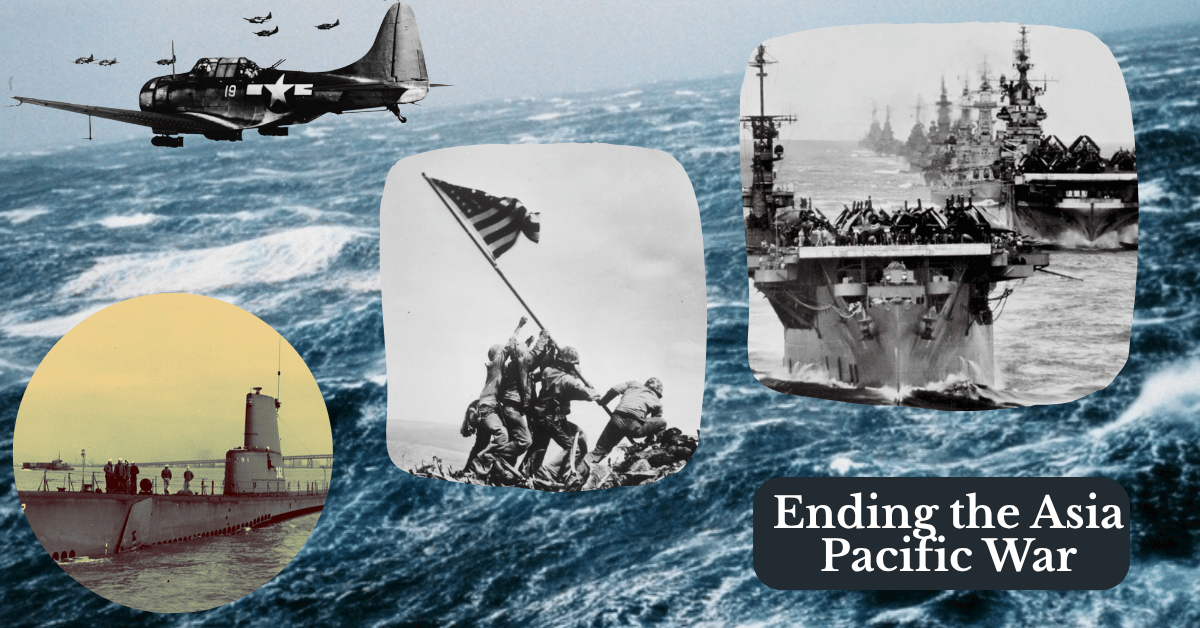
Image credit: various photographs from Naval Aviation Museum, National World War II Museum, and US Navy Archives. |
“Do not think that I have come to abolish the law or the prophets. I have come not to abolish but to fulfill.” (Mt 5:17)
The opening passage of this Gospel is controversial. Is it a general statement of Jesus’ attitude to the Old Testament? Especially in its legal provisions, is it designed to introduce the detailed examples of Jesus’ teaching in relation to the Old Testament law in vv. 21–48 and other points throughout the Gospel? Do Jesus’ words affirm the permanent validity of the details of the Old Testament law as regulations, or do they express more generally the God-given authority of the Old Testament without specifying just how it is applicable in the new situation introduced by the coming of Jesus?
Too often the question becomes framed only with respect to the “Law” where the verse reads: “Do not think that I have come to abolish the law or the prophets. I have come not to abolish but to fulfill” (5:17). The “law or the prophets” establishes a literary bracket with 7:12 (Do to others whatever you would have them do to you.This is the law and the prophets.”), setting off the verses/sections in between as the instructional core of the Sermon. The phrase itself technically refers to the Pentateuch, the Former Prophets (Joshua-Kings) and Latter Prophets (Isaiah-Malachi), but forms the functional equivalent of the whole of Scripture.
Remember that this is not an apologetic to those who had accused 1st-century Christians of rejecting the Law (or rather the rabbinic interpretation of the Law), but rather is for “internal use” by Christians who belong to a community that has made some fundamental changes to Torah observance (which is different that rejecting the Law). Jesus does not abolish the law, yet he does not affirm the status quo of the manner of observance. How are we to understand this “in-between” posture? Eugene Boring (186-87) offers some clear insights as he writes:
“(1) The whole Scripture (‘law and prophets’) testifies to God’s will and work in history. Matthew does not retreat from this affirmation. He does not play off the (abiding) ‘moral law’ against the (temporary) ‘ceremonial law.’
“(2) God’s work, testified to in the Scriptures, is not yet complete. The Law and Prophets point beyond themselves to the definitive act of God in the eschatological, messianic future.’
“(3) The advent of the messianic king’s proclaiming and representing the eschatological kingdom of God is the fulfillment of the Scriptures – the Law and Prophets. The Messiah has come. He embodies and teaches the definitive will of God. The Law and Prophets are to be obeyed not for what they are in themselves, but because they mediate the will of God. But in Matthew, Jesus declares that what he teaches is God’s will and the criterion of eschatological judgment (7:24, 26; cf. 7:21), so there can be no conflict between Jesus and the Torah, which he fulfills. This is a tremendous, albeit implicit, christological claim.
“(4) The messianic fulfillment does not nullify or make obsolete the Law and the Prophets, but confirms them. The incorporation of the Law in the more comprehensive history of salvation centered is the Christ-event which is an affirmation of the Law, not its rejection.
“(5) But his affirmation, by being fulfilled by Christ, does not always mean a mere repetition or continuation of the original Law. Fulfillment may mean transcendence as well (cf. 12:1-14). The Matthean Jesus elsewhere enunciates the critical principle that mercy, justice, love, and covenant loyalty are the weightier matters of the Law by which the rest of must be judged (see 9:13; 12:7, both of which quote that his own life and teaching are the definite revelation of the will of God; cf. 11:25-27; 28:12-20) does indeed mean that neither the written Torah nor its interpretation in the oral tradition…is the final authority.”
At this point one needs to be careful lest one is drawn into a purely “Law” question and begins to focus on the legal portion of the Mosaic covenant to the exclusion of the remainder of that covenant, as well as the other covenants that make up the whole of the relationship of the people with God. Remember that this passage follows upon an earlier passage wherein Jesus is teaching the disciples about discipleship in the kingdom of heaven (5:1-2) – something that is here and yet not fully here.
Image credit: Sermon on the Mount (1877) by Carl Heinrich Bloch | Museum of National History | Frederiksborg Castle, Public Domain
We have slowly been working our way through the early 20th century in Japan in search of key currents and views that were shaping Japan leading up to the 1937 start of the Asia-Pacific War. The 1860s movement from the Shogunate era to the Meiji Restoration was not a move to a constitutional republic that we know and accept in the United States. It is a complex topic best described by dedicated historians. To be clear, historians do not fully agree on the role Hirohito was playing and would play in the path to the Asia Pacific War. Nonetheless, some coverage is needed to understand how events have and will play out in 1930s Japan.
The Role of the Emperor
It is fair to say that a central goal of the Meiji Restoration was to reestablish the Emperor as a center of leadership, especially moral and symbolic leadership – but it needs to be said with qualifications.
One of the Restoration’s core aims was to overturn Tokugawa Shogunate rule, which governed in the Emperor’s name but marginalized him in practice. It was a critical aspect of the Restoration to reassert the Emperor as the legitimate source of authority for the state. This was essential for national unity during rapid modernization and would serve to legitimize institution and structural changes that would be needed for Japan to take its place in the world order. These changes included military conscription, taxation, education, state and foreign policy, and more. In this sense, the Emperor was intended as the moral and symbolic center of the new order.
But that was not to say the architects of the Restoration intended the Emperor to be involved in day-to-day operation of the State. Many of the Restoration leaders were themselves daimyō (regional rulers) in the Shogunate era. While they did not want a Shogun, neither did they intend the Emperor to govern directly. Influenced by Chinese and Western polity, they designed the ruling structures so that real power rested with the cabinet, bureaucracy, and the genrō – the elder statesmen of the era as it happens, themselves). The result was that the Emperor’s role was to sanction and embody decisions, not originate policy. This aligns with the idea of moral leadership rather than active governance.
Yet he served an important political function. The Emperor’s restored status provided continuity with Japan’s past, neutralized factionalism by placing authority above politics, and helped suppress dissent by framing opposition as disloyalty. The emperor-centered ideology was a means to an end, not an end in itself.
By elevating the Emperor as sacred, inviolable and the source of sovereignty, the Meiji system created structural ambiguity. Policies could be justified as “the Emperor’s will” while at the same time the Emperor was shielded from responsibility. While this is a broad statement, 1931 saw military leaders act in the Emperor’s name without his consent, control or authority. He is the Commander-in-Chief of the armed forces, yet his Kwantung Army in Manchuria felt free to do what it wanted, not expecting and not receiving punishment for their actions. Emperor Hirohito’s response to the events of 1931 was to “fire” the Prime Minister and form a new government, but did not take any action within Army ranks. Most historians believe it was a choice for national stability; control could come at a later time.
That did not seem to be the response of an absolute monarch yet neither was it a role of a powerless figurehead of State.
Prior to ascending the throne in 1926, Hirohito had taken a trip that included extended time in Britain. Among his interests was to understand the nuance and complexity of the King of England within the Constitutional Monarchy – which at the time seemed to be the closest configuration of what the Meiji founders had in mind. The historian Herbert Bix offers that King George of England shared with then Crown Prince Hirohito that the role of the monarch was also to influence the levers of power and on rare occasions to press with force. Hirohito never revealed his understanding of the role of emperor, not even after the end of the war in 1945 or later. It has left historians to research and draw their own conclusions. Historian Stephen Large offers an idea of “self-induced neutrality” – knowing he has the power but choosing not to act. Peter Wetzler believes that the Emperor knew how to put his thumb on the scale but at the same time did not believe himself to be responsible for the result. In the end his was only to approve policy, not to create it.
Whatever his actual views, his posture as Emperor from 1926 until 1937 fit into the Meiji system’s likely intent. By elevating the Emperor as divine, inviolable and the source of the nation’s sovereignty, the Meiji system created structural ambiguity wherein policies could be justified as “the Emperor’s will” and yet the Emperor was shielded from responsibility.
Sacred Duty
The education and formation ministries amplified this view of the Emperor with The Development of Sacred Duty. This was an essential idea that Japan needed to take its place among the powerful nations of the world, not only as an economic necessity but as a moral imperative rooted in its self-understanding through the eyes of Shinto religion. The argument was that if the emperor’s will was divine, then Japan’s policies (whether modernization, annexation, or war) could be framed as the fulfillment of a sacred mission. For example, in annexing Korea, Japanese officials and ideologues claimed they were “bringing civilization and order” under the emperor’s benevolent guidance.
This Shinto-based ideology taught that Japan was the land of the gods (shinkoku), uniquely pure and chosen. This translated into foreign policy as a belief that Japan had a moral right and duty to lead other Asian peoples (Korea, Taiwan, eventually China) — even if this meant dominating them. Unlike Western colonial powers, which often justified empire through Christianity or “civilizing missions,” Japan used State Shinto and emperor-centered nationalism to claim it was liberating Asia from Chinese decay or Western imperialism.
This view underpinned Japan’s expansion which was more than military force projection, it included economic and trade justifications – all connected to Japan’s need for markets, raw materials, labor, and trade routes. State Shinto teachings linked these economic aims to national survival and divine destiny. Securing resources in Korea, Taiwan, and later Manchuria wasn’t framed as “colonization,” but as fulfilling the emperor’s sacred mandate to protect and enrich his people. Thus, trade dominance and annexation were sacralized as part of a divine mission, not just pragmatic policy.
The cornerstone that held the structure together was the Emperor – or at least the idea of the Emperor.
This ideology formed the idea of The Eight Corners of the World in which the Emperor of Japan extended divine order first across East Asia then across the globe. In Korea, Manchuria and later in other conquered lands, Shinto shrines were built to enforce the symbolic inclusion of that country under Japan’s sacred imperial rule. This is the underlying foundation behind the Greater East Asia Co-Prosperity Sphere in which Asian countries should come together under Japan’s leadership to be free from Western colonial powers. On paper, it sounded like a partnership — “Asians helping Asians.” Japan said it would bring prosperity, unity, and independence to Asia. In reality, though, it mostly meant that Japan would dominate the region, control its economies, and use its resources for Japan’s benefit. So instead of being true cooperation, it was more akin to Japan empire building with kinder and gentler language and imagery.
In the Center
At the center of the puzzle is Showa Emperor Hirohito, the 124th descendant of the Sun Goddess, son of Emperor Taisho, the son raised from birth to take his father’s place on the throne. The one who inherited the root problem passed on by his father Emperor Taisho who had positioned the throne, for all practical purposes, as a Constitutional Monarch with no real powers – or at least Taisho did not exercise any power. Internal to Japan there were supporters of this dynamic as they desired for full democratic reforms. There were detractors that saw such reforming movements as an “infection” of western ideas. When Hirohito ascended the throne, he entered into an evolving system where the Cabinet and Diet establish policy and precedence internally and externally. Was this the intent of Meiji reforms? Was it an aberration? What was to be his role? Decision maker, Imperial “whisperer” whose position was only hinted at by the question asked, or, like his father, a symbol and endorser of already made decisions.
Historians generally describe Emperor Hirohito’s role between the Mukden Incident (1931) and the February 26 Incident (1936) as that of an engaged but constrained constitutional monarch whose authority was real yet structurally and politically limited and whose own choices increasingly favored management over confrontation. After this period, Hirohito became more engaged – how much more? But we know from this point forward Hirohito was not a passive figurehead. He received regular briefings from Army and Navy Chiefs of Staff, questioned military plans and timelines, and expressed concern about unauthorized actions, especially after Mukden. But Hirohito accepted the military’s assurances and fait accomplis rather than force a constitutional crisis. He was aware of this history of assassinations and divisions within the Army and strategically chose to avoid civil war or regicide. It was the latter in 1936 when Hirohito personally ordered the suppression of the coup. When the throne itself was directly threatened, he acted decisively. Hirohito could intervene, but usually chose not to unless imperial authority itself, not policy, was at stake.
1937 and Beyond
Perhaps getting ahead of ourselves, but continuing the thread, we continue to trace how Emperor Hirohito’s posture changed after 1937 when Japan’s actions initiated the Asia Pacific War with the outbreak of full-scale war against China that began with the Marco Polo Bridge Incident (July 1937)
Hirohito seems to accept the war as a reality to be managed. As Emperor he approved mobilization orders and war directives, accepting that conflict was now unavoidable. He shifted from questioning whether Japan should fight to how the war should be conducted as he focused on military feasibility, logistics, and timelines rather than political alternatives. Historians largely agree that Hirohito no longer saw the war as something he could stop without risking systemic collapse. Perhaps the one sentence description of how he viewed his role as Emperor would be: reluctant acceptance combined with managerial oversight.
As the war in China dragged on, Hirohito demanded more frequent briefings. During these briefings he often questioned generals on operational matters, including troop deployments and supply constraints. He continually expressed concern about two items. The first was overextension of the army. The IJA enjoyed continued success against Chinese forces, but that also meant longer logistic lines and a larger territory “behind the lines” for which they were now responsible. Second, there was no clear exit strategy or end-game that could be delineated. The Emperor made his presence increasingly known, but avoided direct confrontation.
And the war dragged on. Meanwhile on the home front, the Prime Minister who was a prime animating force for Japan’s continued aggression in China, Prince Konoe formed the Imperial Rule Assistance Association (IRAA). It was an attempt to unify Japan under a totalitarian, ultranationalist banner for total war, effectively dissolving all other political parties to eliminate factionalism and mobilize the nation for its expansionist goals in China, Mongolia and Siberia. While intended to consolidate power, it struggled with internal divisions and never fully achieved the monolithic control seen in Nazi Germany, facing resistance from established interests and failing to fully control the military.
In this period Hirohito voiced unease about war with the United States because of Japan’s industrial and naval limitations. At the same time he supported diplomatic efforts but seemed to keep them “on a short leash” so that they did not undermine imperial prestige. It was also in this period that he ultimately approved The Tripartite Pact with Italy and Germany. As well he approved the expansion to the southwest, occupying French Indochina. The Emperor seemed suspended between diplomacy and military momentum, wanting the former but unwilling to tamper down the latter.
In late 1941, despite misgivings, Hirohito approved the decision for detailed war planning against the United States and Britain and sanctioned pre-war operations while insisting that diplomacy continue until the last moment. But more on that in later posts.
After the Allies entered the Asia Pacific War and the tide soon turned, Hirohito asked increasingly pointed questions, privately expressed pessimism, but avoided direct intervention that might undermine military morale. He was informed, offered suggestions, but remained largely reactive but understood his was the final consent/approval of major actions and campaigns.
It was only in August 1945, when Japan was defeated but had not yet surrendered that Hirohito overrode military opposition to accept the Potsdam Declaration, intervened directly to solve a deadlocked cabinet, and ordered the end of the war. This moment starkly contrasted with his earlier restraint but he acted to preserve the nation and the Imperial House.
Historians often describe Hirohito’s post-1937 trajectory as moving from constitutional restraint to managerial involvement to reluctant authorization to a final decisive intervention. The paradox, the evolution if you will, is central to his legacy.
Earlier he possessed the authority to intervene but did not, seemingly out of fear of fracture, precedent, and the sacred status of the throne. He acted decisively only when national annihilation loomed
Image credit: various photographs from Naval Aviation Museum, National World War II Museum, and US Navy Archives
Here on the 6th Sunday of Ordinary Time, our gospel reading continues the “Sermon on the Mount” begun on the 4th Sunday. As mentioned elsewhere, the “Sermon” is the first of the Matthean discourses and perhaps the best known. Warren Carter (Matthew and the Margins) has these introductory comments about the entire sermon:
The focus of Jesus’ teaching concerns the “good news of God’s empire/reign” (4:17, 23; 5:3, 10, 19, 20; 6:10, 33; 7:21). The sermon is not, though, a comprehensive manual or rule book, not a step-by-step “how to” book. Rather it offers a series of illustrations, or “for examples,” or “case studies” of life in God’s empire, visions of the identity and way of life that result from encountering God’s present and future reign. (p.128)
For those who belong to the minority and marginal community of disciples of Jesus, the sermon continues the gospel’s formational and envisioning work. It shapes and strengthens the community’s identity and lifestyle as a small community in a dominant culture that does not share that culture’s fundamental convictions. The community is reminded that the interactions with God, with one another, and with the surrounding society are important aspects of their existence which embraces all of life, present and future. Mission to, love for, and tension with the surrounding society mark their participation in this society. Integrity or wholeness defines their relationships with one another. Prayer, accountability, and the active doing of God’s will are features of their relationship with God and experience of God’s empire. (p.129)
Carter’s insights about the “relationship” language and images present in the Sermon are so far present in the Beatitudes (5:1-12) and metaphors of salt and light (5:14-16) – in describing not the “terms and conditions” of the relationship with God and God’s people, or a halakah (rule of life) – but rather is meant to stimulate the imagination and personal responsibility of freely entering into the covenant relationship with God. But it also leaves the listener to wonder what exactly is meant by “covenant.” In modern language use in English, the term is often thought of in the same light as “contract.” Carter’s insight is that covenant can only be fully expressed when one considers the implied relationships, and thus one is led to ask, “What does it mean to truly be God’s people?”
On a clear, moonless night without haze or the shine from cities, with an unobstructed view – how far away can a 100 watt light bulb be seen by the human eye? You might be surprised to know it is 5-10 miles! Of course, given the curvature of the earth, the distance to the horizon for a 6 foot tall person, standing at sea level, is only 3 miles. But then it depends on the light’s height above sea level. Lots of factors to consider, but underlying it all is the power of light.
Universally across time and cultures, light has been a symbol of hope. The light of a star leading the Maji. The beacon of a lighthouse guiding the mariner to safe harbor. The front porch lights on, waiting for your return.
By June 1944, the United States had been embroiled in a world war for some 2.5 years. From the earliest and darkest days of the war, the tide was beginning to turn. In the Pacific the might of the US Navy and Marine Corp had been assembled to capture and liberate the Marianas Islands of Guam, Tinian and Saipan – a vital and strategic step in the Pacific War. The US 5th Fleet’s role was to guard the massive troop and supply ships mounting the amphibious landings. Meanwhile the Japanese Mobile Fleet was assembling its Plan Z/A-go for an all out naval engagement to cripple the invasion force and stem the tide of the war.
What is known as the Battle of Philippine Sea was a disaster for the Japanese naval air fleet. Their loss of aircraft and skilled aviators was tremendous. The US admirals realized they had a chance to strike a decisive and final blow against the Japanese Fleet, especially its aircraft carriers. The dive bombers and torpedo planes of Task Force 58 were dispatched to strike late in the afternoon. The Japanese fleet was located steaming west at a distance of 275 miles. It was at the very extreme range of the US aircraft to launch, strike and return, but the decision and so began what is known as the Raid into Darkness. The 226 naval aircraft arrived over the Japanese fleet just at sunset. The raid was devastating and lethal, accomplishing its mission. It ended Japanese carrier operations for the remainder of the war.
But now it was night and 226 US aircraft had to find their way home.
In 1944 there was no airborne radar, GPS, or any of the advanced air navigation tools we have today. Pilots used a method called dead reckoning recording direction, air speed, and other factors to estimate their position. Now the strike force had to fly 275 miles back, in the pitch darkness of a moonless night to find one of the 7 aircraft carriers. Positions were uncertain, fuel supply was low, and the fleet was operating under blackout conditions because of the threat of nearby Japanese submarines.
Imagine that you are one of the returning naval or marine aviators. You are running on as lean a fuel mixture as possible trying to stretch the flying range to give yourself a chance to find the fleet and land. You have a flashlight to check your dead reckoning calculations, air speed and heading. Ahead of you is nothing except a very large and very dark ocean. Alone with your thoughts you think of your loved ones at home. You wonder if you will ever see them again. It is a long flight home with only the sound of your engine to keep you company. As time passes your uncertainty grows. It is becoming the dark night of the soul as hope begins to fade.
Then comes the light. The light of your world. The beacon guiding you home to safety.
Despite the threat to the fleet, Admiral Mitscher ordered Task Force 58 to light up the night. The aircraft carrier illuminated the land decks. All ships elevated their search lights. The destroyers and other ships on the picket line did the same, also firing star shell bursts into the night sky. They did not hide their light; they put it on display for all the world to see.
Imagine you are the returning aviator. Imagine the power of that moment. Such is the power of the light.
We live in a world of darkness in which there are plenty of folks navigating in that darkness searching for the way home, hoping to see a light to guide them. When Christians live a closed life, keeping their faith under one of the many bushel baskets of modern life, we are like the fleet running under blackout conditions. We are safe and secure, but we are not a safe harbor for those traveling in the dark.
When Christians turn on the light of faith and star shell the night, perhaps we place ourselves at risk, but we become the light for the world. When we witness to the faith, when the love of God pours from us into the night sky, we reflect the light of salvation beckoning people, come home.
“Just so, your light must shine before others, that they may see your good deeds and glorify your heavenly Father.”
That’s the risk, but that’s the job. Let the light of your faith be a beacon welcoming the dark night traveler to the home they have long searched for.
Here is a sampling of early Church leaders and their thoughts on the salt and light metaphors used in Matthew’ gospel.
St. John Chrysostom (4th century): “For what is salt? It renders food useful and even indispensable. So too, the disciples by their doctrine hinder the whole world from decay. And what is light? It shines forth and discloses what was hidden in darkness. Thus they are both the salt that prevents corruption and the light that enlightens the mind… For the presence of those who live in virtue both stops the corruption of others and guides them to the truth.” (Homilies on the Gospel of Matthew, Homily 15.6–7)
St. Augustine of Hippo (4th–5th century): “The Lord said to His disciples: You are the salt of the earth; you are the light of the world. In these two names He wished to show what His disciples would accomplish: by the one, corruption is kept from the world; by the other, the darkness of ignorance is driven away. So let the Christian be salt by his conduct and light by his teaching and praise of God.” (Sermon 53.6)
St. Hilary of Poitiers (4th century): “To be called the salt of the earth and the light of the world is the charge of a life both pure and manifest. Salt preserves righteousness; light manifests the works of God. He who is salt must also be light, so that both the corruption of sin is restrained and the brightness of faith is shown.” (Commentary on Matthew 4.10–11)
4. St. Jerome (4th–5th century): “The apostles are the salt of the earth in the teaching of the gospel, lest the hearts of believers grow corrupt. They are the light of the world because their works shine and show to all the truth of their preaching. Salt without light is hidden; light without salt lacks strength.” (Commentary on Matthew 5:13–16)
St. Gregory of Nyssa (4th century): “The Lord calls His disciples salt and light: salt because they cleanse the uncleanness of life; light because they reveal to the world the way of salvation. But these are not two works but the same grace: for the soul purified by virtue will also shine with the radiance of truth.” (Homilies on the Beatitudes, Homily 5)
St. Bede the Venerable (8th century): “The Lord made His disciples to be at once salt and light. Salt, that they might season hearts grown tasteless in folly; light, that by their example they might shine before all. For the seasoning of doctrine and the brightness of holiness must go together in the teacher of Christ.” (Homilies on the Gospels I.14)
Across the Fathers, a clear pattern emerges: salt refers to moral integrity, purity, preservation of righteousness, and the inward force of holiness. Light refers to teaching, public witness, visible example, and illumination of truth. Both together express the fullness of Christian discipleship: a holy life (salt) that gives public witness (light).
Image credit: Sermon on the Mount (1877) by Carl Heinrich Bloch | Museum of National History | Frederiksborg Castle, Public Domain
Today’s readings invite us to consider what remains of a life once the moment has passed. What kind of legacy is left behind? We are also asked how that legacy is shaped by the way a person listens to their conscience.
Sirach remembers King David with generosity. He does not ignore his sins, but it recalls what ultimately defined him: gratitude, praise, and repentance. David’s life was far from flawless, yet he allowed the Word of God to correct him. When confronted, he did not defend himself endlessly or shift blame. He turned back to God. Because he repented, his story became a source of life for generations: a legacy shaped not by perfection, but by mercy received.
In the Gospel, we see a very different path. Herod’s conscience is not silent; it is restless. He knows John the Baptist is righteous. He listens to him gladly at times. And yet, when truth threatens his image, Herod begins to rationalize. He tells himself that his oath must be kept, that he has no choice. In that moment of misplaced commitment he steps on the path where each explanation protects his reputation but erodes his freedom.
The result is tragic: a prophet is silenced and Herod is left haunted rather than healed. His legacy is not remembered for courage or repentance, but for a moment when fear and pride overruled truth.
The contrast is stark. A conscience that repents remains alive. A conscience that rationalizes slowly hardens. David’s repentance opened the door to mercy; Herod’s explanations closed it. One legacy gives life because it allows God to have the final word. The other is marked by tragedy because it refuses to surrender.
What about us? Any of these moments echo an experience? These readings speak directly to the human experience of daily choices. We may not face dramatic decisions, but we do face moments when conscience speaks quietly. We can listen or we can explain it away with rationalization that sounds reasonable, even religious. Repentance is simpler: “Lord, have mercy on me, a sinner.”
Today, the Lord invites us to choose the path that leads to life. Not the legacy of being flawless, but the legacy of humility. Not the false security of self-justification, but the freedom of repentance. Because in the end, it is not power or image that shapes a life worth remembering. It is a heart willing to turn back to God.
Image credit: St. John the Baptist Rebuking King Herod | Giovanni Fattori, 1856 | Galleria dell’Accademia, Florence | PD-US
In the 2026 posts I have been working to go into more depth on the events prior 1941 that drew the U.S. to become involved in the Asia-Pacific War. In the first post of the new series I wrote that I wanted to explore:
“…the currents and eddies of history that brought Japan its wars with China (1894-1895 and 1937-1945), with Russia (1904-1905), the annexation of Korea, Manchuria and French Indochina, and to wider war in the Pacific that stretched from Hawaii to Australia and nations in between, notably the Philippines, Malay, Borneo and the Dutch East Indies.”
And more, I wanted to delve into the milieu of conditions that led Japan to think that the wars were necessary, why it felt the U.S. needed to be drawn into the war, understand revisionist historians who assigned large elements of blame on the U.S. for forcing Japan’s hand making war inevitable, and so many other questions – especially what made Japan think they had any possibility for winning a war that would involve the United States.
To that end I have posted a bare bones history of Japan, her people, the ages and epochs she experienced, changes in people, in forms of governance, her relationship with other Asian countries, and especially the changes in Japanese society from the end of the Shogunate period of her history into the modern times of the Meiji Restoration. After covering multiple centuries in a single post, the focus began to narrow to cover decades, and sometimes events of just a single year.
What is common to so many of the posts was something I began to explain in the post “There’s Something About China.” That post tried to address the swirl of history surrounding China, European nations, and Japan in the days of the 19th and early 20th centuries. For business people, pirates, adventurers, explorers, seekers of the mysterious and exotic – all roads lead to China. The 1930s are no different.
But the 1930s are a confluence of many emerging influences within the Japanese world, changing the lenses by which she viewed the outside world. Although Japan had been an open country after Admiral Perry’s appearance in Tokyo Bay in the 1850s, had established a robust international trade, was an allied partner in World War I, and more – she was still a closed country in many other ways. Many of those trends were discussed in the web of previous posts and are just highlighted here:
Social Darwinism had found its way into national strategy. Control of Korea and Manchuria were seen as strategic buffers and reserves of critical resources. This allowed Japanese leaders to claim: “We do not seek conquest; we seek existence.” It is a logic that removed ethical restraint.
The traditional Samurai spirit had been morphed into bushidō as Japan’s equivalent to Western chivalry, and proof Japan possessed a moral civilization worthy of great-power status. This was installed in the military and imperial strategy of the 20th century – as well as popular culture.
The Imperial Army (IJA) and Navy (IJN) received heavy investments in equipment and personnel in order to become a military of a leading world power. The goal for the IJA was control of China and Russia. The measure for the IJN was the U.S. Navy as seen in Japan’s war plan, Kantai Kessen (“Decisive Battle Doctrine”). For details see the post War Plan Orange.
While the Meiji Constitution made provisions for a Constitutional Monarchy similar to Great Britain’s, the 1920s brought new challenges to that understanding. Liberal democracy was discredited by the post-WW1 financial crises and the Wall Street crash. Rising nationalism led to a decade of Governance by Assassination which led to a military operating with impunity, free of civilian controls and juridical consequences.
Whatever national restraints that were present in the 1920s had given way to the trends above. The 1930s were marked with a rejection of the Western nations that Japan felt had already rejected her in the Washington Conferences, the League of Nations charter, and host of other post-WW1 matters. At the same time there was an embrace of a selective account of Japanese history, culture and values. The Pan-Asian aspirations had been subsumed by Japanese nationalism so that Pan-Asian aspirations and Japanese conquest were the vision and destiny. All of this is wrapped into the promotion of racial superiority in spirit and morals, a homeland that had never been successfully invaded, all under the leadership of the divine Showa Emperor, Hirohito. Destiny called. The first call was China.
The Manchurian Campaign – Mukden
“On the roads that led Japan to and beyond Pearl Harbor, the Manchurian campaign was the first signpost. Milestones had been passed, but it was in Manchuria where the road, for the first time, divided.” (Tohmatsu and Willmott, 25).
Until 1928 or so, China was a patchwork of local war lords and shifting alliances. It made Japan’s governance of Korea, Manchuria and the Liaodong Peninsula relatively simple. But in 1928 and 1929 the Nationalist Chinese Party (Kuomintang under the leadership of Chiang Kai-shek) began to assert control over central and northern China including large swaths of Manchuria. The Manchurian warlord Zhang Zuolin has been assassinated by elements of the Japanese Kwantung Army (Kwantung is the Japanese name for Liaodong) only to see his son Chang assume power and align with the Kuomintang. Japan had formally adopted a non-interference policy for China. In the eyes of the military it was time to ignore that policy.
In 1930 nationalist operatives shot Prime Minister Hamaguchi, who survived, but the vacuum of power allowed space for the military to plan and put in place their conspiracy to expand its presence in Manchuria. The conspiracy was rooted in the Kwantung Army as well as the Army Ministry and General Staff in Tokyo. They believed a pre-emptive strike would allow Japan to take advantage of Chinese weaknesses and division. The origin of the plan was among middle-ranking officers in the Kwantung Army who believed that their actions could not be repudiated by Tokyo given the popularity of the military at home. They firmly believed that if they took the unauthorized initiative they would be able to dictate national policy. They were firm in their convictions that neither senior Kwantung officers nor the Army Ministry and General Staff in Tokyo would be able to repudiate their insubordination even insubordination that brought war. The 1928 assassination of Zhang had been the test case.
By early September 1931 the conspiracy was evident. Chiang Kai-Shek had information of what was afoot but knew he was powerless to stop it militarily and a series of river floods within China complicated his never ending power struggles with warlords and the traditional government in Nanking. He instructed the Manchuria Chang to not resist.
The conspiracy was also known to the Emperor and Prime Minister Wakatsuki. An officer from the General Staff, Major General Tatekawa, was sent to Manchuria specifically to ensure restraint, but he found himself distracted and attentive to other matters.
On September 18, 1931, officers of the Kwantung Army staged a small explosion on the South Manchurian Railway near Mukden and blamed it on Chinese forces. Although the damage to the railway was minimal and no Japanese trains were seriously affected, the Kwantung Army treated the incident as justification for full-scale operations. Within two hours virtually every Japanese unit in Manchuria undertook pre-planned offensive action leading to a rapid, unauthorized military takeover of Manchuria. Tokyo’s civilian government ultimately accepted the fait accompli. The Mukden Incident led to the creation of the Japanese puppet state of Manchukuo (1932), Japan’s withdrawal from the League of Nations (1933), and marked another decisive step toward unchecked military expansion and the erosion of civilian control in Japan.
There are a host of events between Mukden and 1934 that are important but can largely be described as unsuccessful attempts by the Kuomintang and affiliated groups in other parts of Northern China and Inner Mongolia to thwart the expanding control of Japan over all of Manchuria. In April 1934 Japan issued the Amau Declaration that asserted Japan had a special responsibility and leadership role in East Asia, particularly in China, and warned that Japan would oppose any foreign actions that interfered with its efforts to maintain order and stability in the region. While it stopped short of announcing formal annexations, it made clear that Japan would not tolerate outside powers, especially Western nations, challenging its political, economic, or military influence in China.
The Amau Declaration formalized Japan’s claim to regional dominance in East Asia and marked another step away from international cooperation toward coercive imperial policy in the 1930s It effectively proclaimed a Japanese sphere of influence in East Asia and was seen as an Asian version of the Monroe Doctrine, but backed by military force rather than diplomacy. The declaration further isolated Japan diplomatically and reinforced perceptions that Japan was abandoning collective security in favor of unilateral expansion.
The campaign in Manchuria proved to be the first of three Japanese offensives north of and astride the Great Wall: within Manchuria itself, in Inner Mongolia, and then in northern China. These efforts, following one after the other, lasted until early 1937, by which time Japan had secured Manchuria and, by a combination of military and other means, had largely neutralized Chinese and Kuomintang influence in Inner Mongolia and northern China.
The Response of Nations
All that was left for China was the posture of no resistance, no recognition of Japanese gains, and no negotiations with Japan. The League of Nations issued the Lytton Commission report condemning Japan. It was ignored and the report’s failure to initiate international sanctions or action proved to be the death knell of the League of Nations. Since the United States was not a League member and was Japan’s largest western trading partner, Japan saw no need to take any action.
In the United States, Franklin D. Roosevelt became president in January 1933 and started to govern amidst a powerful isolationist sentiment among the people and in Congress. We had been drawn into the European morass of World War I and would not be fooled again.
Meanwhile… the Navy
In December 1934, Japan announced it would not renew its participation in the Washington Conference treaties, especially the limits on naval combatants and auxiliary ships. In fact, Japan was already “cheating” on the accords. The Navy began to mimic the Army’s attitude as it longed for the freedom of action that the Army had simply taken for its own. The difference is that the Navy is a capital intensive investment with long lead times. At issue was the need to be unrestrained from a naval inferiority to British and American fleets as a step into support of the vision of Japan’s Asian “Monroe Doctrine” to be implemented by force of arms.
More than a decade before Admiral Kato, chief negotiator at the 1922 Washington Naval Conference, had pointedly noted that the only eventuality that could be worse for Japan than an unrestricted naval race with the United States would be war against that country. The Washington Conference had not been perfect and had required unwanted compromises from Japan, but whatever its faults, it had limited naval construction, and provided Japan with a level of naval security in the western Pacific that had never been its own to command. “This advantage was to be thrown away, and the American and British navies were to be challenged to a naval race by a service that was convinced of Japan’s special place in history. Moreover, it was equally convinced that it had in place an organization and doctrine that, given assured moral superiority over the Americans, would ensure Japan against defeat in a naval war in the Pacific. It was somewhat ironic, under these circumstances, that once limitation arrangements lapsed, both Britain and the United States laid down battleships before Japan, and it was doubly ironic that after the end of limitation, the United States laid down as many capital ships as the rest of the world put together.” (Tohmatsu and Willmott, 40)
The Aftermath
From 1934 through 1944 Japan invested in Manchuria to the extent it promoted export of critical natural resources and food. Perhaps the key investment was in the railroads. In 1931 Manchuria had 3, 600 miles of railbed. Japan added another 2,650 miles. This extended the reach of the rail system to areas of coal mining, iron ore prospecting as well as areas with valuable reserves of magnesite, molybdenum, tungsten, and vanadium. In general, production doubled between 1931 and 1936 – most of which was exported to Japan. Geological exploration saw estimates of iron ore reserves increase from 400 million tons to 2,700 million tons. All of these resources were critical to the military and the supporting industrial complex.
Ten years of Japanese rule witnessed the construction of 2,650 miles of railway to add to the 3,600 miles that had existed in 1931. Coal production in Manchuria rose from 8,950,000 tons in 1931 to 13,800,000 tons in 1936, and iron output rose from 673,000 tons to 1,325,000 tons in the same period. Japanese surveys and prospecting resulted in the revision of estimated reserves of iron ore from 400 million tons to 2,700 million tons and of coal from 4,800 million tons to 20,000 million tons as well as in the discovery of valuable reserves of magnesite, molybdenum, tungsten, and vanadium (critical to steel alloy production).
U.S. Reaction
From 1931 to the outbreak of the Second Sino-Japanese War in 1937 the U.S. reaction was largely restrained and limited to what might be best described as moral opposition. The Stimson Doctrine refused to recognize Manchukuo, the Japanese puppet state in Manchuria as well as other territorial changes achieved by force. It placed U.S. opposition on record, but was otherwise meaningless to Japan.
In 1943 Congress passed The Tydings–McDuffie Act that granted a path to Philippine independence by 1946. Japan concluded that the U.S. was starting a long-term reduction in their military presence in what Japan considered its sphere of influence. It was also seen as a sign that America’s isolationist movement was also evidence of a lack of U.S. willingness and resolve to resist further Japanese expansion in the Asia-Pacific region.
In the period 1935-1937, Congress passed a series of Neutrality Acts aimed at avoiding entanglement in foreign wars. These laws restricted arms sales to belligerents and, it seemed to Japan, more indication of the strong isolationist sentiment in the U.S. This reinforced Japanese assumptions that the U.S. would avoid direct involvement in an Asian conflict and limited Roosevelt’s freedom to act forcefully even if he had wanted to.
Within the diplomatic and intelligence circles, observers increasingly warned that Japan was moving toward full-scale war in China and that moderate civilian control in Tokyo was collapsing. The U.S. quietly increased naval planning and contingency studies, though without public confrontation with Japan.
Up to this point in time there were no embargoes, no assets were frozen, and no trade restrictions specifically targeting Japan. This restraint contrasts sharply with post-1937 policy, when sanctions gradually escalated.
All in all, U.S. actions signaled disapproval but not deterrence. This left a gap that Japanese leaders and officers increasingly understood.
Image credit: various photographs from Naval Aviation Museum, National World War II Museum, and US Navy Archives Source credit: A Gathering Darkness: The Coming of War to the Far East and the Pacific, 1921–1942 by Haruo Tohmatsu and H.P. Willmott

 friarmusings