The Second Stanza – Promises of Reward to the Virtuous

This coming weekend is the Fourth Sunday in Ordinary Time. The gospel is the beginning of Matthew’s well known “Sermon on the Mount.” In yesterday’s post we drilled deep into the nature of the first part of the Sermon known as the Beatitudes. In today’s post we considered the first stanza of the beatitudes (vv.3-6). Today we look at the second stanza (vv.7-10)

7 Blessed are the merciful,  for they will be shown mercy. 8 Blessed are the clean of heart, for they will see God. 9 Blessed are the peacemakers,  for they will be called children of God. 10 Blessed are they who are persecuted for the sake of  righteousness,  for theirs is the kingdom of heaven. Continue reading

The First Stanza – Promises of Reversals to the Unfortunate

This coming weekend is the Fourth Sunday in Ordinary Time. The gospel is the beginning of Matthew’s well known “Sermon on the Mount.” In yesterday’s post we drilled deep into the nature of the first part of the Sermon known as the Beatitudes. In today’s post we consider the first stanza of the the beatitudes (vv.3-6)

3 “Blessed are the poor in spirit, for theirs is the kingdom of heaven. 4 Blessed are they who mourn, for they will be comforted. 5 Blessed are the meek, for they will inherit the land. 6 Blessed are they who hunger and thirst for righteousness, for they will be satisfied.  Continue reading

Beatitudes: structure

This coming weekend is the Fourth Sunday in Ordinary Time. The gospel is the beginning of Matthew’s well known “Sermon on the Mount.” In yesterday’s post we covered the nature and alternative outlines of the Sermon. Today we go a little deeper into the nature of the first part of the Sermon known as the Beatitudes.

Internal Structure 

Altogether there are nine beatitudes in 5:3–12, the ninth (5:11–12) is really an expansion of the eighth (5:10). Some scholars opt for a structure with three sets of three, the first eight exhibit such a tightly knit parallel structure that it is more likely that we should understand them as two sets of four. This is most consistent with Hebraic poetry forms which seem to be the literary background of the Beatitudes. Still there is an internal consistency within each “stanza/verse” as seen in the form of each pronouncement

Blessed are they who… (a quality/activity in the present tense)
for they will be…. (a verb in the future; except vv. 3 and 10)

This form is repeated each time with minor variations.  The first and last beatitude have the same ending: “for theirs is the kingdom of heaven.” Some see an internal chiastic structure of the poetic based on the grammar of the text:
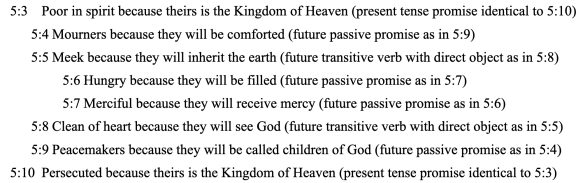
However interesting, this perhaps is a bit over analyzed. It would seem a simpler model (vv. 3 and 10 in the present with the intervening verses in the future) is adequate to point to a “realized eschatology”  and the “two-groups of four” is adequate to retain the underlying poetic.

Mark Allen Powell (119-38) suggests that the text can be outlined in the following way:

This outline is simpler and retains a central idea that the kingdom has begun to break into the world but will only be complete (fulfilled) in a future time.


Image credit: Cosimo Rosselli Sermone della Montagna, 1481, Sistine Chapel, Public Domain 

Beatitudes: scripture, culture and theology

This coming weekend is the Fourth Sunday in Ordinary Time. The gospel is the beginning of Matthew’s well known “Sermon on the Mount.” In yesterday’s post we covered the nature and alternative outlines of the Sermon. Today we go a little deeper into the nature of the first part of the Sermon known as the Beatitudes. Continue reading

Sermon on the Mount: nature and outline

This coming weekend is the Fourth Sunday in Ordinary Time. The gospel is Matthew’s well known “Sermon on the Mount.” In yesterday’s post we covered the context for the Sermon as well as some overarching views of the Sermon regarding its context and audience. Today we consider the nature and alternative outlines of the Sermon. Continue reading

A House Divided

In today’s gospel Jesus proclaims, “...if a house is divided against itself, that house will not be able to stand.” (Mark 3:25). The gospel says it I believe it, my experience reveals it to be true, it makes sense – and ultimately such divided houses do indeed fall. But it is my experience that sometimes it takes a long time to collapse and in the interim, living in the house is an increasingly difficult and unpleasant time. Continue reading

The Sweep of History

Recently, I read “The History of Florida” by Michael Gannon, a professor emeritus at the University of Florida. The book is a monographic sweep through Florida history from the pre-Columbian landscape, the settling by native peoples, the arrival of the first European explorers, the history of ethnicity and immigration, and to the changing landscape of life and people that forms the great state we live in. So far I have also learned an amazing amount by the early Franciscan missionaries in Florida and Georgia in the 16th and 17th centuries. It put me in a “historical mindset” when looking at this week’s readings. Continue reading

A Summary of Jesus’ Activities

This coming Sunday is the 3rd Sunday in Ordinary Time.  In the previous post we discussed the phrase: “the kingdom of heaven is at hand.” Today we summarize the gospel as a prelude to the Sermon on the Mount – the gospel for the 4th Sunday. His fame spread to all of Syria, and they brought to him all who were sick with various diseases and racked with pain, those who were possessed, lunatics, and paralytics, and he cured them. And great crowds from Galilee, the Decapolis,  Jerusalem, and Judea, and from beyond the Jordan followed him.” (Mt 4:24-25) Continue reading