Not like them

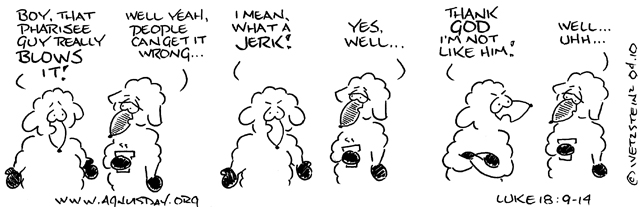
The Gospel for this Sunday is from Luke 18:9-14 in which Jesus tells a parable about those who depend upon their own compliance with religious regulation for righteousness: “The Pharisee took up his position and spoke this prayer to himself, ‘O God, I thank you that I am not like the rest of humanity—greedy, dishonest, adulterous—or even like this tax collector. I fast twice a week, and I pay tithes on my whole income.

comic

A Parable of Right Relationships

This coming Sunday is the 30th Sunday in Ordinary Time, the parable of the Pharisee and the Tax Collector in prayer in the Temple. Culpepper (Luke, 343) concludes his comments with:

The parable of the Pharisee and the tax collector, contrary to some interpretations, is a two-sided parable. To read it as simply a warning against pride, self-sufficiency, or a relationship with God based on one’s own works is to miss the other side of the parable, which connects the Pharisee’s posture before God with his contempt for the tax collector. To miss this connection would be tantamount to emulating the Pharisee’s blindness to the implications of his attitude toward the tax collector. The nature of grace is paradoxical: It can be received only by those who have learned empathy for others. In that regard, grace partakes of the nature of mercy and forgiveness. Only the merciful can receive mercy, and only those who forgive will be forgiven (6:36-38). The Pharisee had enough religion to be virtuous, but not enough to be humble. As a result, his religion drove him away from the tax collector rather than toward him.

Continue reading

Reading the signs

“Red sky in morning, sailor take warning. Red sky at night, a sailor’s delight” So goes the adage. The saying is most reliable when weather systems predominantly come from the west as they do in the United States. A red sky appears when dust and small particles are trapped in the atmosphere by high pressure. This scatters blue light leaving only red light to give the sky its notable appearance. A red sky at sunset means high pressure is moving in from the west, so therefore the next day will usually be dry and pleasant. Red sky in the morning appears due to the high-pressure weather system having already moved east meaning the good weather has passed, most likely making way for a wet and windy low-pressure system. Hence “sailor take warning.” Continue reading

A Parable of Reversal?

This coming Sunday is the 30th Sunday in Ordinary Time. So far we have looked in some depth at the role played by the Pharisee and that of the Tax Collector. Jesus concludes the parable by saying: “I tell you, the latter went home justified, not the former; for everyone who exalts himself will be humbled, and the one who humbles himself will be exalted.” (Luke 18:14) Continue reading

The Tax Collector

This coming Sunday is the 30th Sunday in Ordinary Time. In yesterday’ post we considered the Pharisee in the context of 1st century religious practice. Today we turn our attention to the tax collector – viewed as a sinner against God and traitor to his people. But the we need to be attentive to Luke’s portrayal of sinners at several key junctions:

“I have not come to call the righteous to repentance but sinners.” (Luke 5:32) “…there will be more joy in heaven over one sinner who repents than over ninety-nine righteous people who have no need of repentance.” (Luke 15:7)

Continue reading

A Church ever called to Mission

This Sunday, October 23rd, is World Mission Sunday. In his annual reflection, Pope Francis notes that the most intrinsic work of the Church is missionary. As Jesus ascended into heaven his last words were: You will receive power when the holy Spirit comes upon you, and you will be my witnesses in Jerusalem, throughout Judea and Samaria, and to the ends of the earth.” (Acts 1:8)
Continue reading

The Pharisee

This coming Sunday is the 30th Sunday in Ordinary Time. In the previous posts we considered the context as well as some technical aspects of language to tease out some nuanced meaning in the parable – for Jesus’ time as well as during the time of St. Luke and St. Paul. We noted our assumptions that the Pharisee were always in the wrong. But the Pharisees were not villains. They were dedicated to observing the law. The Pharisee in our text actually exceeds the laws demands. Fasting twice a week rather than once a week. Tithing on all he gets rather than just the foods and animals (Dt 14:22) for which it is required. According to temple standards, Pharisees are the “good guys” –  the “righteous” – and this Pharisee does even more than the ordinary Pharisee.  Are the “temple standards” the correct ones? Clearly there is some merit as the traditions of fasting and tithing as they continue into Christian spiritual practices.

What about the Pharisee’s prayer? There are records of ancient prayers similar to the Pharisee’s and such prayers were not considered self-righteous boasting. The following prayer of thanksgiving from the Talmud was prayed by the rabbis on leaving the house of study.

I give thanks to Thee, O Lord my God, that Thou has set my portion with those who sit in the Beth ha-Midrash [the house of study] and Thou has not set my portion with those who sit in [street] corners for I rise early and they rise early, but I rise early for words of Torah and they rise early for frivolous talk; I labor and they labor, but I labor and receive a reward and they labor and do not receive a reward; I run and they run, but I run to the life of the future world and they run to the pit of destruction. [b. Ber. 28b

A similar ancient prayer (with something offense to our modern sensibilities) is found in the Talmud:

Judah said: One must utter three praises everyday: Praised (be the Lord) that He did not make me a heathen, for all the heathen are as nothing before Him (Is 40:17); praised be He, that He did not make me a woman, for woman is not under obligation to fulfill the law; praised by He that He did not make me … an uneducated man, for the uneducated man is not cautious to avoid sins. [t. Ber. 7.18] [p. 59]

So it would seem that the Pharisee’s prayer thanking God that he is not like the rest of humanity was not all that unusual. He is the model of the pious man, both by what he did do (fasting and tithing); and by what he didn’t do – acting like thieves, evil people, adulterers, and tax collectors. The word Pharisee (“those set apart’) is reflected in his posture of prayer – apart from the others.

Then he spoke this prayer to himself.  The phrasing in Greek is awkward, lending itself to several possible understandings. One understanding is neutral: he simply assumed a posture of prayer and prayed quietly to himself. Two other understandings are negative: he prayed to himself rather than to God, or he prayed with reference to himself but with an eye to the tax-collector.

The Pharisee asks nothing of God. Why? Is he satisfied that his fasting and tithing are sufficient – reflecting a works-salvation mentality? Does he assume these actions reflect his piety and that he is not a sinner? What is clear is that his prayer gives no evidence of humility or contrition.


Image credit: De Farizeeër en de tollenaar (The Pharisee and Publican), Barent Fabritius, 1661, Public Domain

Despised everyone else

This coming Sunday is the 30th Sunday in Ordinary Time. In yesterday’ post we considered differing dispositions for prayer. Today we will explore the difference in how this parable might be understood by a  first century listener.

We read that Jesus is addressing those “who were convinced of their own righteousness and despised everyone else” and then we hear “one was a Pharisee.” And we nod our head, “I knew it!”  We know how Luke has been describing the Pharisees, thus even at the words one was a Pharisee we are disposed to have this not end well for the Pharisees. We are not surprised that the Pharisee will represent the one who trusts himself and his own righteousness rather than God and the one who judges others and holds them in contempt. But let’s consider how the first century listener might have heard this narrative. Continue reading

The Pharisee and the Tax Collector

The image accompanying the scripture posts this week is a 1661 painting by the Dutch artist Barent Fabritius. It used a didactic layout as a means of story telling and teaching. The center of the frame shows the Pharisee (on the left) and the Tax Collector (on the right). They are in the Temple in prayer. There is much to be discerned in their attire, posture, and demeanor. But the artist is clear about the end result. The one who prays with a haughty attitude exists to the left accompanied by a demon. The one who prays humbly exist with the angels attending.


Image credit: De Farizeeër en de tollenaar (The Pharisee and Publican), Barent Fabritius, 1661, Public Domain