 Rebuke as Reward: Then he warned them not to tell anyone about him. He began to teach them that the Son of Man must suffer greatly and be rejected by the elders, the chief priests, and the scribes, and be killed, and rise after three days. He spoke this openly… (Mark 7:30-32)
The Greek epitimaō (warn) is a strong word; hardly one of praise and affirmation. Pheme Perkins [623] has a great insight on what is unfolding: “Readers might expect a word of praise for the confession, since it demonstrates that the disciples are superior to the crowds in their understanding of who Jesus is. Instead, the command to tell no one is introduced with the verb for “rebuke” (ἐπιτιμάω epitimaō), the same verb Mark uses to describe Jesus’ response when the demons acknowledge him as Son of God (3:12). Thus the rebuke does not impugn the correctness of the title being used. The problem with the confession is the inappropriateness of the time (prior to the passion), the context (exorcism and healing miracles), or the witnesses (spoken by demons). Since the episodes surrounding the two affirmations of Jesus’ identity in this section demonstrate that the disciples do not understand that suffering lies at the heart of Jesus’ mission, they are no more able to use the titles “Messiah” and “Son of God” correctly than the demons are. Jesus will accept both titles publicly during his interrogation by the Sanhedrin (Mark 14:62).” Continue reading →

 The “blind leading the blind” is an idiom that can be traced back to the Upanishads (late Vedic Sanskrit texts of Hindu philosophy), which were written around 800 BCE:
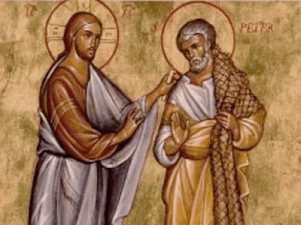 He summoned the crowd with his disciples and said to them, “Whoever wishes to come after me must deny himself, take up his cross, and follow me. 35 For whoever wishes to save his life will lose it, but whoever loses his life for my sake and that of the gospel will save it. (Mark 7:34-35)
 Maggie Astor of the New York Times posted an interesting piece – which was interesting all on its own, but is perhaps more interesting given President Biden’s announced covid-19 mandates and actions – and the inevitable push back against them. Ms. Astor’s point is essentially that we as a nation…. “been there, done that.” I would have linked to the article, but that was not feasible – and so I present her work.
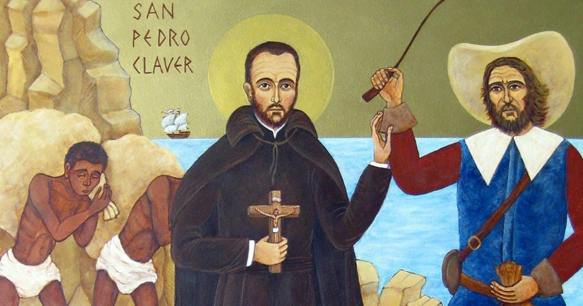 Born on June 26, 1580, in Catalonia, Spain, St. Claver studied at the University of Barcelona and joined the Jesuits at age 20 in 1602. While studying philosophy at Majorca in 1605, St. Claver developed a friendship with Jesuit Brother Alphonsus Rodriguez. Br. Rodriguez, who spent his days doing menial work as a doorkeeper, encouraged St. Claver to become a missionary in the Spanish colonies in America. Young Peter Claver left his homeland forever in 1610 to be a missionary in the colonies of the New World. He sailed into Cartagena, a rich port city washed by the Caribbean. He was ordained there in 1615.
  Today, the Catholic Church celebrates
  Now Jesus and his disciples set out for the villages of Caesarea Philippi. Along the way he asked his disciples, “Who do people say that I am?” They said in reply, “John the Baptist, others Elijah, still others one of the prophets.” And he asked them, “But who do you say that I am?” Peter said to him in reply, “You are the Messiah.” (Mark 7:27-29)
 Our
Our 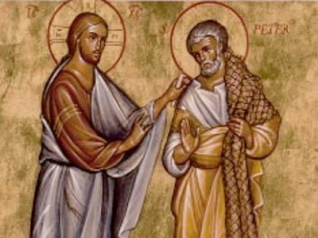 This
This  Many Catholics are aware of Pope Francis’ encyclical Laudato Si (Praise Be to You) which carries the subtitle “on care for our common home.” In this encyclical and in other documents the Pope critiques capitalism, not as an economic theory in itself, but in its divorce from the human condition and Creation. In Laudato Si’, Pope Francis wrote: “The economy accepts every advance in technology with a view to profit, without concern for its potentially negative impact on human beings. Finance overwhelms the real economy…Some circles maintain that current economics and technology will solve all environmental problems.” (#109).
  friarmusings