
 Salvador Dali’s painting “Ascension” is certainly one of the most provocative paintings depicting the Ascension of Our Lord Jesus. The symbolic elements are many, the speculations even more, and the agreement on meaning is still up for grabs. But I sometimes tend to focus on some of the more realistic elements cast among the surrealistic things. While the art experts discuss the finer points of Dali — his life, faith, and his work, I am fascinated by perspective, as well as the hands and feet. The former as though clutching at something; the latter soiled and showing the wear and tear of life on earth. Continue reading
Those bringing good news
Reply
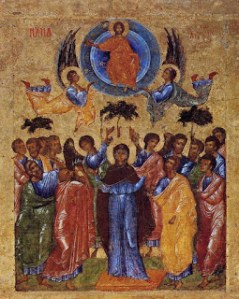 The Ascension of the Lord is a great celebration of the Church. It commemorates the bodily ascension of Jesus into heaven. According to St. Luke it occurred 40 days after the Resurrection (Acts 1:3). It is a feast of great antiquity with liturgies and art of the 4th century already addressing it as a norm of the Church. In the Eastern Church this feast is known in Greek as Analepsis, the “taking up,” and also as the Episozomene, the “salvation from on high,” indicating that by ascending into his glory Christ completed the work of our redemption.
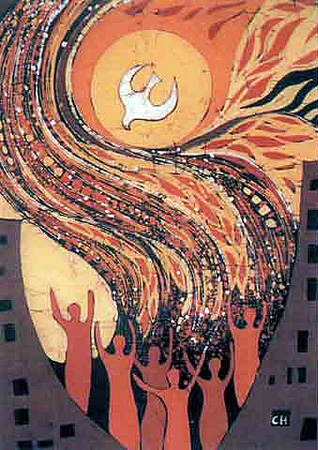 The gospel for
  It is a small part of
  Google Maps apparently is everywhere these days. I just finished searching on the app for places I knew from “back in the day.” The area around Nairobi, Mombasa, Kisii Town, Nakuru, and other places were well mapped; driving directions are available. Things have changed a lot. Back then my inquiry of how to get some place was often met with the less than precise “the other side” accompanied by a vague wave of the hand in a direction that was not always discernible to me. Especially when I was upcountry in the west of Kenya, there were times I felt like I was near the edge of the world.
  In today’s
  In the course of my MBA studies, professional career, life as a priest, and all the points in between, I have witnessed and participated in conversations gone wrong. “What we have here is a failure to communicate” (Captain, in Cool Hand Luke). I have studied instantiated and uninstantiated communications, message and meta message theory, and a whole host of topics whose names have been lost in the course of time. It seems as though communications is a mathematical stew of thousands of variables and a limited number of equations… translated: there is no one solution. At best you can hope to reach an optimal answer given a particular starting point – it won’t be perfect, but it will hopefully work.
  One of our Bible study folks asked about the reference in The Letter to the Galatians to St. Paul’s time in Arabia. I had always wanted to post something on the topic – and now I have an immediate request to do so. The problem is that we don’t really know a lot of biographical information about St. Paul – at least not in the sense of modern biographies.
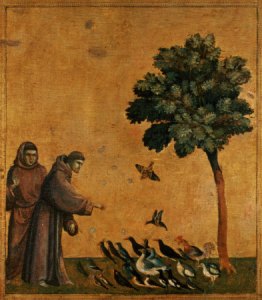 Over the last few weeks, we described Francis of Assisi in the role in which he is most popularly recognizable: the lover of nature and animals. Interestingly, this role is not original in the Christian tradition. In a valuable book reviewing the nature stories of Franciscan literature, Edward Armstrong shows that many of Francis’ attitudes have precedents in biblical, early Christian, and medieval ideas about nature. One group of scholars place Francis in the tradition of hermits who retired to wilderness and befriended animals. Others associate him with a theological trend, unfortunately not dominant, which affirms creation as containing intrinsic value. Most see the stories about Francis as having precedents in the already-known lives of saints, although they may have been true of Francis as well.
  friarmusings