A potential addition to our modern lexicon: the travel plans being made by persons who have received their covid vaccinations.
Vaxication
Reply

A potential addition to our modern lexicon: the travel plans being made by persons who have received their covid vaccinations.

“Gathered around the water cooler” was (maybe still is?) an expression to describe the gathering in the office of people to give greetings, exchange news, and tell stories. In Kenya it was the well, a river, or the public water tap. Every place and time has had a place where we gather to tell the stories that animate our lives. I suspect this morning, the conversation is the buzzer-beating ending of the NCAA semi-final game between UCLA and Gonzaga: overtime, 3 seconds left, Jalen Suggs goes the length of the court and drops a 40-footer to end the game. The twitter sphere exploded. Possibly one of the greatest college games ever as the two teams went back-and-forth. And now the water-cooler experts can debate if Suggs’ shot was the best ever or does Duke’s Christian Lattener 1992 bucket (with amazing inbound pass from Grant Hill) to defeat Kentucky in the “Elite Eight” contest. remain “best ever.”
I wonder what amazing shot was replaced by the Hill-Lattener game winner? I wonder if I will be around when that shot is forgotten and the next entry is compared to Gonzaga/Jalen Suggs thriller? Such are the stories we tell.
But in a few minutes I will be celebrating Easter Sunday 2021 and the greatest story ever told. Best ever. Now there’s a story to share when gathered at the water cooler.

In the last several articles we have described the brothers who gathered around Francis and committed themselves to his way of following Christ. Two of the earliest arrivals were Leo and Rufino. The first became Francis’ chaplain and confessor, as Leo was an ordained priest already. Rufino, a lifelong confidant and wisdom figure for Francis, was also the first cousin of an aristocratic woman of Assisi, the niece of Monaldo, lord of Coriano. Clare di Favarone di Offredicio was a woman from the very class of landed aristocrats that the young Francis had imitated and longed to join socially. Continue reading
 The sun has risen on Holy Saturday. The Christian world has remembered and celebrated the events of the Last Supper, all that unfolded in Gethsemane, the trials, the scourging, the via dolorosa, crucifixion, death, burial, and now… we wait. This week someone remarked how lucky I was to be Franciscan friar and that I could take these days for solitude, reflection, and quiet. And indeed, some of my brothers not in parish ministry are able to do that. Many are on retreat. Not so here in the parish.
This morning there is a meeting to finalize the materials for tonight’s Vigil Mass, decorate the church from the solemnity of Good Friday into the joy of Easter morning, and a rehearsal for the events of the evening’s celebration. There are many moving parts in a Vigil celebration well done – some involved in the liturgy come with a veteran’s experience while others, the Elect and Confirmandi, are new to this stage. New to the liturgical choreography is the understanding and framing of the scenes and movements for live stream. The rehearsal will finish, the notes receive a last minute editing, and all put right until we again assemble hours later. Until then we will wait. Continue reading
The first time I heard this classic Christian song it was in this Southern Harmony arrangement. It is a song in which I find deep resonance and connection. For me it is a wonderful accompaniment on Good Friday – to hear this and ponder Jesus on the Cross. Indeed, what wondrous live is this?
 There have been many a Good Friday in the course of my life. I have heard the Passion narrative. I led the Passion narrative during Good Friday liturgies. Over the many years of Bible study I have covered the Passion narrative more than a few times. And now thru the gift of my friends Jerry and Maureen, I experienced Good Friday in a way not to ever be forgotten. Continue reading
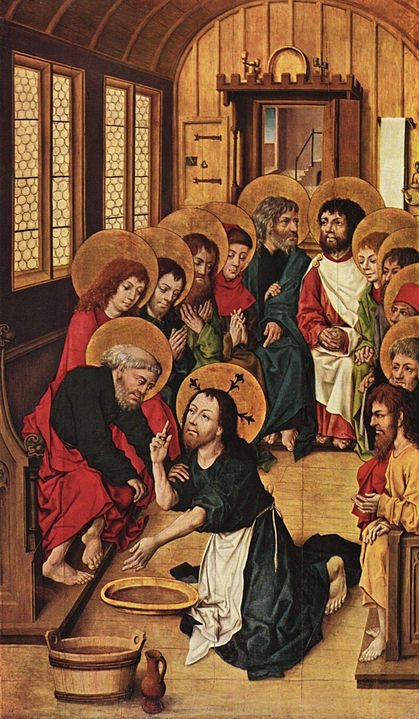 On Holy Thursday it is tradition and part of the evening’s liturgy to celebrate the washing of feet – known as the Mandatum. The name comes from John 13:34 (Latin,Vulgate) – “Mandatum novum do vobis ut diligatis invicem sicut dilexi vos.” “I give you a new commandment, that you love one another as I have loved you.”
Throughout the Christian era the meaning of the foot washing has been understood as a symbol of the self-sacrificing and humble service expected of disciples. But if one attends to the text, there are two verses that should give one pause. In v.8 Jesus clearly tells Peter “Unless I wash [nipsēs] you, you will have no inheritance with me.” In addition, there is v.10: “Whoever has bathed [leloumenos] has no need except to have his feet washed [nipsasthai], for he is clean all over…”
Tenebrae, Latin for “darkness,” is a religious prayer service with a long history of various styles and practices of celebration. Originally it was a celebration of matin prayer (middle of the night) and lauds (at daybreak). It was characterized by gradual extinguishing of candles, and by a “strepitus” or loud noise taking place in total darkness near the end of the service. Outside of monasteries, if the practice is observed, it include lauds and evening prayer from “Spy Wednesday” to Good Friday. Especially in the Anglican tradition, Tenebrae is set to music…enjoy

There is a lot going on in the readings of Holy Week. Today is “Spy Wednesday” with Judas busy about his treachery and betrayal. As we move farther into the week, the story line seems to narrow from Jesus in the public square of Jerusalem to gathering with his disciples for a last supper, a Passover meal. As the story continues it narrows, it leaves accounts of individuals all moving into isolation. Peter falls into the slumber of a long night while Jesus prays. Jesus is arrested and Peter waits, far removed, in a courtyard. When asked if he is with Jesus, he withdraws through his denial, and then he is alone. The sum of all these individual stories leaves Jesus isolated alone. It is a brand of social distancing to another end, but social distancing nonetheless. Jesus is the contagion people wish to avoid. And so they separate themselves from being in contact with Him and, in the end, each other. The community of disciples is no longer together. Continue reading
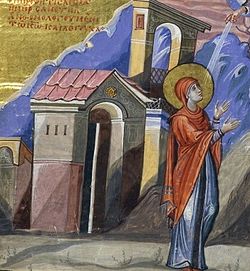 Here is the midst of Holy Week, we will watch as Jesus, our Lord and Savior, God of All, experiences weakness and powerlessness, submitting to his arrest, trial, scourging and crucifixion. We have all felt some measure of powerlessness, moments of isolation and hardship. Consider the story of Hannah, mother of Samuel.
1 There was a certain man from Rama-thaim, Elkanah by name, a Zuphite from the hill country of Ephraim. He was the son of Jeroham, son of Elihu, son of Tohu, son of Zuph, an Ephraimite.2 He had two wives, one named Hannah, the other Peninnah; Peninnah had children, but Hannah was childless.3 This man regularly went on pilgrimage from his city to worship the LORD of hosts and to sacrifice to him at Shiloh, where the two sons of Eli, Hophni and Phinehas, were ministering as priests of the LORD.4 When the day came for Elkanah to offer sacrifice, he used to give a portion each to his wife Peninnah and to all her sons and daughters,5 but a double portion to Hannah because he loved her, though the LORD had made her barren.6 Her rival, to upset her, turned it into a constant reproach to her that the LORD had left her barren. (1 Samuel 1:1-6)
 friarmusings