
 A man named John was sent from God (v.6) Into this overarching narrative of the grand plan of salvation, we have the curious insertion of John the Baptist. We should note that this fourth gospel never uses the moniker “the Baptist” or “the Baptizer” – in fact John is never called the “forerunner” or “herald.” John has one role and one role only: witness (v.7). Leon Morris suggests that this is a response to a late 1st century controversy about the role and place of John the Baptist in the story of Christianity. “We should recall that some had baptized in John’s name as far afield as Ephesus (Acts 19:3), and they may have gone further. The great Apollos is first introduced as one who “knew only the baptism of John” (Acts 18:25). Our author does not enter directly into controversy with such people, but he insists more than any of the other Evangelists on the subordinate place of the Baptist. One of the aims of this Gospel plainly was to show how clearly and consistently John had pointed people to Jesus.” (Morris, 78) John the Evangelist does not directly confront the claims of the Baptist’s followers, but he insists more than any of the other Evangelists on the subordinate place of the Baptist. One of the aims of this Gospel plainly was to show how clearly and consistently John the Baptist had pointed people to Jesus. Continue reading
 Recently, Pope Francis offered that the church should modify the translation of the “Our Father” to clear up the confusion around the phrase “lead us not into temptation.” “That is not a good translation,” the Pope said. The phrase in question appear in Matthew 6:13 and Luke 11:4 as μὴ εἰσενέγκῃς ἡμᾶς εἰς πειρασμόν. The Greek verb for lead is “eisphero” and the original Greek word for testing or temptation is “peirasmos.” Continue reading
 If the 4th Gospel is indeed more about how God reveals God’s self in the person of Jesus, then we need to realize that Jesus was not born into a time of theological vacuum. Jewish theology was robust and with a history of succeeding and competing rabbinic schools. The followers of Jesus and the people of his time were Jews who were raised and lived this theology. It provided the framework for their daily lives and shaped their expectations about the Messiah, the Anointed One, who was to come. Among the gospels, John’s is the writings whose work expresses the fulfillment of those expectations and provides the theology for those that would follow Jesus. The basis of the theology is evident from the opening: John 1:1 “In the beginning was the Word, and the Word was with God, and Word was God…” Continue reading
The 3rd Sunday in Advent continues to feature John the Baptist as the herald and forerunner of the Messiah, using the 4th gospel. John the Evangelist has deftly changed the narrative presented in the Synoptic Gospels. Here in the fourth gospel the story of Jesus is not ultimately a story about Jesus; it is the story of God as God reveals God’s self in the person of Jesus. Thus the narrative is well placed in Advent at the head of the liturgical year: “In the beginning…” Continue reading
The 3rd Sunday in Advent continues to feature John the Baptist as the herald and forerunner of the Messiah. The Reading for the Third Sunday of Lent is John 1:6-8, 19-28 (shown below in bold italics) – but it seemed good to me to also show the more continuous context of the Gospel according to John:
1 In the beginning was the Word, and the Word was with God, and the Word was God. 2 He was in the beginning with God. 3 All things came to be through him, and without him nothing came to be. What came to be 4 through him was life, and this life was the light of the human race; 5 the light shines in the darkness, and the darkness has not overcome it. 6 A man named John was sent from God. 7 He came for testimony, to testify to the light, so that all might believe through him. 8 He was not the light, but came to testify to the light. Continue reading
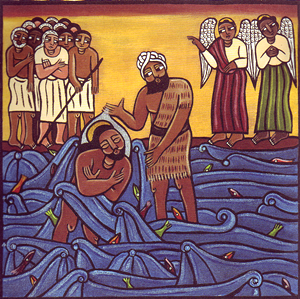 “One mightier than I is coming after me. I am not worthy to stoop and loosen the thongs of his sandals. 8 I have baptized you with water; he will baptize you with the Holy Spirit.”
John’s message is telescoped to focus upon a single theme, the proclamation of a person still to come who will baptize the people with the Holy Spirit. As seen in the Notes, it is not clear what Mark means by this expression, nor is it clear that John understands the very messianic terms he uses – at least in their fullness. In referring to this new Baptizer, whose dignity overshadowed his own, John avoided traditional messianic terms. The precise identity of the Coming One remained hidden, apparently, even from John. Continue reading
 John the Baptist is a crucial figure in the history of revelation and redemption. In retrospect, his appearance in the wilderness was the most important event in the life of Israel for more than three hundred years. The absence of a prophet throughout this period had been interpreted to signify that the prophetic task was accomplished. Yet all clung to the hope that the “faithful prophet” would appear, the Prophet like Moses, whose coming would signal the events of the “last days” (Deut. 18:15–19; 1 Macc. 4:42–46; 14:44). The very fact of John’s appearance was an eschatological event of the first magnitude, and signified that the decisive turning point in the history of salvation was at hand. It was John, the preacher of radical repentance, who initiated the messianic crisis. To speak of the gospel of Jesus is to speak of the good news which began with John. Continue reading
2 As it is written in Isaiah the prophet: “Behold, I am sending my messenger ahead of you; he will prepare your way. 3 A voice of one crying out in the desert: ‘Prepare the way of the Lord, make straight his paths.’”
We often interpret vv. 2-3 in light of Matthew and Luke where they clearly refer to John the Baptist. John is presented before the OT quotes are given. However, in Mark, the only person who has been named prior to the quotes is Jesus. Note also, for those who have difficulty memorizing scripture, Mark’s quote is a hybrid: v. 2 seems to come from Ex 23:20 (LXX) and Mal 3:1 (MT) and v. 3 from Isaiah 40:3, but not quoted exactly. Continue reading
Question 3: What was meant by “Christ”? Is it a title? Is it part of Jesus’ name?
 friarmusings