
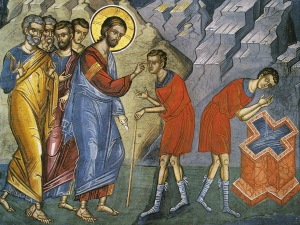
 Sin in the Gospel according to John. John seems to understand sin in a way that accents a singular aspect in a way that deserves mention. Words for “sin” occur often in our text: hamartano = “to sin” (9:2, 3; elsewhere in John: 5:14 & 8:11); hamartia = “sin” (9:34, 41); hamartolos = “sinner” (9:16, 24, 25, 31 — all the occurrences in John). The question is does John’s discussion match the discussion of hamartia in the other gospels?
In our passage, the concept of sin will be quickly introduced via the disciples’ question in v.2 : “Rabbi, who sinned, this man or his parents, that he was born blind?” This reflects traditional Jewish speculation on the relationship of illness and sin (cf. 5:14). In 1st century Palestine, people commonly assumed that disease and disorders on both the personal and national level were due to sin, as summarized in the rabbinic saying from around 300 CE that “there is no death without sin and there is no suffering without iniquity” (b. shabbat 55a). Continue reading
 Last year, on a Delta airlines flight from Phoenix, a tragedy occurred. During the flight, one of the passengers suffered a heart attack. His wife called out for help. The trained flight crew responded as did a passenger who was a doctor. Another passenger attended to the passenger’s wife. He offered to pray with her, to pray for her husband, and he stayed with her as the tragedy unfolded. He stayed with her as life hung in the balance. He left the plane with her and collected her luggage. He carried their luggage to the car that was waiting for him and took the woman to the hospital. He stayed with her as a doctor broke the news that her husband had died.
  In last week’s column, I was suggesting that we humans under appreciate the impact and power of habits – good and bad. The previous column, paralleling Stephen’ Covey’s “The 7 Habits of Highly Effective People,” began to explore the habits of the heart for committed Christians. The premise was that we humans are not fundamentally thinking creatures, or believing creatures, but desiring creatures. Thinking and believing are key and essential parts of who we are, but what pushes and pulls us has more to do with what captures our desires, our affections — our hearts. Our identity as persons is shaped by what we ultimately love or what we love as ultimate. It is the heart that needs formation in the Christian life. I then began to list some habits for forming a loving heart.
 friarmusings