 The great Catholic Biblical scholar, Rev. Daniel J. Harrington, SJ, started one of his books with the story of some traveling evangelists coming to his home in Boston when he was about 10 years old. This was around 1950. When his Irish-Catholic mother opened the door, the “ministers of the Word” said that they’d like to come in and discuss the Bible. “We’re Catholics,” she said. “We don’t read the Bible.” Fortunately, things have changed since then – but then again, in some ways, not. Sometimes we are more like Mrs. Harrington than we want to admit.
In his book, “How Do Catholics Read the Bible?” Fr. Harrington provided a wonderful introduction to the “what” and “why” of reading the Bible.
Christianity is sometimes described along Judaism and Islam as a ‘religion of the book.’ However, that description is not entirely accurate, since Christianity is really the religion of the person, Jesus Christ, the Word of God, to whom the words in the church’s book [the Bible] bear witness. Or better still, Christianity is the religion of God understood and experienced as Father, Son, and Holy Spirit. The Bible, or Holy Scripture, the book that was both created the church and was created by the church, is a privileged witness to God’s dealing with the people of God in both the Old and the New Testaments.
That is as concise a summary as I have seen. It clearly carries the thoughts and ideas of the two great 20th Century church documents on Scripture – Dei Verbum (The Word of God; Vatican II) and “The Interpretation of the Bible in the Church” from the Pontifical Biblical Commission. Let me point out just a couple of highlights of these two important documents.
First, Dei Verbum looks at the Bible as an instance of God’s personal self-revelation to us. That’s important: God communicates himself so that we can come to know Him, to love Him, and to serve Him in this life and be with Him in the next. As one of my Franciscan brothers writes, God wants to date us, get to know us, and commit to an eternally lasting relationship.
Second, both documents look carefully at the relationship between Scripture and tradition. In the Catholic Church we consider tradition to be guided by the Holy Spirit, and so Vatican II emphasized the close relationship between Scripture and tradition, describing them beautifully as both “flowing from the same divine wellspring.” Christians have been faithfully reading and reflecting on Sacred Scripture for two millennia, all the while guided by the Holy Spirit. Their reflection, passion, and understanding are part of the tradition. As we read the Bible today, we are only catching up to our ancestors in the faith, joining them, joining the community of believers in our own “family history.”
Third, the Pontificial Biblical Commission’s document applauds our attempts to understand the different literary methods that are used in the texts – e.g., sometimes Jesus is indeed speaking in hyperbole. The Commission critiques the pure literalist / fundamentalist interpretation, which it calls “dangerous” as it has a tendency to take a book whose goal is to build a personal relationship with Jesus and reduce it to a rule book so as to engender a false certitude. The Bible is not a checklist of how to be in love with God.
In my own life, the Bible is a place where I encounter God. As my dad said, “the main thing is making sure the main thing remains the main thing.” The main thing is the person of Jesus. All the prophets and the Law of the Hebrew Scriptures point to Him. All the writers of the New Testament point to Him. So, I look to the Bible to meditate on what Jesus said and did during his ministry. How he lived. How he cared for people. And what we are meant to do as his disciples. It’s the main thing.
So, with apologies to Mrs. Harrington, because we’re Catholic we are people called to read the Bible and come to know the One who calls us into the eternally life-giving relationship.

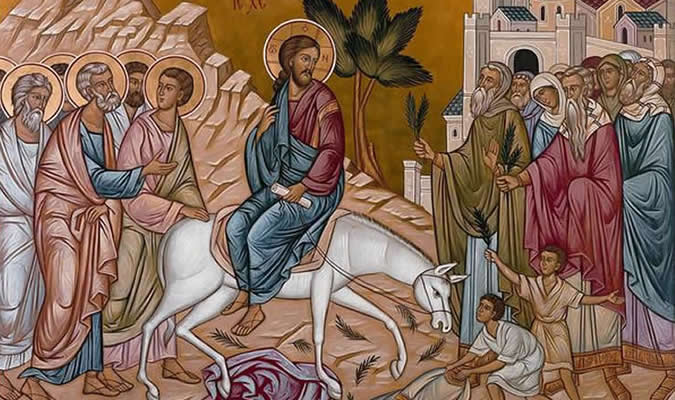 The Gospel reading for Palm Sunday of the Lord’s Passion is quite lengthy and so will not be included here. It can be found at the USCCB website:
 Death is always untimely. It comes crashing headlong into our lives and into our families. Even if death’s inevitability has been forecasted and known, its arrival remains untimely. There is always more we wanted to do or say. There is never enough time, only the time given us.
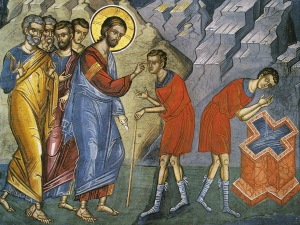 Being Lead to Decision: Faith or Disbelief. Where the authorities drive the man away (v.34), here Jesus finds the man (cf. 6:37) and asks: “Do you believe in the Son of Man?” Just as the Samaritan woman was confronted by Jesus with the possibility of the anticipated Messiah’s being already present (4:25-26), so also the healed man is confronted by Jesus with the possibility that the future judge is already present. To this point in John 9, the theme of the judgment evoked by the light of the world (9:5; cf. 3:17-21; 12:31-36) has largely been implicit. Jesus’ question makes this theme explicit as he asks the man whether he recognizes in his healer the one who brings of salvation. As v.36 indicates, the man is ready.
  friarmusings