 I think that on our best days, we who profess to be Christian, we are storytellers. This morning I have three stories for you. Two of which we know the ending; the third is a work in progress. Continue reading
Small worlds
3

I think that on our best days, we who profess to be Christian, we are storytellers. This morning I have three stories for you. Two of which we know the ending; the third is a work in progress. Continue reading
 Last week I wrote that if Lent was about making “room for God” – and that is a good start – then the Easter season and beyond should be about coming to realize that God is the entire room! “God should be not merely the reference point but the whole context out of which we operate. God is not merely the source of our existence, he is the substance of our existence, the very life we have, and without God we would be lifeless, even if we are alive. Put another way, if Jesus is not Lord of all, he is not Lord at all.” Continue reading
 In today’s Gospel, we hear, “So Simon Peter went over and dragged the net ashore full of one hundred fifty-three large fish.” Scholars have speculated on all kinds of reasons for the number “153.” It is perhaps simply the number that was there, it might be the number of known fish species in the world (at that time), or perhaps the number of known nations. Who knows. Continue reading
 Thomas. Although many translations include “doubt” in v. 27 — and thus lead to the phrase “Doubting Thomas,” but there is no Greek word for “doubt” in the verse. The phrase do not be unbelieving, but believe contrasts apistos and pistos — the only occurrence of both these words in John. Simply put, the word does not mean “doubt” and Greek does not lack the equivalent words: diakrinomai, dialogismos, distazō, dipsychos, aporeō, and aporia. Lowe and Nida (Greek-English Lexicon of the New Testament Based on Semantic Domains) give three definitions for the adjective – pistos.
Thus apistos would be “not having trust or faith or certainty.” Continue reading
 My Franciscan brother, Fr. Dan Horan OFM, is prolific writer of exceptional clarity. He has an article over at American Magazine that might create some dialogue in the world of Franciscan scholars and perhaps a pundit or two. A simple history of the Franciscan intellectual tradition (too simple to be factual) is that many people from Bonaventure on have tried to peer into the writings and life of St. Francis and synthesize his thought and spirituality in flowing and lofty constructs and thoughts. Francis was no simple person, but he was a man of particular dedication to Scripture. One only need to read Francis’ own writings to see that. And that is at the core of Fr. Dan’s article Continue reading
“Receive the holy Spirit” The sacred writer had already introduced the giving of the Holy Spirit in John 7 in a scene during the Feast of Tabernacles in which the Spirit is promised at a future time when Jesus was glorified. In the Fourth Gospel it is at the crucifixion that Jesus is glorified in that his willing obedience manifests the nature of God, which is love. It is there on the cross that Jesus deliver the Spirit into the world (19:30), symbolized immediately afterward by the flow of the sacramental symbols of blood and water. Continue reading
Commentary. Meanwhile the disciples, still reeling from the events of the last three days, gather in the upper room. In Matthew 28:8, Mary Magdalene’s reaction to the encounter with Jesus was “fearful but overjoyed.” Perhaps this too is the experience of the disciples. All John tells us is that they were gathered together, hiding as it were, for fear of the Jews (v.19)
These are the disciples who scattered and fled at Jesus’ arrest, who stood at a distance from the cross, and in the case of Peter denied Jesus. These are disciples that upon seeing Jesus appear within the room would have likely experienced shame as they remembered all they had done and failed to do. Yet Jesus’ words are not words of recrimination or blame, his first resurrected words to the disciples as a group is “Peace be with you.” Continue reading
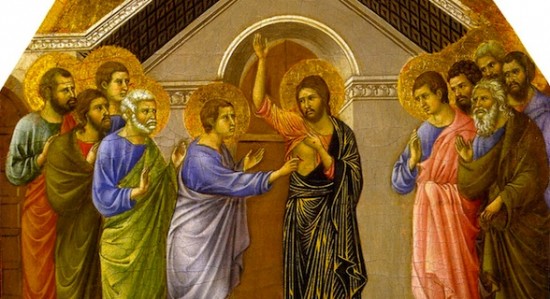
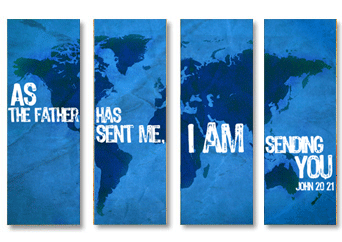
John 20:19-31 19 On the evening of that first day of the week, when the doors were locked, where the disciples were, for fear of the Jews, Jesus came and stood in their midst and said to them, “Peace be with you.” 20 When he had said this, he showed them his hands and his side. The disciples rejoiced when they saw the Lord. 21 (Jesus) said to them again, “Peace be with you. As the Father has sent me, so I send you.” 22 And when he had said this, he breathed on them and said to them, “Receive the holy Spirit. 23 Whose sins you forgive are forgiven them, and whose sins you retain are retained.” 24 Thomas, called Didymus, one of the Twelve, was not with them when Jesus came. 25 So the other disciples said to him, “We have seen the Lord.” But he said to them, “Unless I see the mark of the nails in his hands and put my finger into the nailmarks and put my hand into his side, I will not believe.” 26 Now a week later his disciples were again inside and Thomas was with them. Jesus came, although the doors were locked, and stood in their midst and said, “Peace be with you.” 27 Then he said to Thomas, “Put your finger here and see my hands, and bring your hand and put it into my side, and do not be unbelieving, but believe.” 28 Thomas answered and said to him, “My Lord and my God!” 29 Jesus said to him, “Have you come to believe because you have seen me? Blessed are those who have not seen and have believed.” 30 Now Jesus did many other signs in the presence of (his) disciples that are not written in this book. 31 But these are written that you may (come to) believe that Jesus is the Messiah, the Son of God, and that through this belief you may have life in his name.
My previous post was a serious article by veteran Vatican/Catholic reporter John L. Allen, Jr. of the Boston Globe/Crux.com. Here is a more light-hearted post from the same article:
On baseball and Catholicism –
John L. Allen, Jr. , Boston Globe and Cruxnow.com
Easter is my favorite holiday, not only because it recalls the central event in the Christian account of salvation history, meaning Christ rising from the dead, but also because it coincides with baseball’s Opening Day. Continue reading
“Among Islamic radicals incensed with the West, no two groups stir rage like Christians and atheists. Christians symbolize the perceived sins of the Western past, while atheists embody what Islamists see as the decadence and apostasy of the Western present.”
Insightful article by the ever-insightful and veteran Vatican/Catholic reporter John L. Allen, Jr. of the Boston Globe/Crux.com: An Easter reflection on what Christians and atheists have in common
 friarmusings