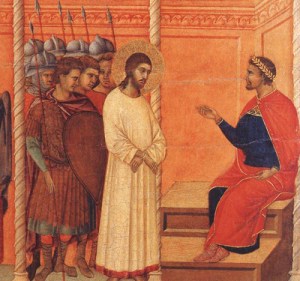
 1 As soon as morning came, the chief priests with the elders and the scribes, that is, the whole Sanhedrin, held a council. They bound Jesus, led him away, and handed him over to Pilate. 2 Pilate questioned him, “Are you the king of the Jews?” He said to him in reply, “You say so.” 3 The chief priests accused him of many things. 4 Again Pilate questioned him, “Have you no answer? See how many things they accuse you of.” 5 Jesus gave him no further answer, so that Pilate was amazed. 6 Now on the occasion of the feast he used to release to them one prisoner whom they requested. 7 A man called Barabbas was then in prison along with the rebels who had committed murder in a rebellion. 8 The crowd came forward and began to ask him to do for them as he was accustomed. 9 Pilate answered, “Do you want me to release to you the king of the Jews?” 10 For he knew that it was out of envy that the chief priests had handed him over. 11 But the chief priests stirred up the crowd to have him release Barabbas for them instead. 12 Pilate again said to them in reply, “Then what (do you want) me to do with (the man you call) the king of the Jews?” 13 They shouted again, “Crucify him.” 14 Pilate said to them, “Why? What evil has he done?” They only shouted the louder, “Crucify him.” 15 So Pilate, wishing to satisfy the crowd, released Barabbas to them and, after he had Jesus scourged, handed him over to be crucified. (Mark 15)
Continue reading →

 This year in the cycle of liturgical years we are primarily using the Gospel of Mark for our Sunday readings. But then this particular Gospel is the shortest of the four canonical texts and so it requires “a little help” to fill in the whole of the year – especially during the long stretch of Ordinary Time between Pentecost and Advent. This year, as per normal for Year B in the cycle of readings, the 17th through the 20th Sundays or Ordinary Time is from the Gospel of John. Continue reading



 friarmusings