Everything you need to know about life you can learn from backpacking and camping… Back in the day, I used to camp and backpack in Virginia and West Virginia. Generally it was just for a weekend – maybe two or three days. We would carry everything in/out. I remember having fun, enjoying it all, but I always felt like I need a day to recover. There was always a stiffness about my neck, arms, shoulders, upper back and all the rest that is connected to those parts. I could still feel the after effects of the pack’s burden. “Come to me, all you who labor and are burdened, and I will give you rest.” – There were treks when I would have been more than happy to let Jesus carry that burden. Continue reading
My yoke is easy: invitation
Jesus’ Invitation. The last three verses of the chapter contain many echoes of the invitation of Jesus Ben Sira (Sir 51:23–27; cf. also Sir 6:24–31) for men to come and learn from him and take up wisdom’s yoke, so that they may find rest. No doubt Jesus and his hearers knew and valued this book, but Jesus’ invitation reveals a higher authority: it is his own yoke that he offers, and he himself gives the rest which Ben Sira had to win by his ‘little labors’. Continue reading
My yoke is easy: commentary
Commentary. Despite the rejection in vv.20-24, some persons accept Jesus’ mission and message – and it is for this that he gives praise to God. In context these words are not a prayer of thanksgiving for a successful mission (cf. Lk 10:21-22), but are a prayerful reflection on the failure of the Galilean mission. The prayers highlight another Matthean theme: reversal. Those who are considered wise and learned are in fact not – at least in the things of the kingdom of heaven. Yet those who are childlike have understood and accepted the revelation of the kingdom in the person of Jesus Continue reading
My yoke is easy: context
Matthew 11:25–30 25 At that time Jesus said in reply, “I give praise to you, Father, Lord of heaven and earth, for although you have hidden these things from the wise and the learned you have revealed them to the childlike. 26 Yes, Father, such has been your gracious will. 27 All things have been handed over to me by my Father. No one knows the Son except the Father, and no one knows the Father except the Son and anyone to whom the Son wishes to reveal him. 28 “Come to me, all you who labor and are burdened, and I will give you rest. 29 Take my yoke upon you and learn from me, for I am meek and humble of heart; and you will find rest for your selves. 30 For my yoke is easy, and my burden light.” Continue reading
Yoked to Christ
This coming Sunday – the 14th Sunday of Ordinary Time – uses Matthew 11:25-30 which includes 29 Take my yoke upon you and learn from me, for I am meek and humble of heart; and you will find rest for your selves. 30 For my yoke is easy, and my burden light.” Because our parish is having a six-week course in church history, focusing of the Reformations, someone asked me today how this gospel speaks to predestination. It is not an easy question to address as it touches on one’s understanding of predestination, justification, sanctification, grace, free will, and more.
As it happens, the Church History “course” is coming up to the section on the Swiss Reformers wherein the topic “predestination” is raised by John Calvin and later reformers. I had prepared a primer – and I do mean a primer – on predestination as being discussed in the 16th century: Predestination, Election, Grace and Free Will. Here is the link in case it is of interest to you.
The house He is building
“…you are Peter, and upon this rock I will build my church” Let’s be honest, at first glance, Peter seems a bit shaky to be the one to lead Christ’s Church. Peter stumbled, fell, and he denied – and for good measure, denied a few more times. Peter did not always “get it;” he struggled to understand. And even when he did understand, there was often a slight hesitation— unsure what to do, some fear that he would get it wrong. A lot like you and me. “…you are John or Jane, Jack or Jill, and upon you I will build my family, my company, my hopes and dreams, ”
And then people made demands upon us and tasked us spiritually, emotionally, physically. Peter was someone who knew fatigue, knew failure, and reached that place where just like us he thought to himself: “give me a break; just give me an hour to myself…..” In those moments we do not feel like anyone’s “rock.” Continue reading
Saints Peter and Paul
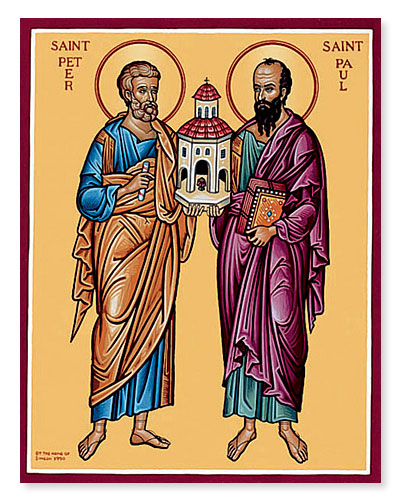
Most of the apostles and lots of saints have their own feast day, but how about the two most famous saints of the early church? There is February 22nd in which the Church celebrates the “Chair of Peter” the sign that Peter was the first among the apostles and the one designated to lead the early Church after Jesus’ Resurrection and Ascension. But there is no “Feast of St. Peter.”
St. Paul, although not one of the Twelve, was an Apostle commissioned by Jesus. There is the January 25th celebration of “The Conversion of St. Paul” which commemorates the Damascus Road episode described in Acts of the Apostles: 9:1-31, 22:1-22, and 26:9-24. It is the scene made famous by the “Conversion on the Way to Damascus” painting by Caravaggio. But there is no “Feast of St. Paul.” Continue reading
Differences and divisions
There is a fine line between differences and divisions. Think about our own families – the kids are different, unique and that what makes them remarkable and fascinating. In my family growing up, the middle child Patricia, very different from her older sister Kathy, and her favorite brother – that would be me – and the fact that I was the only brother is but a secondary detail. Patricia was always aware of the differences and, on occasion, would proclaim, “I am adopted.” On occasion we would agree, although she was a dead ringer for Grandma Kate at the same age. Those differences were part of what made us unique and what made us family. They never became divisions. Continue reading
Corpus Christi – its liturgical history
This weekend the Church celebrates the Solemnity of the Body and Blood of Christ, a feast perhaps better known by the Latin Corpus Christi. At its core, the solemnity is a celebration of the Tradition and belief in the Eucharist as the Real Presence of the Body and Blood of Jesus Christ. Many folks wonder why this celebration is not part of Holy Thursday, and it was, mixed in with other themes, e.g., institution of the priesthood. And, all this occurs in the shadow of Good Friday. The placement of the celebration is not one that necessarily lends itself to a joyful celebration.
Saint Juliana of Liège, O.Praem, was the one who became the spark leading to a joyous celebration of Corpus Christi. For her devotion, life, and efforts, she is known as the “Apostle of the Blessed Sacrament.” Liège was already a center for devotion to the Eucharist, so from her early youth, Juliana had great veneration for the Eucharist and longed for a special feast day in its honor. In 1208 at age 16, she began having visions of the moon in its full splendor, crossed diametrically by a dark stripe. In time, she came to understand that the moon symbolized the life of the Church on earth, the opaque line, on the other hand, represented the absence of a liturgical feast in honor of Christ’s Body and Blood. Not having any way to bring about such a feast, she kept her thoughts to herself, except for sharing them with Blessed Eve of Liège, who lived in a cell adjacent to the Basilica of St. Martin, and a few other trusted sisters in her monastery. The vision was repeated for the next 20 years, but she maintained it as a secret. When she eventually relayed it to her confessor, he relayed it to the Bishop of Liège, Robert de Thorete. Eventually, the celebration of Corpus Christi became part of the annual celebrations in the diocese.
The archdeacon of the diocese, Jacques Pantaléon of Troyes was also won over to the cause of the Feast of Corpus Christi during his time in the Diocese of Liège. He eventually became Pope Urban IV in 1264. He instituted the Solemnity of Corpus Christi on the Thursday after Pentecost as a feast for the entire Latin Rite, by the papal bull Transiturus de hoc mundo.

Corpus Christi – other thoughts
Where the principal focus of the previous section is the bread of life as the divine revelation given to men by and in Jesus, John 6:51 adds a clearly Eucharistic theme – ‘I am the living bread come down from heaven; whoever eats this bread will live forever; and the bread that I will give is my flesh for the life of the world.’ While some argue the words are metaphor, the Jews clearly understand. Jesus is referring to eating of his flesh. He recounts this action verb several other times between vv. 51-58, while adding the drinking of his blood to the command. This is no metaphor for accepting his revelation, already adequately expressed. Continue reading