
The Little Ones

42 And whoever gives only a cup of cold water to one of these little ones to drink because he is a disciple—amen, I say to you, he will surely not lose his reward.”

Jesus emphasizes the importance of even the smallest act of compassion by mentioning the offering of a cup of cold water. Water is essential for sustenance and refreshment, especially in a hot climate, and providing a cup of cold water to someone in need can alleviate their discomfort and signify care and concern. By using this example, Jesus highlights that even the most seemingly insignificant act of kindness can have profound significance in the eyes of God. Continue reading
Prophets and the Righteous

41 Whoever receives a prophet because he is a prophet will receive a prophet’s reward, and whoever receives a righteous man because he is righteous will receive a righteous man’s reward.

In this verse, Jesus outlines the significance and benefits of receiving and supporting individuals who are considered prophets and righteous men. The term “prophet” refers to someone who receives divine revelations and communicates God’s messages to the people. In 5:11-12, Jesus has already connected the disciples in their suffering and persecution to “the prophets who were before you.Continue reading

Receiving the one sent

The dialog shifts from a focus on the disciples on a mission, to those they encounter on the way. No doubt they have already met people along the way who enthusiastically greeted Jesus, and were willing to offer support and shelter to the disciples. They are perhaps not committed to the more rigorous demands of discipleship, but there is a positive attitude to the disciples and their mission. Jesus is happy to recognize this less committed level of following him as good and true, and which deserves and will receive its reward. Continue reading

Taking up the Cross

Jesus uses the expression “take up his cross” here and more famously in Mt 16:24: “Whoever wishes to come after me must deny himself, take up his cross, and follow me.” What is Matthew’s intent in using this expression? Undoubtedly writing some 40 years after the Crucifixion, it echoes the Roman execution methods broadly and the death of Jesus specifically. The cross, in this context, represents the suffering, rejection, and ultimately, the crucifixion that Jesus himself would endure. Taking up one’s cross, therefore, implies a willingness to bear the hardships and challenges associated with following Jesus, even if it leads to personal sacrifice or persecution. Continue reading

Divisions

The coming Sunday is the 13th Sunday of Ordinary Time in Liturgical Year A. As Jesus had warned in earlier passages, there will be divisions within families that will bring a believer to a choice: loyalty to Jesus or the family.

37 “Whoever loves father or mother more than me is not worthy of me, and whoever loves son or daughter more than me is not worthy of me;38 and whoever does not take up his cross and follow after me is not worthy of me.39 Whoever finds his life will lose it, and whoever loses his life for my sake will find it. Continue reading

True Family

The coming Sunday is the 13th Sunday of Ordinary Time in Liturgical Year A and continues to explore verses in the “Missionary Discourse” of Matthew’s gospel. Last week, in discussing the 12th Sunday passage (Mt 10:26-33) we noted that Jesus had sent the disciples on mission: we learn the names of the Twelve, hear of their commission (vv. 5-15), and, also, we hear warnings of the persecutions they will face (vv.16-25). It is after this warning that last week’s gospel, ominously opens with: “Therefore do not be afraid of them.” Yes, as Jesus warns, they will share in the life, mission, and suffering as will their Teacher. But, they are to trust the One who cares for the even smallest of creatures. The sparrows, which can be purchased for a pittance, are cared for by God (v.31) during their lifetime alive, but even their death is within the Creator’s care. All happens with “your Father’s knowledge” – and so the disciples are to trust. Continue reading

Absent from life

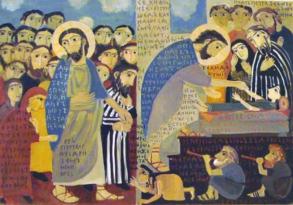
Mark-5-two-miraclesThe full gospel reading for Sunday (there is a shorter option) begins: “When Jesus had crossed again in the boat to the other side, a large crowd gathered around him, and he stayed close to the sea. One of the synagogue officials, named Jairus, came forward. Seeing him he fell at his feet and pleaded earnestly with him, saying, “My daughter is at the point of death. Please, come lay your hands on her that she may get well and live.” He went off with him, and a large crowd followed him and pressed upon him.” (Mark 5:21-24) – and then drops this story line, picking up the account of a woman on the way – a woman hemorrhaging for many years – and thus rendered ritually “unclean” because of the flow of blood. Although suffering, she was very much alive, but at the same time face a kind of death because of her isolation from family and society. Continue reading

The fullness of life

Mark-5-two-miraclesLast week (the 12th Sunday in Year B) we heard Mark’s account of Jesus on the stormy waters of the Sea of Galilee (Mark 4:35-41) during which Jesus calmed the seas with his word. This coming Sunday’s gospel moves into Chapter 5. The chapter begins with Jesus and the disciples returning to Jewish land as they again cross the Sea of Galilee. In Mark, the lake represents literally and figuratively the boundary between Gentiles and Jews.

The lectionary moves into additional miracle accounts while skipping the story of the Gerasene demoniac. Our gospel selection includes a miracle within a miracle. They are the final two miracles of the “miracle section” of Mark (4:35-5:43), which includes four miracles and reactions to the miracles:

  • Calming the storm at sea — the disciples still have no faith (Mk 4:34-41)
  • Casting a demon from a man and the subsequent desire of the locals that  Jesus leave town even as the healed man becomes a witness (Mk 5:1-20)
  • Raising Jairus’ daughter – “don’t be afraid, only believe” (Mk 5:21-24, 35-43)
  • Healing the hemorrhaging woman – her faith saved her (Mk 5:25-34)

Continue reading