
This coming Sunday is the 18th Sunday in Ordinary Time. 32 So Jesus said to them, “Amen, amen, I say to you, it was not Moses who gave the bread from heaven; my Father gives you the true bread from heaven. 33 For the bread of God is that which comes down from heaven and gives life to the world.” 34 So they said to him, “Sir, give us this bread always.” 35 Jesus said to them, “I am the bread of life; whoever comes to me will never hunger, and whoever believes in me will never thirst. Continue reading
Tag Archives: Bread of Life Discourse
The Challenge
This coming Sunday is the 18th Sunday in Ordinary Time. 30 So they said to him, “What sign can you do, that we may see and believe in you? What can you do? 31 Our ancestors ate manna in the desert, as it is written: ‘He gave them bread from heaven to eat.’” Continue reading
For What Are You Working?
This coming Sunday is the 18th Sunday in Ordinary Time. 27 Do not work for food that perishes but for the food that endures for eternal life, which the Son of Man will give you. For on him the Father, God, has set his seal.” 28 So they said to him, “What can we do to accomplish the works of God?” 29 Jesus answered and said to them, “This is the work of God, that you believe in the one he sent.” Continue reading
Why Are You Looking?
This coming Sunday is the 18th Sunday in Ordinary Time. 24 When the crowd saw that neither Jesus nor his disciples were there, they themselves got into boats and came to Capernaum looking for Jesus. 25 And when they found him across the sea they said to him, “Rabbi, when did you get here?” 26 Jesus answered them and said, “Amen, amen, I say to you, you are looking for me not because you saw signs but because you ate the loaves and were filled. Continue reading
Walking on Water and Transition
This coming Sunday is the 18th Sunday in Ordinary Time. As noted previously, the episode in 6:16–24 when Jesus walks on the water, is missing from the summer Sunday sequence of readings. It is striking that John’s sequence — the loaves miracle followed by that on the Sea of Galilee — is identical to that of Mark 6:34–51 and Matthew 14:13–33. In all three accounts Jesus calms his disciples with the identical majestic phrase: “It is I. Do not be afraid” (John 6:20; Mark 6:50; Matt 14:27). This phrasing, which in the Greek has no predicate, simply reads egō eimi = I am, has strong overtones of divinity, echoing the name for Yahweh found in Isa 43:10, 13, 25. Jesus is the divine presence; the disciples need have no fear. Continue reading
Parallel Cycles in John
This coming Sunday is the 18th Sunday in Ordinary Time for Year B of our lectionary cycle. We had been following the Gospel of Mark’s narrative sequence of the life and ministry of Jesus. Starting last Sunday (17th Sunday of Ordinary Time), and continuing this and the following three Sundays, we hear the Bread of Life Discourse (John 6). Let us consider some context for what St. John describes. Continue reading
Metaphor? Sacramental?
Is the Bread of Life Discourse (John 6), metaphor or sacramental? There are many commentaries and religious traditions that insist on a metaphorical interpretation of “eat” and “drink” and thus “eat” and “drink” as metaphors for belief. There are some Catholic commentators (e.g. LaGrange) who insist there is no metaphor, that the entirety of Jesus’ discourse is sacramental/Eucharistic. As Fr. Raymond Brown and Fr. Francis Moloney point out, the truly Catholic position is “both-and.” What begins in John 6:22-50 as metaphor for belief, is ultimately answered in John 6:51-58 as Eucharist. With that in mind let us consider (a) a “big picture” view of this core question of John 6, but (b) fair warning: it does get a bit technical and dense in places. But give it a go!! Continue reading
Comes down from heaven
Wrapping up our look into the gospel for the 18th Sunday of Ordinary Time….
32 So Jesus said to them, “Amen, amen, I say to you, it was not Moses who gave the bread from heaven; my Father gives you the true bread from heaven. 33 For the bread of God is that which comes down from heaven and gives life to the world.” 34 So they said to him, “Sir, give us this bread always.” 35 Jesus said to them, “I am the bread of life; whoever comes to me will never hunger, and whoever believes in me will never thirst.
At verses 12 and 27 (gathering the fragments after feeding the crowd and referencing perishable food), Jesus implicitly linked the feeding miracle with the manna story of Exodus 16. In v.32, he does so explicitly. For the second time in this chapter Jesus prefaces his remarks with the solemn, Amen, amen, I say to you. Continue reading
The challenge
Continuing our look into the gospel for the 18th Sunday of Ordinary Time….
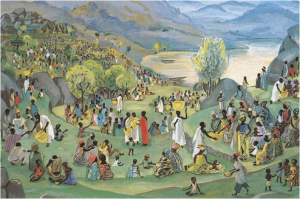
30 So they said to him, “What sign can you do, that we may see and believe in you? What can you do? 31 Our ancestors ate manna in the desert, as it is written: ‘He gave them bread from heaven to eat.’”
Throughout vv. 27–31, Jesus and the crowd use the same words but with very different meanings, another instance of the Johannine literary technique of misunderstanding. The crowd’s questions in v. 30 repeat key words from vv. 26–29: “sign” (sēmeion, v. 26), “do” (poieō, v. 28), “see” (eidete, v. 26, idōmen, v. 30), “believe” (pisteuō, v. 29), “work” (ergazomai, vv. 27–28). They shift the burden of who is to work from themselves (vv. 27–29) to Jesus (v. 30). The crowd’s questions imply a contingency: They will do God’s work only if Jesus does God’s work first and performs a sign. Continue reading
For what are you working?
Continuing our look into the gospel for the 18th Sunday of Ordinary Time….
27 Do not work for food that perishes but for the food that endures for eternal life, which the Son of Man will give you. For on him the Father, God, has set his seal.” 28 So they said to him, “What can we do to accomplish the works of God?” 29 Jesus answered and said to them, “This is the work of God, that you believe in the one he sent.” Continue reading