
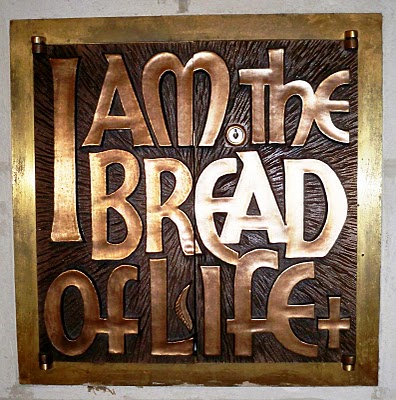
The bread come down: losing nothing

bread-of-life-tabernacleA Missing Piece. The sequence of Sunday gospels does leave out vv. 35-41. The text from the 18th Sunday centers around Jesus challenging the people’s motivation for coming to Jesus. He tells them they only came to see more signs, eat their fill, but not really “work” for the bread that is eternal. The people not only do not understand Jesus’ point, but become bogged down in “what do I have to do to get it” as though they could accomplish this on their own talents and perseverance. Jesus response is that all one need do is believe – and the conversation returns to “show us another sign” and they up the ante – “and make it better than the one Moses did in the desert.” Dodd notes that “The ‘signs’ which the people expect from the Messiah are mere miracles; yet when they see a miracle they fail to see the ‘sign’; for to the evangelist a σημεῖον is not, in essence, a miraculous act, but a significant act, one which, for the seeing eye and the understanding mind, symbolizes eternal realities.” It is at this juncture that returns to the theme of “bread from heaven” only not the one, like the manna in the desert that will spoil, but one that last forever. Continue reading

The bread come down: context

bread-of-life-tabernacle41 The Jews murmured about him because he said, “I am the bread that came down from heaven,” 42 and they said, “Is this not Jesus, the son of Joseph? Do we not know his father and mother? Then how can he say, ‘I have come down from heaven’?” 43 Jesus answered and said to them, “Stop murmuring among yourselves. 44 No one can come to me unless the Father who sent me draw him, and I will raise him on the last day. 45 It is written in the prophets: ‘They shall all be taught by God.’ Everyone who listens to my Father and learns from him comes to me. 46 Not that anyone has seen the Father except the one who is from God; he has seen the Father. 47 Amen, amen, I say to you, whoever believes has eternal life. 48 I am the bread of life. 49 Your ancestors ate the manna in the desert, but they died; 50 this is the bread that comes down from heaven so that one may eat it and not die. 51 I am the living bread that came down from heaven; whoever eats this bread will live forever; and the bread that I will give is my flesh for the life of the world.” (John 6:41-51) Continue reading

…that you believe: living bread

Bread-of-Life-John-6Comes Down from Heaven. 32 So Jesus said to them, “Amen, amen, I say to you, it was not Moses who gave the bread from heaven; my Father gives you the true bread from heaven. 33 For the bread of God is that which comes down from heaven and gives life to the world.” 34 So they said to him, “Sir, give us this bread always.” 35 Jesus said to them, “I am the bread of life; whoever comes to me will never hunger, and whoever believes in me will never thirst.

At vv.12 and 27 (gathering the fragments after feeding the crowd and referencing perishable food), Jesus implicitly linked the feeding miracle with the manna story of Exodus 16. In v.32, he does so explicitly. For the second time in this chapter Jesus prefaces his remarks with the solemn, Amen, amen, I say to you. Jesus reworks four essential elements of v. 31: Continue reading

…that you believe: challenge

Bread-of-Life-John-6The Challenge.30 So they said to him, “What sign can you do, that we may see and believe in you? What can you do? 31 Our ancestors ate manna in the desert, as it is written: ‘He gave them bread from heaven to eat.’”

Throughout vv. 27–31, Jesus and the crowd use the same words but with very different meanings, another instance of the Johannine literary technique of misunderstanding. The crowd’s questions in v. 30 repeat key words from vv. 26–29: “sign” (sēmeion, v. 26), “do” (poieō, v. 28), “see” (eidete, v. 26, idōmen, v. 30), “believe” (pisteuō, v. 29), “work” (ergazomai, vv. 27–28). They shift the burden of who is to work from themselves (vv. 27–29) to Jesus (v. 30). The crowd’s questions imply a contingency: They will do God’s work only if Jesus does God’s work first and performs a sign. Continue reading

…that you believe: working

Bread-of-Life-John-6For What Are You Working? 27 Do not work for food that perishes but for the food that endures for eternal life, which the Son of Man will give you. For on him the Father, God, has set his seal.” 28 So they said to him, “What can we do to accomplish the works of God?” 29 Jesus answered and said to them, “This is the work of God, that you believe in the one he sent.”

A modern reader might be more prone to take the beginning part of v.27 for exactly what it implies: don’t work; it will be given to you – the implication being, given as a gift – and more than that the given (Jesus) has been ordained/sealed for this purpose. But then the one who are hearing these words receive them in a difference context. These are working people for whom there is family and tradition – these are gifts – everything else is earned. The crowd gives “work” (ergazomai) a new meaning. Jesus’ admonition about laboring to receive a gift of imperishable food is transformed by the crowd into a question about their performance of works. The grace in Jesus’ words disappears. Continue reading

…that you believe: looking

Bread-of-Life-John-6Why Are You Looking? 24 When the crowd saw that neither Jesus nor his disciples were there, they themselves got into boats and came to Capernaum looking for Jesus. 25 And when they found him across the sea they said to him, “Rabbi, when did you get here?” 26 Jesus answered them and said, “Amen, amen, I say to you, you are looking for me not because you saw signs but because you ate the loaves and were filled.

The implication of the narrative is the crowd who finally caught up with Jesus in Capernaum could not have known about the miraculous events (vv.16-21) of the evening nor would they have had an opportunity to react to the ego emini statement – to even ponder, “Who is this that calms the sea.” Their last encounter with Jesus was at the miraculous feeding of the 5,000 and their desire then was to take Jesus by force and make him kind. It is at this point Jesus withdrew from them as the people wanted to remake the Messiah in their own conception. Jesus would not allow that; perhaps Jesus does not want to be found by the crowd “looking for Jesus.Continue reading

…that you believe: context

Bread-of-Life-John-624 When the crowd saw that neither Jesus nor his disciples were there, they themselves got into boats and came to Capernaum looking for Jesus. 25 And when they found him across the sea they said to him, “Rabbi, when did you get here?” 26 Jesus answered them and said, “Amen, amen, I say to you, you are looking for me not because you saw signs but because you ate the loaves and were filled. 27 Do not work for food that perishes but for the food that endures for eternal life, which the Son of Man will give you. For on him the Father, God, has set his seal.” 28 So they said to him, “What can we do to accomplish the works of God?” 29 Jesus answered and said to them, “This is the work of God, that you believe in the one he sent.” 30 So they said to him, “What sign can you do, that we may see and believe in you? What can you do? 31 Our ancestors ate manna in the desert, as it is written: ‘He gave them bread from heaven to eat.’” 32 So Jesus said to them, “Amen, amen, I say to you, it was not Moses who gave the bread from heaven; my Father gives you the true bread from heaven. 33 For the bread of God is that which comes down from heaven and gives life to the world.” 34 So they said to him, “Sir, give us this bread always.” 35 Jesus said to them, “I am the bread of life; whoever comes to me will never hunger, and whoever believes in me will never thirst. (John 6:24-35) Continue reading

Knowing Jesus: reflection

John 6+crowd+feedingAs noted in the Context section, our verses are followed by the Johannine account of Jesus walking on the water and calming the seas (John 6:16-21). Whereas the miraculous feeding miracle was performed before the crowds, this miracle is with the disciples alone. It is with that context that I offer Gail O’Day’s reflection [597-98]. Continue reading

Knowing Jesus: miracle

John 6+crowd+feedingThe Miracle. 10 Jesus said, “Have the people recline.” Now there was a great deal of grass in that place. So the men reclined, about five thousand in number. 11 Then Jesus took the loaves, gave thanks, and distributed them to those who were reclining, and also as much of the fish as they wanted.

One should note that the account indicates there are 5,000 men – so if one assumes women and children present, not an unwarranted assumption, then are a great deal more than 5,000 people present. Continue reading

Knowing Jesus: quiz

John 6+crowd+feedingBefore the Miracle. 5 When Jesus raised his eyes and saw that a large crowd was coming to him, he said to Philip, “Where can we buy enough food for them to eat?” 6 He said this to test him, because he himself knew what he was going to do. 7 Philip answered him, “Two hundred days’ wages worth of food would not be enough for each of them to have a little (bit).” 8 One of his disciples, Andrew, the brother of Simon Peter, said to him, 9 “There is a boy here who has five barley loaves and two fish; but what good are these for so many?”

The miracle is initiated by Jesus. Just as Jesus initiated contact with the Samaritan woman (4:9) and initiated the healing of the man by the pool (5:6), so also here he anticipates the hunger of the crowd. His question, “Where can we buy enough food?” is a different question from “How can we provide enough food?” Continue reading