 11 As he continued his journey to Jerusalem, he traveled through Samaria and Galilee. 12 As he was entering a village, ten lepers met (him). They stood at a distance from him 13 and raised their voice, saying, “Jesus, Master! Have pity on us!” 14 And when he saw them, he said, “Go show yourselves to the priests.” As they were going they were cleansed. 15 And one of them, realizing he had been healed, returned, glorifying God in a loud voice; 16 and he fell at the feet of Jesus and thanked him. He was a Samaritan. 17 Jesus said in reply, “Ten were cleansed, were they not? Where are the other nine? 18 Has none but this foreigner returned to give thanks to God?” 19 Then he said to him, “Stand up and go; your faith has saved you.”
“Stand up and go; your faith has saved [sozo] you” (v.19). Such are the words spoken to the Samaritan leper, the only one who returned and gave thanks to Jesus. sozo has as a basic meaning, “to rescue from danger and to restore to a former state of safety and well being.” Thus it is translated with words like “save,” “heal,” “make whole,” depending upon how the danger is understood. How are we to understand the use of sozo here in this verse? Continue reading →

 There are weeks that are so marvelous that you want to relive them, hold them and keep them ever safe. I hope your summer had one of those weeks. A family reunion, a vacation, a solar eclipse in totality, evenings at the coast watching sunsets, the week when the all-grown-up kids were home, time with the grandchildren – a week that was by any measure, “a keeper.” Continue reading
 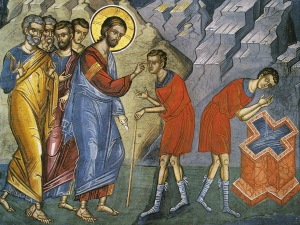 Being Lead to Decision: Faith or Disbelief. Where the authorities drive the man away (v.34), here Jesus finds the man (cf. 6:37) and asks: “Do you believe in the Son of Man?” Just as the Samaritan woman was confronted by Jesus with the possibility of the anticipated Messiah’s being already present (4:25-26), so also the healed man is confronted by Jesus with the possibility that the future judge is already present. To this point in John 9, the theme of the judgment evoked by the light of the world (9:5; cf. 3:17-21; 12:31-36) has largely been implicit. Jesus’ question makes this theme explicit as he asks the man whether he recognizes in his healer the one who brings of salvation. As v.36 indicates, the man is ready.
  Catholics, in general, are reluctant to talk about their faith in the presence of others. Why? It is easy to talk about church issues and controversies or moral values but not about our relationship with Christ or about how we recognize God’s action in our lives. It seems socially ungracious to “talk religion” around the water cooler or on the golf course or at the swimming pool. Maybe some Catholics have grown up without clear knowledge of their beliefs, and therefore, feel inadequate to explain or defend the faith. Others may feel that religion is a private matter.
 friarmusings