
As Christians, we live in the times between the great polls of our faith: the coming of Jesus in this world as the Christ child, the one who would secure our redemption by the cross and resurrection. And the other pole, the coming of Jesus as Lord of lords and King of kings to have dominion over all of heaven and earth. We live in the times between; times that are as normal as can be and times that are turmoil and chaos. And there are moments when we live in but a small segment of this universe. It is the betwixt-and-between times when there are moments we wish the world would end and there are moments that seems to be spinning out of control and we wish everything would just stay the same.
The in between times are filled with stories of families. With winter’s approach there will soon be a story in the paper about a family huddled around the gas kitchen stove on a winter’s eve because the electricity bill is unpaid and power is cut off. We already have stories of refugee families huddled in the mountains of Syria, seeking warmth against a biting wind, seeking to escape the wrath of ISIS. Somewhere there is a family huddled in the ER waiting room; their oldest child in an automobile accident, the surgeons coming to say, “We’re doing all we can.” Maybe it’s a love one huddled with their oncologist looking at the x-ray that shows those spots on the lungs that have return after years of remission. These are the moments you wish the world would end, at least the world as you now know it.
The in-between times are also filled with stories of the world that seems to be off kilter. After the attacks in Paris we are cautious, perhaps fearful to be in crowds. Did you see the incredible security at the Macy’s day parade and increased security at the malls. And as a nation we are now cautious about admitting Syrian refugees to our country; the very people seeking a new home, new beginning, freedom from the horrors of their homeland. We fear terror will slip in alongside them. Violence in our city streets and cyber insecurity are coercing us to consider forgoing our civil rights. These can be the moment you wish the world would stop remain the world as you know it.
These are the in between times. These are the times between the Christ child’s coming and the King who will return. Times that we are called to live in hope. To live in hope, because we know how the story ends. The ending has been written by the resurrected Christ. And yet we still fear, we know trepidation, and there is hesitation, avoidance, and the desire that it all just goes away. And so we wait.
Advent is the season of waiting. Yet is the season when our readings are filled with signs that will leave the world and dismay, perplexed, feeling trapped, and perhaps hopeless. Like the apostles, we want to know when all these things will happen. But the gospel message is different. If you listen closely to all the readings today, the message is “how will we live in the meantime? How we live in a time given us?” How will we live in the time given us?
Now that school has started again, I will take time to catch the final movie in the Hunger Games series. In case you are not familiar with the storyline, it takes place in a future in a land called Panem. Year ago the districts rebelled against the capital – and they lost. The ensuring 75 years have been ones of forced servitude, a police state, and minimum survival in the districts, while the capital basks in luxury and licentiousness. To remind the districts of their servitude, one a year the capital host the “Hunger Games.” It is a futuristic version of the gladiator games. Two people from each district compete. Among the 24 warriors, there is only one survivor.
The questions that looms over the people of the districts is how will they live the time given the. Katniss Everdeen lived her own life in District 12 until she is thrown into a larger world as a contestant in the games. In her first games the only goal is to survive. Which she does. What she wants most is to return to the world she knows, a world in which she knows the rules. She wants things to just return the way they were. She chooses to live the time given her as she had before.
But the manner of her victory in the games has given people in all the districts hope. As the President of Pane, Coriolanus Snow, notes, “Too much hope can be a dangerous thing.” Life chooses for her, she now lives a life in fear of the retribution by President Snow. She chooses to live in fear for her family, for the district, for herself. She lives without hope that things will change or improve. She fears that things will ever be the same. She fears the odds will never be in her favor.
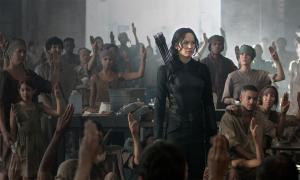 Buried in today’s Gospel, there is a simple line that answers the question how we are to live in the meantime. It says stand up and raise your heads because your redemption is at hand. Over the course of the hunger games trilogy, that is what Katniss does. Sometimes reluctantly, sometimes heroically. She becomes the sign of hope for all the world to see in the simple gesture of hands raised in silence.
In time, Katniss chooses to live in the way that brings hope. She lives in a way that brings the light of hope into a world fraught with fear. She does not bring just a little hope, measured out and rationed. She comes to understand that without hope or too little hope, the world ends in a whimper or stay stuck huddled around a gas stove, huddled in the mountains of Syria, or forever in the emergency waiting room. Her extraordinary choices unleash waves of hope and begin to change the world.
We are called to bring, not just a little hope, but hope that is a writ large because of the life Christ. The kind of hope that create something new wherever it is sown. It is hope that fuels change in our lives, our homes, our parish, our communities and, our world. Change can be hard. But whatever hardships or limitations we may now endure, hope rooted in Christ creates face and a better future and leads one to act, to do something to bring about that better future.
Without hope life simply gets increasingly more difficult. With hope you can do extraordinary things because the future is not only open but also promised. It is a future fueled by the promise of Christ. It is a future that echoes with a refrain we will hear again and again during Advent and Christmas: be not afraid.
- A young girl named Mary will be not afraid and say, “be done unto me according to your word.”
- A man named Joseph will be not afraid and take Mary is his wife.
- Shepherds on a hillside will fear not and go to Bethlehem to see what has been promised and hope for.
- The refugee family will walk the length and breadth of the globe to see what has been promised and hoped for.
We say that Advent is a time of waiting. I am not sure that is fully correct. Advent is a time of Hope, time to risk extraordinary things, time to be not afraid. The time to stand up and raise our heads because our redemption is at hand. A season to be intentional about the time given us.
What extraordinary thing you this Advent because of the promises of Christ? Maybe no one in the world will know but you. Maybe the only person who will know is the one you reached out to. Maybe the whole world will hear about your extraordinary acts. Whatever the scope and scale, it is one act of hope that opens up a whole new world. One act that is fuel for change, fuel for goodness, all fueled by the promise of Christ.
This is Advent. Fear not. Stand up and raise you head, your redemption is near.
How will you use the time given you?

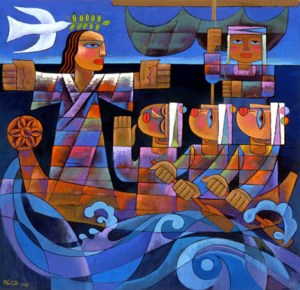 This gospel is pretty well-known. Here at Sacred Heart we have an entire stained-glass window depicting the scene. Every children’s bible story book seems to have the story with all manner of illustrations. There is a lot you can do with this simple gospel account. In my day, I have heard sermons that encourage us to “go outside the box” by asking us to be like Peter and be bold enough to “get out of the boat.” The message was to take risks as individuals of faith or perhaps as a parish. Other sermons have told us to “keep our eyes on Jesus” in all that we do – good advice – with the message often an invitation to a particular piety and devotion – also good advice. And there is something to said about the boat itself. It is a place of relative calm among the waves. It is the place where Jesus leads Peter. It is the place where the community, as the gospel says, “did him homage, saying, ‘Truly, you are the Son of God.’” There is a lot you can preach about, inspired by this gospel.
 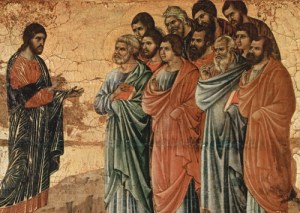 30 Even all the hairs of your head are counted.31So do not be afraid; you are worth more than many sparrows.
  friarmusings