 Luke 19:1-10. 1 He came to Jericho and intended to pass through the town. 2 Now a man there named Zacchaeus, who was a chief tax collector and also a wealthy man, 3 was seeking to see who Jesus was; but he could not see him because of the crowd, for he was short in stature. 4 So he ran ahead and climbed a sycamore tree in order to see Jesus, who was about to pass that way. 5 When he reached the place, Jesus looked up and said to him, “Zacchaeus, come down quickly, for today I must stay at your house.” 6 And he came down quickly and received him with joy. 7 When they all saw this, they began to grumble, saying, “He has gone to stay at the house of a sinner.” 8 But Zacchaeus stood there and said to the Lord, “Behold, half of my possessions, Lord, I shall give to the poor, and if I have extorted anything from anyone I shall repay it four times over.” 9 And Jesus said to him, “Today salvation has come to this house because this man too is a descendant of Abraham. 10 For the Son of Man has come to seek and to save what was lost.”
Context. A long section of the Gospel of Luke is passed over as we move from the 30th to the 31st Sunday in Ordinary Time, Year C:
- 18:15-17 The Little Children
- 18:18-25 The Rich Ruler
- 18:26-30 The Demands of Discipleship
- 18:31-34 The Third Passion Prediction
- 18:35-43 The Blind Beggar
For many weeks the Sunday gospels have been accounts are that are unique to Luke. At the beginning of his narrative of the journey to Jerusalem (9:51), Luke departed from the outline of Mark and began introducing material from sources either personal or common to Matthew and himself. At this point Luke begins to follow Mark again. The paragraphs below provide a very brief description of these passages: Continue reading →

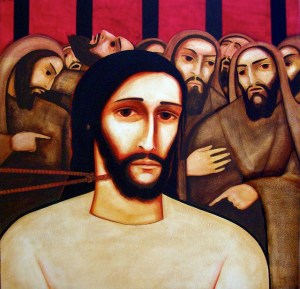 Up to this point in the narrative the chief priests, scribes, and leaders have been the ones who have been active throughout the arrest, hearing and trials of Jesus. While in the privacy of the Sanhedrin gathering, the charges brought against Jesus by this group were religious. Once the assembly moved to the public forum involving Pilate, the charges became secular – “misleading our people; he opposes the payment of taxes to Caesar and maintains that he is the Messiah, a king.” (23:2) In the start of this section, “the people” are now present. Previously the people have supported Jesus (cf. 19:47-48, 20:1, 20:6, 20:19, 21:38) – what will they do now? Continue reading
  The arrest of Jesus leads into three successive and connected scenes: Peter’s denial (vv. 54-62), the mocking of Jesus (vv. 63-65), and the trial before the religious authorities (vv. 66-71). What is interesting is that in the midst of the Passion narrative of Jesus, there is the scene in all four gospels that concentrate on Peter and his response. Luke’s account is unique in the following respects: sequence – in that the denials occur in the courtyard before the mocking and interrogation; structure – Luke does not connect the denial as a caused by the trial; and detail – such as the servant girl sitting at the fireside where there is light to clearly recognize Peter – and most vividly, it is Luke that reports Jesus looked Peter “dead in the eye,” bringing the full gravitas of the denials to Peter.
  Of course we all know that after the meal with his disciples that Jesus went to the Garden of Gethsemane. Actually, no gospel says that. Matthew and Mark wrote that he went to a garden. John says he went to Gethsemane. Fuse them all together and you get the “Garden of Gethsemane.” What does Luke say? Luke only calls it “the place.” There is no garden specifically mentioned nor is Gethsemane. Is it important? Well, it is a reminder to be attentive to the text before you and not meld the familiar stories and scenes from other sacred writers. Each sacred writer has something distinctive that can be missed if one fuses all the details from other accounts.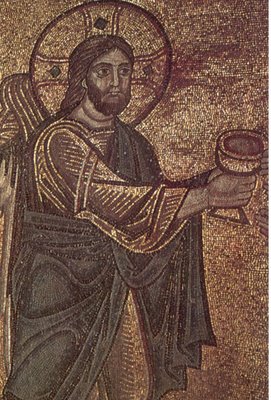
 Introduction to The Lucan Passion Narrative: The passion narratives provide the climax for each of the four gospels, catching up themes that weave their way through the evangelists’ entire portrayal of Jesus life and bringing them to a dramatic completion. In deft strokes the evangelists tell us of the final hours of Jesus’ life – his last meal with his disciples; his arrest in Gethsemane; his interrogation by the religious leaders; the trial before Pilate; and finally the heart clutching scenes of Jesus’ crucifixion, death and burial.


 friarmusings