Journey On

The gospel for today includes the well known passage from John 3:16, “For God so loved the world that he gave his only Son.” It also includes a perhaps not as well known passage: “And just as Moses lifted up the serpent in the desert, so must the Son of Man be lifted up” I think folks quickly get “Son of Man…lifted up” as a reference to Jesus’ crucifixion and death on Good Friday. But the part, “And just as Moses lifted up the serpent in the desert…” is perhaps unfamiliar and is easy to get lost in the fame of John 3:16.

The first reading today is from The Book of Numbers, the fourth book of the Old Testament. Numbers is the title of the book in English, but the Hebrew title is Bemiḏbar, “in the wilderness” which is a better description as the whole book recounts a large part of the 40 years in the wilderness between Israel’s enslavement in Egypt and reaching the Promised Land. It has not been an easy journey and the people have complained about… well, about everything. It is an ongoing litany of “what have you done for us lately.” The people even go so far as to complain to Moses:  “Why have you brought us up from Egypt to die in the wilderness, where there is no food or water? We are disgusted with this wretched food!” These are not happy campers on this wilderness trek.

Continue reading
God so loved the world…

For God so loved the world that he gave his only Son, so that everyone who believes in him might not perish but might have eternal life. 

Verse 16 provides the link between the two parts of the discourse. It sums up vv. 14-15 by reiterating the salvific dimensions of Jesus’ death, but moves the argument forward with its reference to God’s love. God gave Jesus to the world because God loves the world.

The verb translated “give” (didōmi) is regularly used in the Fourth Gospel to describe God as the source of what Jesus offers the world (3:35; 5:22, 26, 36). John 3:16 is the only place in the Fourth Gospel that says God “gave” his Son to the world; the more common expression is that God “sent” Jesus, as in 3:17. (Two Greek verbs meaning “to send” [pempō and apostellō are used interchangeably see 3:17; 4:34; 5:23-24, 30, 36-37; 6:38.) “send” Jesus is more clearly associated with will for the world, whereas didōmi seems to be used in 3:16 to underscore that the incarnation derives from God’s love for the world as well as from God’s will.

Continue reading

God so loved the world

Next Sunday is the celebration of the Solemnity of the Most Holy Trinity. You can read a complete commentary on the Gospel here.

Holy Trinity Sunday is celebrated on the first Sunday following Pentecost in most of the liturgical churches in Western Christianity. It is a solemn celebration of the belief in the revelation of one God, yet three divine persons. Yet, It was not uniquely celebrated in the early church! Continue reading

Something wonderful

“Something wicked this way comes.” I have always thought that this phrase is elegant – alarming and scary for sure, but elegant nonetheless. Compare it to “Here comes something wicked” or any other more mundane turn of the phrase. The line is original to Macbeth: “By the pricking of my thumbs, something wicked this way comes”, spoken by by the witches (Act 4, Scene 1). The line is a very striking piece of verse, not only because of it phrasing, but also because of its ominous announcement of an approaching evil, some monster coming into the moment. In its hearing Macbeth has no idea that he is the monster that is coming, or rather becoming. Continue reading
Everyone who believes: given

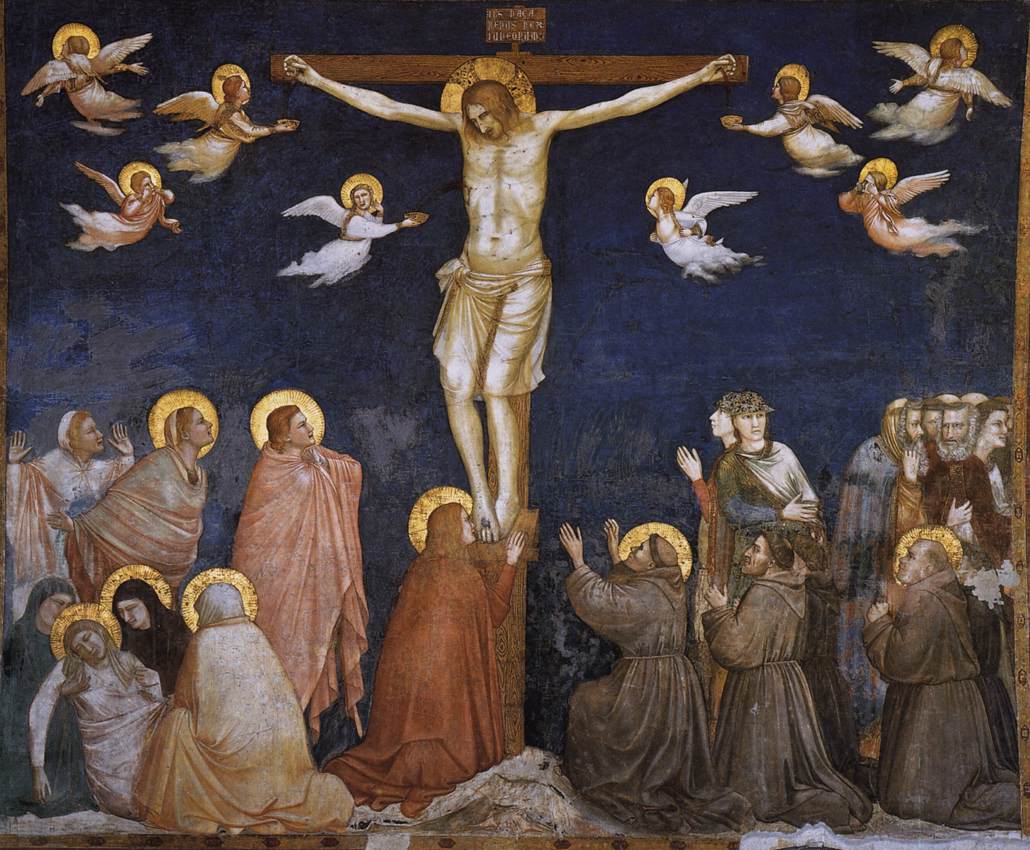
Giotto_Lower_Church_Assisi_Crucifixion_01Given. For God so loved the world that he gave his only Son, so that everyone who believes in him might not perish but might have eternal life. Verse 16 provides the link between the two parts of the discourse. It sums up vv. 14-15 by reiterating the salvific dimensions of Jesus’ death, but moves the argument forward with its reference to God’s love. God gave Jesus to the world because God loves the world. Continue reading

Trinity Sunday: God so loved the world

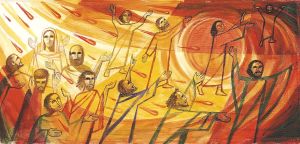
Syuzanna Avetisyan - somewhere on Google+God so loved the world… For God so loved the world that he gave his only Son, so that everyone who believes in him might not perish but might have eternal life. Verse 16 provides the link between the two parts of the discourse. It sums up vv. 14-15 by reiterating the salvific dimensions of Jesus’ death, but moves the argument forward with its reference to God’s love. God gave Jesus to the world because God loves the world. Continue reading

Like it or not

God so loved1John 3:16 – “For God so loved the world that he gave his only Son” It is perhaps the best known bible verse here in the United States. It appears on signs held up in crowd shots at major sporting events, it appeared in the midst of Tim Tebow’s eye black at a college national championship game, and it appears on bumper stickers. It’s everyone’s favorite Bible verse. But… I’ve wondered whether, if people thought about what this verse says for just a little longer than it takes to read a bumper sticker, it might just prove to be far less comforting and far more troubling. Continue reading

Whoever believes: given

Giotto_Lower_Church_Assisi_Crucifixion_01Given. For God so loved the world that he gave his only Son, so that everyone who believes in him might not perish but might have eternal life. Verse 16 provides the link between the two parts of the discourse. It sums up vv. 14-15 by reiterating the salvific dimensions of Jesus’ death, but moves the argument forward with its reference to God’s love. God gave Jesus to the world because God loves the world. Continue reading

Trinity Sunday: God so loved the world

Syuzanna Avetisyan  - somewhere on Google+God so loved the world… For God so loved the world that he gave his only Son, so that everyone who believes in him might not perish but might have eternal life. Verse 16 provides the link between the two parts of the discourse. It sums up vv. 14-15 by reiterating the salvific dimensions of Jesus’ death, but moves the argument forward with its reference to God’s love. God gave Jesus to the world because God loves the world. Continue reading