Today’s first reading is from one of my favorite books: The Book of Jonah. The book is only four chapters long and we are in Chapter 3. The whole Jonah and the “whale” has already happened, Jonah has traveled to Nineveh as a very reluctant prophet. Frankly Jonah hopes that God calls down a rain of fire, death, doom and destruction upon the king, the people, and all the animals. His entire call to conversion is five words in Hebrew. We get a few more in English, but not many: “Forty days more and Nineveh shall be destroyed.” Jonah does not say who will destroy them or why or in any way amplify the bottom line.
“When God saw by their actions how they turned from their evil way, he repented of the evil that he had threatened to do to them; he did not carry it out.” (Jonah 3:10) Great! The Ninevites repented, God relented, and Jonah’s prophetic mission is complete. But poor Jonah, it’s not the result he wanted. Chapter 4 is a long description of Jonah pouting about this turn of events.
But such are the turn of events when the Holy Spirit comes in ways you’d never expect.
It happens all the time to every homilist if we are honest. Sometimes I sit and wonder from whence came the idea for a particular homily. But mostly I am surprised after the homily.
A person comes up to say, “Thank you, Father, your homily really touched me. It was just what I needed to hear.” Often I will ask them what moved their hearts. The reply is often not the point of the homily, but there was one word, one phrase upon which the Holy Spirit descended and turned into a seed which will bear great fruit in the life of the listener.
But such are the turn of events when the Holy Spirit comes in ways you’d never expect.
Enthusiastic or reluctant, gifted or timid, … whatever… speak into the waiting world. The Spirit can take over from that point.

 The “sign of Jonah” is mentioned three times in the Gospels, twice in Matthew (12:38-41; 16:4) and once in Luke (11:29-32) – as well as indirectly perhaps in Mark 8:12 (“Why does this generation seek a sign? Amen, I say to you, no sign will be given to this generation.”). A comparison of the two gospels is perhaps of interest:
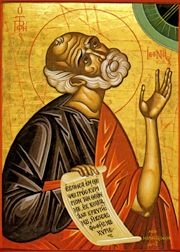 “10 When God saw by their actions how they turned from their evil way, he repented of the evil that he had threatened to do to them; he did not carry it out.” (Jonah 3:10) Great! The Ninevites repented, God relented, and Jonah’s prophetic mission is complete. As mentioned, that would have been an “they all lived happily ever after” ending. But there is another chapter in the story whose first verse gives us an idea that the story’s ending is anything but happy.
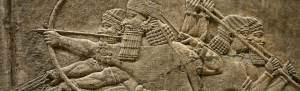 “Forty days more and Nineveh shall be destroyed.” (Jonah 3:4) I think it noteworthy that Jonah does not announce the reason for the destruction or by whose hand, what the Ninevites can do to avert disaster, only that there is a set time of 40 days. What was the reaction of the Ninevites to Jonah’s proclamation? “When the people of Nineveh believed God; they proclaimed a fast and all of them, great and small, put on sackcloth.” (v.5) It does not seem as though it took a whole lot to get Nineveh to repent.
 When last seen Jonah had just hit bottom, swallowed alive. Up to this point, despite lots of opportunities, Jonah had not prayed, even when commanded by the ship’s captain in the midst of the raging tempest at sea – even as all the crew around him offered prayers to a pantheon of gods. But now it is different. He is alone, his choices and their consequences have “consumed” him, and … and what?
 friarmusings