
Today’s readings invite us to consider what remains of a life once the moment has passed. What kind of legacy is left behind? We are also asked how that legacy is shaped by the way a person listens to their conscience.
Sirach remembers King David with generosity. He does not ignore his sins, but it recalls what ultimately defined him: gratitude, praise, and repentance. David’s life was far from flawless, yet he allowed the Word of God to correct him. When confronted, he did not defend himself endlessly or shift blame. He turned back to God. Because he repented, his story became a source of life for generations: a legacy shaped not by perfection, but by mercy received.
In the Gospel, we see a very different path. Herod’s conscience is not silent; it is restless. He knows John the Baptist is righteous. He listens to him gladly at times. And yet, when truth threatens his image, Herod begins to rationalize. He tells himself that his oath must be kept, that he has no choice. In that moment of misplaced commitment he steps on the path where each explanation protects his reputation but erodes his freedom.
The result is tragic: a prophet is silenced and Herod is left haunted rather than healed. His legacy is not remembered for courage or repentance, but for a moment when fear and pride overruled truth.
The contrast is stark. A conscience that repents remains alive. A conscience that rationalizes slowly hardens. David’s repentance opened the door to mercy; Herod’s explanations closed it. One legacy gives life because it allows God to have the final word. The other is marked by tragedy because it refuses to surrender.
What about us? Any of these moments echo an experience? These readings speak directly to the human experience of daily choices. We may not face dramatic decisions, but we do face moments when conscience speaks quietly. We can listen or we can explain it away with rationalization that sounds reasonable, even religious. Repentance is simpler: “Lord, have mercy on me, a sinner.”
Today, the Lord invites us to choose the path that leads to life. Not the legacy of being flawless, but the legacy of humility. Not the false security of self-justification, but the freedom of repentance. Because in the end, it is not power or image that shapes a life worth remembering. It is a heart willing to turn back to God.
Image credit: St. John the Baptist Rebuking King Herod | Giovanni Fattori, 1856 | Galleria dell’Accademia, Florence | PD-US
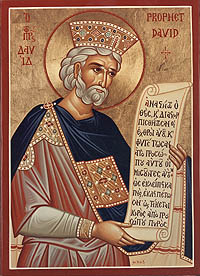 David, son of Jesse – the one who became King of Judah and Israel – anointed as a young lad, the one who defeated Goliath, the one who established Jerusalem as the holy city and brought the Ark of the Covenant to reside. King David of whom the Books of Kings and Chronicles hold up as favored of God, as the high-water mark of all the kings – it is his voice who cries out to the Lord. “A heart contrite and humbled, O God, you will not spurn” (Ps 51:19) Such is the refrain from the Responsorial Psalm from
  King David – living the dream! I mean who could have imagined? The Lord God had sent his prophet Samuel out to anoint the one who would be king – and the young shepherd David was selected among all of Jesse’s sons – the one to be king of Israel and all of God’s chosen people. And the Lord had been with David on the battlefield as he stood before the giant warrior Goliath. The Lord had stayed with David when he was a wanted man on the run from the murderous hand of King Saul. The Lord had guided David as be took on the mantle of leadership and had united the 12 tribes of Jacob into one nation. And now David was king.
  friarmusings