
Today

This coming Sunday is the 3rd Sunday of Ordinary Time. 20 Rolling up the scroll, he handed it back to the attendant and sat down, and the eyes of all in the synagogue looked intently at him. 21 He said to them, “Today this scripture passage is fulfilled in your hearing.” 

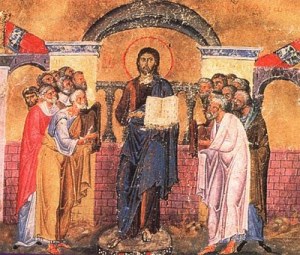
With the reading complete, Jesus takes the posture (sitting) of the teacher – as he was expected to do. All eyes are upon him, his reputation preceding, his choice of scripture provocative – the eyes of all in the synagogue looked intently at him. Then simply and powerfully Jesus tells them that this great promise of God given in Isaiah, this promise of the long awaited Messiah has been fulfilled.

Continue reading

The Mission

This coming Sunday is the 3rd Sunday of Ordinary Time. It is important to note that this mission is specifically directed at the needs of people: poor, captive, blind, oppressed. Significantly, Jesus’ work will be good news to the poor. Mary’s prayer (1:52-52; the Magnificat) praises the Lord for lifting up the lowly and sending the rich away empty. Later, Jesus announces God’s blessing on the poor (6:20) and then refers to the fulfillment of the charge to bring good news to the poor in his response to John (7:22). The poor also figure more prominently in Jesus’ teachings in Luke than in any other Gospel (14:13, 21; 16:20, 22; 18:22; 21:3).Culpepper [105-6] provides additional insights for Luke’s use of the Isaian text:

Continue reading

In the power of the Spirit

This coming Sunday is the 3rd Sunday of Ordinary Time. As noted, this passage begins with a reference to Jesus being “in the power of the Spirit.” While there are no doubt some implicit Trinitarian ideas here, the OT should serve as the means of understanding the direction of Luke’s narrative. The OT metaphors of wind (Heb: ruach – breath, wind, spirit), smoke, and cloud, as well as fire, were ways of talking about the active presence of God in the world. Even though the single Hebrew term is translated in various ways even when used of God, this idea became a way to talk about God in terms of his immediate activity in the world. The idea behind the Hebrew term ruach expressed the immanence of God in the world and encompassed his willingness and power to act in human history. This idea carried over into most of the NT since the equivalent term in Greek (pneuma) carries the same varied meaning.  As well, this “power of the Spirit” also points to a commissioning of prophets and enabling leaders to carry out their mission. 

Continue reading

The Spirit: first words

This coming Sunday is the 3rd Sunday of Ordinary Time and Jesus is in the synagogue in his hometown of Nazareth. In the previous post Jesus proclaimed a reading from the Prophet Isaiah. In this post Jesus’ first words are recorded.  How appropriate that the first record of public ministry is the very living Word made flesh sharing the Word of God. Luke records these first spoken words of Jesus’ ministry:

18 “The Spirit of the Lord is upon me, because he has anointed me to bring glad tidings to the poor. He has sent me to proclaim liberty to captives and recovery of sight to the blind, to let the oppressed go free, 19 and to proclaim a year acceptable to the Lord.”

Continue reading

Expectations

This coming Sunday is the 3rd Sunday of Ordinary Time. Jesus is in the synagogue in his hometown. He came to Nazareth, where he had grown up, and went according to his custom into the synagogue on the sabbath day. He stood up to read 17 and was handed a scroll of the prophet Isaiah. He unrolled the scroll and found the passage where it was written: The Gospel of Mark has a similar account but records it later in Jesus’ public ministry near the end of the ministry in Galilee (Mark 6:1-6a). Luke reports the account at the beginning of Jesus’ ministry. In doing so, Luke highlights the initial admiration (Luke 4:22) and subsequent rejection of Jesus (Luke 4:28-29) and presents it as a foreshadowing of the whole future ministry of Jesus. Moreover, the rejection of Jesus in his own hometown hints at the greater rejection of him by Israel (Acts 13:46). Luke’s account seems to have at least two emphases: (a) the announcement of Jesus’ ministry as the fulfillment of God’s promises from the OT in general, but in Isaiah in particular; and (b) a statement about the context of Jesus’ ministry (cf.  Luke 4:18-19). In each case, the prophet Isaiah serves as the fulfillment text. 

Continue reading

Beginning of Public Ministry

This coming Sunday is the 3rd Sunday of Ordinary Time in Lectionary Year C. We begin with the opening verses of the Gospel according to Luke. Its inclusion with the main body of the Sunday Gospel, is not for biblical scholarship or context, but it serves to emphasize the certainty of the story that follows. While many scholars note that it flawlessly follows the conventional form of prologues, it is surprising how little we are actually told. Unlike other gospels, it does not mention Jesus by name or title, gives no indication of the subject matter of the writing, does not name its sources, nor describe the scope of the writing. That being said, Luke’s concerns are more than historical (orderly sequence; more specifically, historical rhetoric). It promises to compile a narrative of the events that have been fulfilled among us that has been passed from the eyewitnesses from the beginning and the ministers of the word that handed the accounts onto Luke’s generation (ca. 85 CE).

Continue reading

Restored Honor

Today’s gospel is one that always needs 1st century context. Jesus has just been at synagogue where he cast out an unclean spirit from a man. Then we read, “After Jesus left the synagogue, he entered the house of Simon. Simon’s mother-in-law was afflicted with a severe fever, and they interceded with him about her. He stood over her, rebuked the fever, and it left her. She got up immediately and waited on them..” (Luke 4:38-39) Continue reading

A Necessary Tuneup

In our gospel from today’s readings, we find a powerful and transformative moment in the life of Jesus. He has returned to his hometown of Nazareth, and on the Sabbath day, he enters the synagogue. As was custom, someone was asked to read. Jesus is handed the scroll of the prophet Isaiah. He unrolls it and begins to read: “The Spirit of the Lord is upon me because he has anointed me to bring glad tidings to the poor. He has sent me to proclaim liberty to captives and recovery of sight to the blind, to let the oppressed go free, and to proclaim a year acceptable to the Lord.Continue reading

Release and Catch

fishing netIn most bibles that give heading titles to sections (which are helpful, but not part of the original text), today’s gospel is labelled, e.g., The Call of Simon the Fisherman. James and John, the sons of Zebedee, get second billing in this account. However Jesus never “calls” them. He never utters a “follow me” to them, like in the accounts of calling the same fishermen in Mark 1:16-20 and Matthew 4:18-22. In our text, Jesus only talks to Simon. Later Jesus will give the command, “Follow me,” to Levi (Luke 5:27), who like these fishermen, “leaves everything and follows him” (5:11, 28). Jesus announces to Simon (and only to Simon!) what Simon will now be doing. This call/announcement comes not in a “holy” place such as the temple or synagogue, but at work. The call comes not to extraordinary, designated holy people such  as priests or Pharisees, but to a fisherman; one who knows his sinfulness.
Continue reading

Wisdom and Love

Things “went south” pretty quickly after Jesus read the words from the prophet Isaiah, told the crowd that those prophetic words were fulfilled in their hearing, and then just sat down. How did things get so out of hand so quickly – from prayer to attempted homicide. When they got home, I wonder if they reflected on the whole incident? Did they take it into prayer and search for the presence of God in the midst of all that turmoil? Continue reading