What was done for us

I think it is very possible to drift through life, or at least parts of your life. Looking back into my life, I certainly find that to be true. Over the years listening to people chatting with me on the sidewalks, in the office, in the confessional and more – it seems to be quite common. Maybe it is during a time when there are too many things that you are trying to juggle. Or during a time when one thing occupies a huge amount of your attention and energy. Or maybe it is just a part of your life that is in cruise control so to speak. Your attention is just elsewhere.

My dad used to say that the main thing is making sure that the main thing remains the main thing.

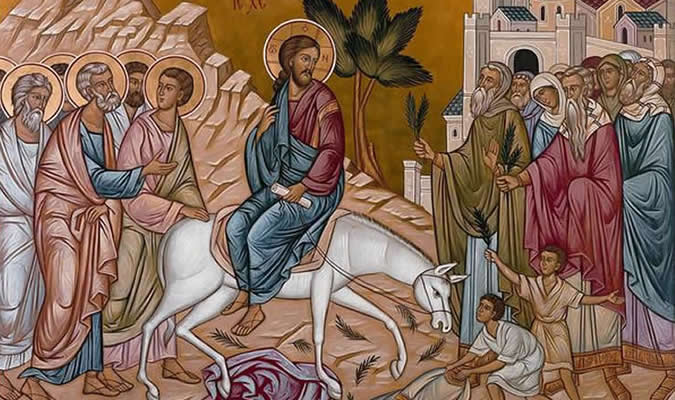
Lent is a season built upon and focused on bringing the “main thing” into focus: the life, death, and resurrection of Jesus Christ. I especially remember the Lenten season of almost 40 years ago. I had been growing in faith – at least getting more serious about my spiritual, prayer, and life in the faith. I decided to take a week of vacation during Holy Week. It was a time to relax, visit people, take long bike rides and decompress so I would be ready to celebrate Holy Thursday, Good Friday, the Easter Vigil, and Easter Sunday.  And Palm Sunday too – but I have to admit it was a bit of an afterthought. But sure, Palm Sunday is the gateway to the week. Jesus starts Holy Week on a high as he triumphantly enters Jerusalem to the cries of Hosanna – only to reach the low point of Good Friday. As a narrative arc, that makes sense.

It wasn’t my first Palm Sunday, but I remember being surprised there was a  Gospel that started the Mass. I was even more surprised at the Passion gospel. I distinctly remember thinking that reading the Passion was jumping the gun a bit, don’t you think? I mean, won’t Good Friday arrive in its own good time? Can’t we wait to hear about the Last Supper, the betrayal, Gethsemane, the trials, Pontius Pilate, scouring, the crucifixion, and Jesus dead, laid in a tomb? What is the rush? Let me enjoy the triumphant entry.

Why did the Church add this to Palm Sunday? Short answer, they didn’t, it had been there for my lifetime. I guess I had been drifting through Holy Week for the whole of my life. Yet I missed it. Lots of people might not be here for Holy Thursday and Good Friday. That sets up a danger in going from the Palm Sunday shouts of  “Hosanna to the Son of David; blessed is the he who comes in the name of the Lord; hosanna in the highest;” then jumping to Christ Resurrected. The “danger” is “see, it all works out, Jesus wins” and thinking the glory and love of God is revealed in the Resurrection alone. 

I think there is something in reading the Passion today that not only gives us the context for the week. But it points to the heart of Holy Week. And we need to sit with that for a few days before we celebrate the particulars of Holy Thursday and Good Friday. We need time to let it rummage around and let it find its home within us.

Our Lenten journey has brought us to Holy Week where so many folks focus on all that Jesus suffered for us because of our human condition, stiff-neck and unrepentant as we can be.  Even though that is true, I think it misses the mark – is incomplete at best. Yes, Jesus suffered for us, but Jesus has entered into the part of humanity where darkness dwells. 

It is through the betrayal, Gethsemane, the trials, Pontius Pilate, scouring, the crucifixion that Jesus enters into the darkest part of humanity. Where he is tortured, broken, held in bondage, scourged and crucified – helpless in the hands of Roman power, corrupt authorities and betrayal. Now at the end, there is no vestige of human experience untouched and embraced by God.

Our savior has gone into the place where people are entombed. Where there is torture, brokenness, bondage, hopelessness, and abandonment.  The place where we hear “Eli, Eli, lema sabachthani? … My God, my God, why have you forsaken me?” from the voices of the faithful, the lost, the despairing, and those who are afflicted and feel as though there is no place left for hope. Jesus has been there.

And we hear the whole story today – not piecemeal – but in its entirety. A story to carry with us throughout the week when Mary will anoint Jesus’ feet with her hair, where 30 pieces of silver will change hands, where Passover fellowship will give way to betrayal, giving way to scourging and crucifixion. Arms stretched to connect heaven and earth. And yet, in the end, death. Abandoned. 

Such is the love of God for us. The glory of God displayed as a Love so vast, a desire that all be saved that runs so deep, that God holds back nothing. Nothing. Not even his only Son. Such love. Such love. It is the glory of God. There on the cross, the glory of God is revealed. 

Holy Week is a journey into the Glory of God, rightly understood.

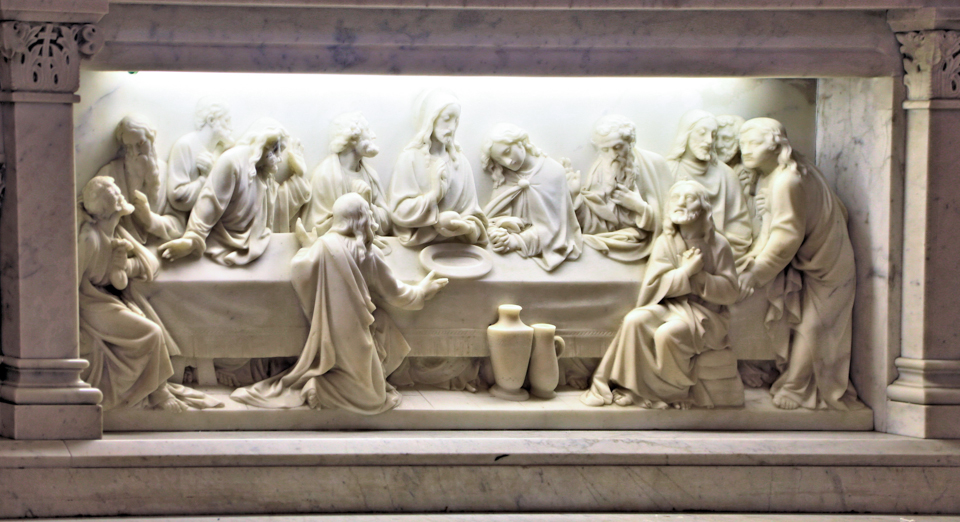
It is to understand the Mass of the Lord’s Supper on Holy Thursday in a profound way. To understand that the Word of God, condescendere, stepped down in humility to pitch his tent with us. Stepped down to wash his disciples feet; knowing that Jesus will step down even further into the full darkness of the human condition. That all will be saved; all will be converted, even the most broken part of our lives. So, when Jesus asks the Apostles on Holy Thursday, “Do you know what I have done for you?”  The answer is far richer. Then to sit, watch the altar being stripped, darkness begin to fall within the church, and the grand silence settles, and we ponder – do we really understand what He has done for us?

Holy Week begins today.

And by Sunday morning we pray we will be closer to being able to more completely answer that question: “Do you know what I have done for you?”  

We need time to let it rummage around and let it find its home within us.

It is a glimpse into the heart of Holy Week. It is Palm Sunday of the Lord’s Passion. It is our wake up call so that we ensure the main thing remains the main thing.  Amen.


Image credit: Canva modified

The Passion Narrative

Each year “Psalm Sunday” includes not only the entry into Jerusalem, but also a proclamation of the Passion Narrative – this year from the Gospel of Luke. Each gospel includes a version of the narrative which provides the climax for each of the four gospels, catching up themes that have woven their way through the evangelists’ entire portrayal of Jesus’ life and bringing them to a dramatic completion. In deft strokes the evangelists tell us of the final hours of Jesus’ life – his last meal with his disciples; his arrest in Gethsemane; his interrogation by the religious leaders; the trial before Pilate; and finally the heart clutching scenes of Jesus’ crucifixion, death and burial.

Continue reading

Letting things rummage around

holyweekBack in the day, before becoming a Franciscan, back when the rhythm of my day was set by clients, projects, and things of the workplace, I let a different pattern take hold for Holy Week. I always took vacation. I took time off to relax, visit people, take long bike rides and decompress so I would be ready to celebrate Holy Thursday, Good Friday, the Easter Vigil, and Easter Sunday.

But you know what? I have to admit, I did not pay a lot of attention to Palm Sunday. I wonder if I went to Mass and then to the office to clear up last minute things to make sure the week was free. Yet today is the gateway to Holy Week. Continue reading

Palm Sunday of the Lord’s Passion

This coming Sunday marks Palm Sunday of the Lord’s Passion (Year C). You can read a complete commentary on this gospel here.

Jesus has been traveling toward Jerusalem since Luke 9:51 (the conclusion of the Lucan narrative of the Transfiguration). The final approach to the holy city is marked with a third passion prediction (18:31-34), two scenes in the nearby city of Jericho (18:35-43; 19:1-10) and the parable of the talents (19:11-27) – the latter of which highlights a kingly figure coming to claim what was rightfully his. With this preceding, Jesus makes his entrance procession into Jerusalem. Continue reading

Passion Sunday: the sheep scatter

Jesus arrestedJesus Predicts Desertion and Promises Reunion (26:30b-35) The Gospel reading for Palm Sunday of the Lord’s Passion is quite lengthy and so will not be included here. It can be found at the USCCB website:

One of the curious “tests” that some scholars apply to a passage regarding “authenticity” (by which they really mean historicity) is “would it embarrass the early church?” If it would, then it must be so “authentic” and compelling that the sacred writer includes it even though it is embarrassing. Jesus’ prediction that all the disciples would abandon him in his hour does not reflect well on the future leaders of the nascent Christian movement. Continue reading

Palm Sunday of the Passion: a last meal

Altar-1The Gospel reading for Palm Sunday of the Lord’s Passion is quite lengthy and so will not be included here. It can be found at the USCCB website:

Jesus Inaugurates the Eucharist (26:26-30a) As Joachim Jeremias and other scholars have shown in looking at all the received Eucharistic traditions (Paul in 1 Corinthians and the synoptic gospel writers), Jesus follows the form and outline of the Passover Seder. The thanksgiving over the bread and the cup recorded in vv. 26 and 27 will therefore be a regular part of the main section of the Passover meal (making this the third of the four cups of the Passover), and we may reasonably assume that Jesus used the traditional words of thanksgiving. But it worthwhile to point out that said the blessing refers to blessing God, not blessing the bread. Continue reading

Palm Sunday of the Passion: betrayer and betrayed

Entry_Into_Jerusalem1The Gospel reading for Palm Sunday of the Lord’s Passion is quite lengthy and so will not be included here. It can be found at the USCCB website:

Commentary. This very long narrative will be broken into small passages that may help the reader to focus and reflect on specific sections. The general outline listed in the previous post is provided for you to locate these smaller passages within the larger framework. The narrow framework is taken from Boring’s outline of the Matthean Passion narrative. Continue reading

Palm Sunday of the Passion: context

Entry_Into_Jerusalem1Context. The climactic events that have been repeatedly predicted since the Galilean ministry are now about to unfold (12:38–40; 16:4, 21; 17:12, 22–23; 20:17–19; 21:38–39; 23:32). Jesus was aware of the forces arrayed against him (26:2), yet he did not resist doing the will of the Father despite the suffering that would be involved (26:36–46). Ironically, the very religious leaders who opposed and sought to destroy Jesus were the unwitting instruments God used to fulfill his plan to exalt Jesus. Continue reading

Letting things rummage around

holyweekBack in the day, before becoming a Franciscan, back when the rhythm of my day was set by clients, projects, and things of the workplace, I let a different pattern take hold for Holy Week. I always took vacation. I took time off to relax, visit people, take long bike rides and decompress so I would be ready to celebrate Holy Thursday, Good Friday, the Easter Vigil, and Easter Sunday.

But you know what? I have to admit, I did not pay a lot of attention to Palm Sunday. I wonder if I went to Mass and then to the office to clear up last minute things to make sure the week was free. Yet today is the gateway to Holy Week. Continue reading

Passion Sunday: the sheep scatter

Jesus arrestedJesus Predicts Desertion and Promises Reunion (26:30b-35) The Gospel reading for Palm Sunday of the Lord’s Passion is quite lengthy and so will not be included here. It can be found at the USCCB website:

One of the curious “tests” that some scholars apply to a passage regarding “authenticity” (by which they really mean historicity) is “would it embarrass the early church?” If it would, then it must be so “authentic” and compelling that the sacred writer includes it even though it is embarrassing. Jesus’ prediction that all the disciples would abandon him in his hour does not reflect well on the future leaders of the nascent Christian movement.

The NSRV says “You will all become deserters [skandallisthēsesthe]…” – and though it more literally means to “fall away” “be caused to stumble” – there is something scandalous that will shake their faith to the very core. This the word that Matthew uses to describe the hometown folk, the Pharisees, and those who profess belief in Jesus but who stumble when the world or persecution arises on account of Jesus’ word (13:21). Continue reading