
Today is the Solemnity of St. Joseph. Several years ago Pope Francis wrote the Apostolic Letter Patris Corde – With a Father’s Heart. It is a wonderful reflection of the attributes and characteristics of fatherhood – and also understands that St. Joseph serves as a model, not just for fathers, but for all who care for others. Click here to read the full text of Pope Francis’ Apostolic Letter.
The biblical record of St. Joseph is narrated by Matthew and Luke. Their accounts tell us very little, yet enough for us to appreciate what sort of father he was, and the mission entrusted to him by God’s providence. In so many of the scenes, Joseph is navigating his way through uncertainty, the unexpected, and events that seem to ask too much of him – and yet he is a just and righteous man seeking to do God’s will.
I think it notable that today’s celebration offers two gospel selections: (1) the account from Matthew wherein Joseph knows that Mary is already with child or (2) the child Jesus is lost in the Temple. In both accounts Joseph’s concern is for the other. In the first account, while he feels the need to end the betrothal to Mary he is concerned about Mary’s welfare, that she not be exposed to shame. In the second account, his is a natural concern for a missing child. I have often wondered what Joseph thought upon finding Jesus and the child says: “Why were you looking for me? Did you not know that I must be in my Father’s house?” The text tells us neither he or Mary understood. But I wonder if Jesus’ word cut Joseph “to the quick.” Did Joseph feel diminished or dismissed? Pope Francis comments on all this:
Often in life, things happen whose meaning we do not understand. Our first reaction is frequently one of disappointment and rebellion. Joseph set aside his own ideas in order to accept the course of events and, mysterious as they seemed, to embrace them, take responsibility for them and make them part of his own history. Unless we are reconciled with our own history, we will be unable to take a single step forward, for we will always remain hostage to our expectations and the disappointments that follow. The spiritual path that Joseph traces for us is not one that explains, but accepts. Only as a result of this acceptance, this reconciliation, can we begin to glimpse a broader history, a deeper meaning.”
In those moments in our life when disappointment arrives and we are asked to set aside our own ideas, with the help of St. Joseph, may we recognize the movement of the Spirit calling us into the mysterious unfolding of God’s plan.
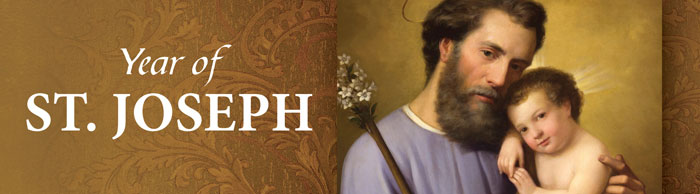
Image credit: detail of St Joseph with the Infant Jesus | Guido Reni, 1620s | Hermitage Museum St Petersburg Russia | PD-US
 When asked “What was the first movie that Kevin Costner appeared in?” The average fan of things “celluloid” often responds “No Way Out.” Certainly that was a movie that brought him into the limelight, established his leading man status, and led to his career in many other memorable films. The actual answer is the 1982 Ron Howard film “Night Shift.” He is listed in the credits as ‘Frat Boy No. 1’ and appears at the climax of a frat-style, over-the-top party playing out in a New York City morgue. When the music is suddenly stopped by a frantic Henry Winkler, Costner can be seen holding a beer and looking surprised at the sudden halt of celebration. He has no speaking role, but he appears. (and one might argue “Sizzle Beach, USA” is the real answers, but it was released in 1986 and thus Costner did not “appear” until then)
  friarmusings