
Being Known and a Final Thought

This coming Sunday is the 32nd Sunday of Ordinary Time. Our gospel is the parable of the Ten Virgins. 11 Afterwards the other virgins came and said, ‘Lord, Lord, open the door for us!’ 12 But he said in reply, ‘Amen, I say to you, I do not know you.’

Such is the plaintive cry of those who thought they ought to be included. With the emphatic formula, “Amen, Amen” the following words have the force of a judicial verdict. “”I do not know you.” This dramatic verse carries a profound and symbolic meaning within the context of the parable and possibly underscores several important spiritual concepts: Continue reading

Wise and Foolish: being prepared

This coming Sunday is the 32nd Sunday of Ordinary Time. Our gospel is the parable of the Ten Virgins. At the center of the parable are the “ten virgins who took their lamps and went out to meet the bridegroom. Five of them were foolish and five were wise”  Matthew has already used this doublet in the Sermon on the Mount. At the opening of the Sermon, Matthew 5:13, “You are the salt of the earth. But if salt loses its taste, with what can it be seasoned? It is no longer good for anything but to be thrown out and trampled underfoot.” The expression loses its taste, literally “becomes foolish.” Continue reading

Lacking Oil

This coming Sunday is the 32nd Sunday of Ordinary Time. Our gospel is the parable of the Ten Virgins. It was not that five slept and five stayed awake: v. 5 says explicitly that they all slept and all had to be awakened by the midnight shout. The problem goes back to the preparations they had made before going to sleep. At the core of the problem is that they lacked oil for their lamps. While the parable itself offers no allegorical identification for the oil, we do know that oil is a rich and multifaceted symbol in both the Old and New Testaments. Its symbolic use carries various meanings and significance in different contexts. Here are some of the key ways in which oil is symbolically used in both the Old and New Testaments: Continue reading

Parthenos and a locked door

This coming Sunday is the 32nd Sunday of Ordinary Time. Our gospel is the parable of the Ten Virgins. “…the kingdom of heaven will be like ten virgins who took their lamps and went out to meet the bridegroom.” (Mt 25:1) As best we can know the scene is part of the procession returning to the bridegroom’s home. This story mentions only two parties, the bridegroom and the ten girls. The precise role of the young women in the ceremonies is not clear but most scholars assume that  Hellenistic-Roman marriage customs also apply in Jewish circles at the time, and thus the young women are servants from the bridegroom’s house, awaiting the return of the bridegroom with his bride. Continue reading

Weddings

This coming Sunday is the 32nd Sunday of Ordinary Time. Our gospel is the parable of the Ten Virgins. The gospel reading begins: “Jesus told his disciples this parable: ‘The kingdom of heaven will be like…’” and then goes on to place the parable in the midst of a first century wedding celebration. Both of Matther’s use of a wedding celebration setting are a part of the overarching message about the Kingdom of Heaven. Continue reading

The Future and Judgment

This coming Sunday is the 32nd Sunday of Ordinary Time, Lectionary Cycle A. Our gospel is the parable of the Ten Virgins.

The gospel readings for the 29th through 31st Sundays in Lectionary Cycle A all describe a series of confrontations between Jesus and religious authorities of Jerusalem, namely the scribes and Pharisees. The reading for the 31st Sunday ends with Jesus warning the disciples to not become hypocrites like the scribes and Pharisees (Mt 23:12). It would seem like one more verse would have been a capstone to the warning: “Woe to you, scribes and Pharisees, you hypocrites” (v.13) Continue reading

Taking Stock

Here at the tail end of hurricane season (officially Nov 30th), let me ask you…. How many of you were prepared this past season, stocking up on extra flashlights and batteries? Extra water and food? Something to charge your cell phone? Of course, forecasting is pretty good these days, we always have advanced warning, and there is time to run to the store or borrow from our neighbors. Right?  Given the scenes from the days preceding Hurricane Irma, I think that was most people’s strategy. But not all things in life are well forecast.  Some rain comes down upon us without notice. Continue reading
Ever ready: allegory

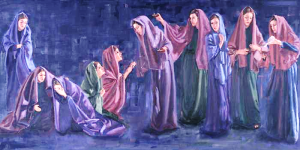
1 “Then the kingdom of heaven will be like ten virgins who took their lamps and went out to meet the bridegroom.” Be it parable or allegory, we are limited in dissecting this passage from the gospel. Many commentaries offer insight from wedding customs, but of another culture or age. One commentary I reviewed was assuming 10th century Jewish wedding customs from Spain reflected an unaltered liturgical custom. Possibly.

We know that weddings provided one of the high points in village life, and the question of who was and was not included affected one’s social standing. Our knowledge of Jewish wedding customs at the time is limited, leaving scholars to suggest analogies from other cultures; but it is probably wiser to admit our ignorance. This story mentions only two parties, the bridegroom and the ten girls. The precise role of the latter in the ceremonies is not clear but most scholars assume that Hellenistic-Roman marriage customs also apply in Jewish circles at the time, and thus the young women are servants from the bridegroom’s house, awaiting the return of the bridegroom with his bride after the wedding feast at her house. Possibly. Continue reading

Ever ready: prepared

The young women are described with the Greek term for “virgins” which is meant to indicate unmarried friends or relatives of either the bride or the bridegroom. The story tells us that their role included escorting the bridegroom in a torchlight procession to his house, but that they were not present at whatever part of the ceremonies immediately preceded this procession. The unexpected delay at that point in the proceedings may have been caused by extended bargaining over the financial settlement, or by any number of other causes, deliberate or accidental. It does not matter; all that matters is the delay, and the effect it had on the readiness of the girls when the time for their part in the ceremonies eventually arrived. Continue reading