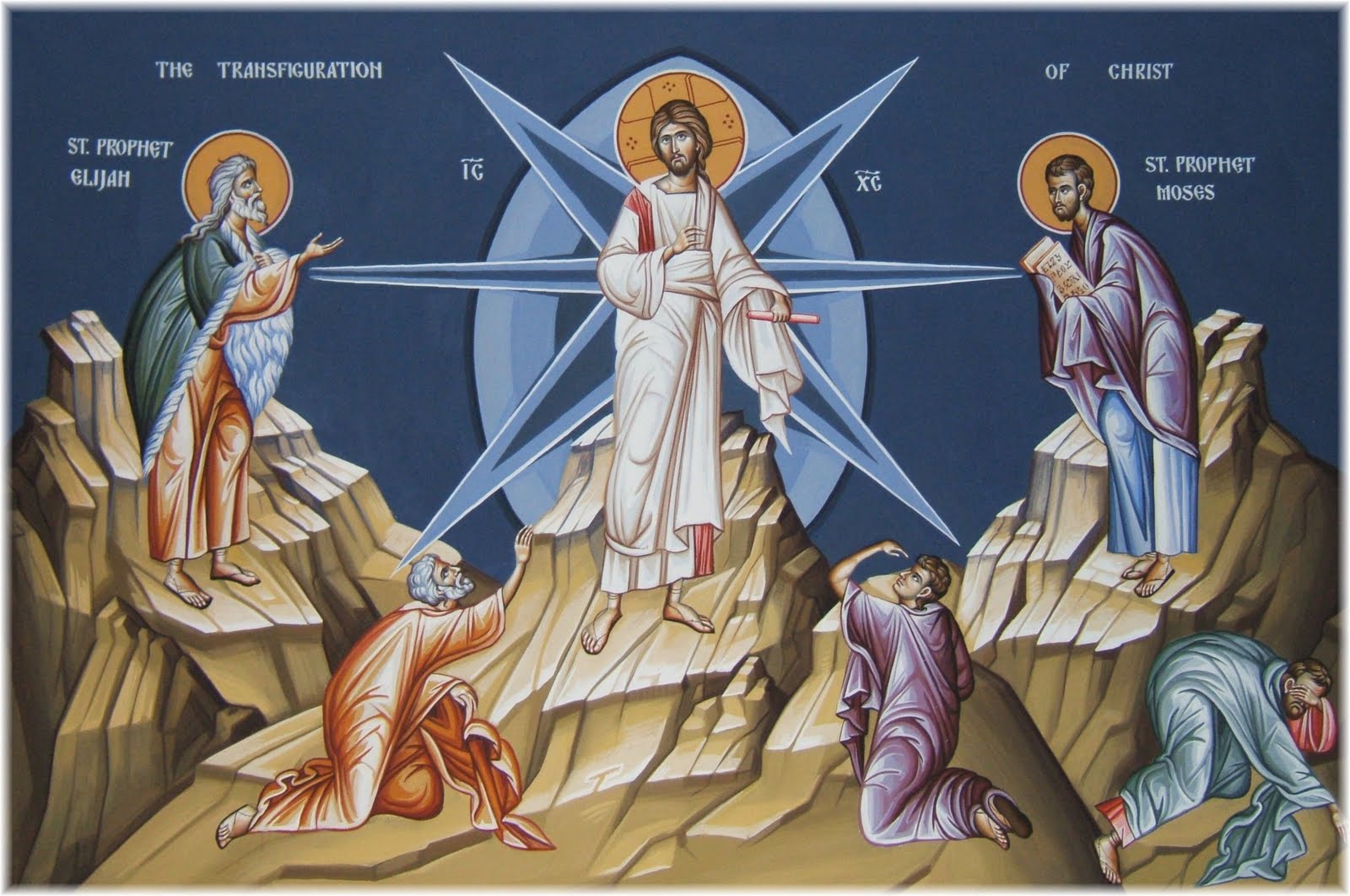
 What are they to understand? What purposes did this theophany serve? There are a number of possibilities. Brian Stoffregen has compiled a good list of things to consider. Continue reading
Transfiguration: reasons why
Reply

What are they to understand? What purposes did this theophany serve? There are a number of possibilities. Brian Stoffregen has compiled a good list of things to consider. Continue reading
2 After six days Jesus took Peter, James, and John and led them up a high mountain apart by themselves. And he was transfigured before them, 3 and his clothes became dazzling white, such as no fuller on earth could bleach them. 4 Then Elijah appeared to them along with Moses, and they were conversing with Jesus. 5 Then Peter said to Jesus in reply, “Rabbi, it is good that we are here! Let us make three tents: one for you, one for Moses, and one for Elijah.” 6 He hardly knew what to say, they were so terrified. 7 Then a cloud came, casting a shadow over them; then from the cloud came a voice, “This is my beloved Son. Listen to him.” 8 Suddenly, looking around, they no longer saw anyone but Jesus alone with them. 9 As they were coming down from the mountain, he charged them not to relate what they had seen to anyone, except when the Son of Man had risen from the dead. 10 So they kept the matter to themselves, questioning what rising from the dead meant. Continue reading
 This weekend, my Franciscan brother, Fr. Bill McConville, OFM is preaching at all the Masses as part of the Lenten Parish Mission (which I hope you are planning to attend if you are in the Tampa area). Having a guest homilist is a secret pleasure for a priest – even if you like the whole process of preparation and presentation (which I do). Still, it is a like a holiday that shows up at your door step. Woohoo!! It is a double blessing because I know Fr. Bill well. I know his homily will be great and I will get to listen to it. At least I hope I listen, pay attention, and even more, consider all that Fr. Bill has to say about this wonderful gospel describing the Transfiguration. Continue reading
Annemarie Reiner (of Adelaide, Australia) posted this reflection on the Transfiguration on her blog “Who Do You Say That I Am.” (August 2006) It is a very nice reflection for this Lenten Season.
When we look at our Gospel today we can understand why daily reflection is so important. These three disciples (and the rest of them) didn’t get who Jesus was until well after his death. They didn’t understand what had happened at the transfiguration. They didn’t understand what was happening as they witnessed Jesus’ life. They didn’t understand what was happening at the crucifixion. But they kept pondering their experiences over and over – if they didn’t we simply wouldn’t have the New Testament.
So what do we learn from this? Continue reading
Peter’s Response. As in 16:13-20, Peter again responds, again without a full understanding. Consider Peter’s proposal to make three tents (skēnḗ; also “booth” or “tabernacle”). What did he intend? It has been variously understood as traveler’s hut, the “tent of meeting” where God spoke with Moses outside the camp (Exod 33:7), a more formal tent used in the Festival of Booths (cf. Lev 23:42–43; Zech 14:16ff), and even as the Jerusalem Temple tabernacle. It is this last image that Matthew may have in mind as background – notwithstanding Peter’s intention. It is the Temple tabernacle where the Shekinah, the fiery cloud that symbolized the continuing presence of God among the people, dwelt over the ark of the covenant. The response to Peter’s proposal is three-fold (Boring, 364) Continue reading
Commentary. Matthew 17:1-13 is an instructional session for all the disciples – note that in v.10, Peter, James and John have been joined the remainder of the group. Just as the preceding scene (16:13-28) juxtapositions the divine transcendence of Peter’s confession of Jesus as Son of God based on a revelation from heaven (16:17) with Jesus’ own teaching about the suffering Son of Man, so also in this scene the confession of the heavenly voice is juxtaposed with Jesus’ self-confession as suffering Son of Man.
The description of the Transfiguration is brief—just the first three verses of Matthew 17. But the incident becomes the context for two significant incidents for the disciples. Continue reading
Matthew 17:1–9 1 After six days Jesus took Peter, James, and John his brother, and led them up a high mountain by themselves. 2 And he was transfigured before them; his face shone like the sun and his clothes became white as light. 3 And behold, Moses and Elijah appeared to them, conversing with him. 4 Then Peter said to Jesus in reply, “Lord, it is good that we are here. If you wish, I will make three tents here, one for you, one for Moses, and one for Elijah.” 5 While he was still speaking, behold, a bright cloud cast a shadow over them, then from the cloud came a voice that said, “This is my beloved Son, with whom I am well pleased; listen to him.” 6 When the disciples heard this, they fell prostrate and were very much afraid. 7 But Jesus came and touched them, saying, “Rise, and do not be afraid.” 8 And when the disciples raised their eyes, they saw no one else but Jesus alone. 9 As they were coming down from the mountain, Jesus charged them, “Do not tell the vision to anyone until the Son of Man has been raised from the dead.” Continue reading
There is someone in Tampa that clearly enjoys the Tampa Bay Times. Most mornings – recently at least – they help themselves to the copy intended for the friary. At the crack of dawn, one of the friars makes the daily pilgrimage to the Florida Ave. curb to retrieve the newspaper. Sometimes we are rewarded for our journey; some days not. But even the days when the paper has been absconded, perhaps that too has its own rewards. When our newspaper takes flight it also carries away the bad news with it. I know, I know – it’s not all bad news, but… At least for a while we get a respite from the next report of death, doom, despair, flood, fire, famine, pestilence, poverty, and plague. Continue reading
 friarmusings