One’s life does not consist of possessions

The front side of folios 13 and 14 of a Greek ...

18th Sunday of Ordinary Time: Luke 12:13-21

13 Someone in the crowd said to him, “Teacher, tell my brother to share the inheritance with me.” 14 He replied to him, “Friend, who appointed me as your judge and arbitrator?” 15 Then he said to the crowd, “Take care to guard against all greed, for though one may be rich, one’s life does not consist of possessions.” 16 Then he told them a parable. “There was a rich man whose land produced a bountiful harvest.  17 He asked himself, ‘What shall I do, for I do not have space to store my harvest?’ 18 And he said, ‘This is what I shall do: I shall tear down my barns and build larger ones. There I shall store all my grain and other goods 19 and I shall say to myself, “Now as for you, you have so many good things stored up for many years, rest, eat, drink, be merry!” 20 But God said to him, ‘You fool, this night your life will be demanded of you; and the things you have prepared, to whom will they belong?’ 21 Thus will it be for the one who stores up treasure for himself but is not rich in what matters to God.” Continue reading

An Approved Rule of Franciscan Life

Pope Innocent III Accords Recognition to the F...

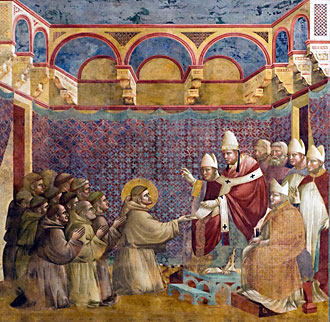
The year is 1221 and at the request of the “cardinal protector” of the friars, Cardinal Hugolino, Francis and several of his brothers have taken up the task of writing a formal rule of life.  It was not clear that the Franciscans were actually a “religious order.”  When Francis visited Pope Innocent III in 1209, the pope verbally approved (or did he?) a Rule of Life that was written down in few words.  In 1216, the 4th Lateran Council ruled that no new religious orders could be formed:  all new groups would be absorbed into existing religious orders.  Hugolino recognized the uniqueness of the charism of St. Francis and his brothers and was determined that it not be lost to the church.

Francis and some companions undertook the writing of the “early rule” also known as the Rule of 1221.  It is a potpourri of spiritual reflections, exhortations, and communal and individual norms of behavior – all animated by extensive citations from Scripture.  Even though Francis was attempting to write a juridical rule of life that would “pass muster” from the canon lawyers in the Roman Curia, at the same time he was trying to write a rule borne out of his lived experience of following Christ and the pathway that was revealed to him:  “God has called me to walk in the way of humility and showed me the way of simplicity.  I do not want to hear any talk of the rule of Saint Augustine, of Saint Bernard, or of Saint Benedict.  The Lord has told me that he wanted to make of me a new fool in the world, and God does not want to lead us by any other knowledge than that.” (Assisi Compilation, 18)

The rule was finished, shown to Hugolino (we do not know of his reaction), and submitted to the Roman Curia.  We know the end result.  There is a reason why the “early rule” or “Rule of 1221” is more formally known as the regula non bullata – it was rejected.  But undaunted, Francis and his brothers rolled up their sleeves and went to work on a more streamlined rule, one more suited to the tastes of the canon lawyers.  This “later rule” or “Rule of 1223” is known as the regula bullata because it was formally issued under the Papal Bull (seal) Solet annuere.   It conferred on the Franciscans the official status of “Order” as a juridical foundation.

The document was the most the Curia would accept and was far less than Francis wanted, even if it remained faithful to his fundamental intuitions of the way of life God had showed to him.  For the next three years of his life, Francis worked to continue to give example, a living testimony, of the manner and meaning of the approved rule – and at the end of his life Francis wrote his Testament, a clear indication of what Francis wanted for the order:  live under the Rule of 1223 – but hold the Rule of 1221 close to your heart.  Here is one example of the differences between the two rules:

Regula non bullata (1221)

Chapter 16:  Those who are going among Saracens and other non-believers

Regula bullata (1223)

Chapter 3:  Of the Divine Office and fasting, and how the friars are to travel about the world

The Lord says:  Behold, I am sending you as lambs in the midst of wolves.  Therefore, be prudent as serpents and simple as doves (Mt 10:16).  Therefore, any brother who, by divine inspiration, desires to go among the Saracens and other nonbelievers should go with the permission of his minister and servant.  And the minister should give [these brothers] permission and not oppose them, if he shall see that they are fit to be sent; for he shall be bound to give an account to the Lord (cf. Lk 16:2) if he has proceeded without discretion in this or in other matters.  As for the brothers who go, they can live spiritually among [the Saracens and nonbelievers] in two ways.  One way is not to engage in arguments or disputes, but to be subject to every human creature for God’s sake (1 Pet 2:13) and to acknowledge that they are Christians.  Another way is to proclaim the word of God when they see that it pleases the Lord, so that they believe in the all-powerful God—Father, and Son, and Holy Spirit—the Creator of all, in the Son Who is the Redeemer and Savior, and that they be baptized and become Christians; because whoever has not been born again of water and the Holy Spirit cannot enter into the kingdom of God (cf. Jn 3:5) There are 14 more lines- all scripture about mission. And this is my advice, my counsel, and my earnest plea to my friars in our Lord Jesus Christ that, when they travel about the world, the should not be quarrelsome or take part in disputes with words (cf. 2 Tim. 2:14) or criticize others; but they should be gentle, peaceful, and unassuming, courteous and humble, speaking respectfully to everyone, as is expected of them.  … Whatever house they enter, they should first say, “Peace to this house” (Lk. 10:5), and in the words of the Gospel they may eat what is set before them (Lk. 10:8).

The differences are sometimes quite clear.   In the 1223 Rule, one travels about the world while making sure that the Divine Office is prayed and proscribed fasts are observed – both worthy things.  Only then is one to evangelize and be about mission – which has a certain logic and order to it all.In the 1221, the rules on prayer and fasting have their own section as foundational to being a friar, but the Rule holds up a model of minoritas and mission as intrinsic to the friar way of life.  It is in this Rule that one sees the passion and soul of St. Francis and his attempt to describe the vision God has shown him.  Especially prominent is mutual discernment between one brother and his community about God’s call.

The Rule of 1221 and the Testament, even though not juridically approved, reveal the soul and passion of St. Francis, and as such are the “go to” texts when Franciscans study what it means to be “friar minor.”

Prayer, Seeking, Asking

English: Saint Luke the Evangelist. Russian Ea...

Luke 11:1-13 – The Lord’s Prayer

With the geographical note, “in a certain place” Luke has
separated this narrative from the immediate context of Chapter 10 (the
conclusion of the mission of the 72, the parable of the Good Samaritan,
and the encounter with Martha and Mary). Luke now presents three
episodes concerned with prayer:

  • the first (Luke 11:1–4) recounts Jesus teaching his disciples the Christian communal prayer,
  • the “Our Father”; the second (Luke 11:5–8), the importance of persistence in prayer; and
  • the third (Luke 11:9–13), the effectiveness of prayer.

The Matthean form of the “Our Father” occurs in the “Sermon on the
Mount” (Matthew 6:9–15); the shorter Lucan version is presented while
Jesus is at prayer and his disciples ask him to teach them to pray just
as John taught his disciples to pray. In answer to their question, Jesus
presents them with an example of a Christian communal prayer that
stresses the fatherhood of God and acknowledges him as the one to whom
the Christian disciple owes daily sustenance, forgiveness, and
deliverance from the final trial. Continue reading

Racial Blues

In truth, I really could not think of a good title. But I guess that is OK. They aren’t my words. They point to the words of Fr. Bryan Massingale, a priest of the Diocese of Milwaukee and a professor of theology at Marquette University. Take five minutes and read his reflection on the trial of George Zimmerman for taking the life of Trayvon Martin.  “When profiling is “reasonable,” injustice becomes excusable

And after reading his reflection, take a lifetime to reflect.

Mary Magdalene

Magdalene Penitent
Donatello
Museo dell’Opera del Duomo – Florence

Did you know that Mary Magdalene is mentioned 12 times in the gospels, more than most of the Apostles. She was present at the crucifixion and was the first witness to the Resurrection (John 20 and Mark 16:9). She was the “Apostle to the Apostles”, an honorific that St. Augustine bestowed upon her in the fourth-century, and possibly he was but repeating a moniker already in use.

Mary Magdalene has long been confused with other women in Scripture also named Mary as well as an anonymous women, the unnamed sinner (commonly thought to have been a prostitute) in Luke 7:36-50.  In time, the identities of all these women were conflated into one in the person of “Mary Magdalene, the repentant prostitute.” The first written evidence we have of this conflation  of Mary Magdalene being a repentant prostitute comes from Ephraim the Syrian in the fourth century. Continue reading

Winner the Pooh, Rabbit, Martha and Mary

A Very Merry Pooh Year

Patrica Datchuck Sanchez had an interesting beginning to her commentary on the Martha and Mary story in Luke’s gospel:

Convinced that there is a discernible wisdom in A.A. Milne’s Winnie the Pooh (Dell Pub. Co., New York: 1926), I consulted the portly bear for a lesson in hospitality, the central theme of today’s first reading and gospel. Edward Bear, known to his friends as Winnie the Pooh, or Pooh for short, decided to visit Rabbit. As he drew nearer to Rabbit’s home, Pooh began to hum. “Aha”, he said, “Rabbit means Company and Company means Food and Listening-to-Me-Humming!” When he called out, “Is anybody at home?” he heard a scuffling noise and then silence. He called again, more loudly, “Is anybody home?” No!, said a voice and then added, “You needn’t shout so loud. I heard you quite well the first time!” “Oh, bother!” said Pooh. “Isn’t there anybody home at all?” The answer came back, “Nobody!”

There is, perhaps, at times, a little of Pooh and Rabbit in all of us. Pooh regarded hospitality as an opportunity for food, fun and attention. Rabbit saw it as a bothersome chore he’d rather forego.

Franciscan Rules

francis-innocentThe year is 1220 and Francis has just announced his decision to step down as “leader” of the Franciscan brothers.  In last week’s installment (Hierarchy of Authority – Hierarchy of Example), I described Francis’ reason for stepping down.  Francis had already seen the effects of a vacuum in spiritual authority brought about by his year-long absence while in the Middle East.  It is in leaving to his “vicar” and to the Roman Church the care of making decisions of a normative or disciplinary type that he could hope to preserve a superior authority, of a spiritual type, that would only have been diminished in the heat of daily administration. Continue reading

Perusing Scripture

English: old greek papyrus

Greek papyrus (Photo credit: Wikipedia)

“Peruse” is an interesting word, according to Merriam-Webster it has an original meaning (15th century): to examine or consider with attention and in detail : study.  That makes sense given its derivative from Middle English in which “per” meant completely.  But “peruse” acquired a different meaning over time:  to look over or through in a casual or cursory manner.  Etymology studies only indicate the shift in meaning in the 20th century (some argue for 19th century) – not the reasons why.  If I had to offer an uninformed guess, it would be because the word sounds “casual” and so people, not realizing the actual meaning, began to use “peruse” in a different, almost opposite way from its original meaning. Words can be like that. Continue reading

Rules

We are promised that whenever two or three are gathered in Jesus’ name, there He will be among us.  I have always suspected when the number is more than a billion world-wide, you better have rules. Rules are necessary – even helpful, but we always need to remember the basis of the rule or things get confusing when people interpret rules in differing ways. I suspect a lot of church arguments fall in this category. Believe it or not, the most common “church rule” question I receive is “how many times a day can I receive Eucharist.”  There is a set number and conditions – I will leave you the details to research on-line.  But when you find the rule (if you do) will you find the basis for the rule? Continue reading

Martha and Mary

English: Johannes Vermeer's Christ in the Hous...

English: Johannes Vermeer’s Christ in the House of Martha and Mary (Photo credit: Wikipedia)

Luke 10:38-42 – Martha and Mary

16th Sunday in Ordinary Time

38 As they continued their journey he entered a village where a woman whose name was Martha welcomed him. 39 She had a sister named Mary (who) sat beside the Lord at his feet listening to him speak. 40 Martha, burdened with much serving, came to him and said, “Lord, do you not care that my sister has left me by myself to do the serving? Tell her to help me.” 41 The Lord said to her in reply, “Martha, Martha, you are anxious and worried about many things. 42 There is need of only one thing. Mary has chosen the better part and it will not be taken from her.” Continue reading