
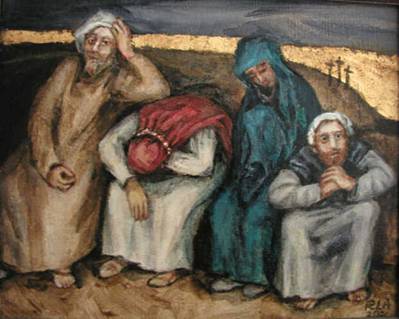
 Commentary. Luke sets the scene with markers of time (that very day), place (on the road between Jerusalem and Emmaus) and situation – two disciples who earlier had been with the disciples, heard the women’s testimony and apparently discounted their testimony has idle wistfulness. The community of believers has been fractured.
Unable to see. Elsewhere in the Gospel according to Luke “eyes” and “sight” have been correlated with comprehension, faith and salvation (cf. 1:78-79; 2:30; 6:39-42; 10:23; 11:34; 18:35-42; 10:42). For most the gospel referred to as the “Journey to Jerusalem” (9:51 – 18:14) the disciples have witnesses Jesus’ teaching, mighty deeds, and revelation of his heavenly Father. But in the earliest hours of the new world order after the Resurrection, the two disciples do not recognize Jesus. Their eyes are “prevented” from seeing, an expression for spiritual blindness. It ironic that the two travelers consider themselves the truly knowledgeable ones who are shocked that this fellow traveler has no idea of the very public events of the last three days. While they understand the details of the events from a human perspective, they are truly unaware of those event’s meaning. Continue reading
 Last week I wrote that if Lent was about making “room for God” – and that is a good start – then the Easter season and beyond should be about coming to realize that God is the entire room! “God should be not merely the reference point but the whole context out of which we operate. God is not merely the source of our existence, he is the substance of our existence, the very life we have, and without God we would be lifeless, even if we are alive. Put another way, if Jesus is not Lord of all, he is not Lord at all.”



 friarmusings