Wheat and the Tares

wheatCommentary. Although our gospel text does not seem to indicate the audience, v.34 (All these things Jesus spoke to the crowds in parables) does make it clear that the hearers are not the disciples alone, but that the crowd is again and active participant. Given the disciples’ question: “Why do you speak to them in parables?” (v.10) and the fact that Jesus is again speaking in parables, it is clear that a larger audience is present.

Weeds Among the Wheat. This parable is unique to Matthew and unlike the other evangelists who also tell a pericope of the “Sower and the Seed,” Matthew’s use and placement of this unique parable seems to serve as a reinforcement of the themes of on-going conversion (understanding, action, joy, perseverance in suffering brought about by tribulation or persecution, and ultimately bearing fruit superabundantly. The context of the parable is clearly “in the world” that place where anxiety and the lure of riches choke the word and it bears no fruit (v.22). Continue reading
The Kingdom of Heaven: context

wheatMatthew 13:24–3324 He proposed another parable to them. “The kingdom of heaven may be likened to a man who sowed good seed in his field. 25 While everyone was asleep his enemy came and sowed weeds all through the wheat, and then went off. 26 When the crop grew and bore fruit, the weeds appeared as well. 27 The slaves of the householder came to him and said, ‘Master, did you not sow good seed in your field? Where have the weeds come from?’ 28 He answered, ‘An enemy has done this.’ His slaves said to him, ‘Do you want us to go and pull them up?’ 29 He replied, ‘No, if you pull up the weeds you might uproot the wheat along with them. 30 Let them grow together until harvest; then at harvest time I will say to the harvesters, “First collect the weeds and tie them in bundles for burning; but gather the wheat into my barn.”’” 31 He proposed another parable to them. “The kingdom of heaven is like a mustard seed that a person took and sowed in a field. 32 It is the smallest of all the seeds, yet when full-grown it is the largest of plants. It becomes a large bush, and the ‘birds of the sky come and dwell in its branches.’” 33 He spoke to them another parable. “The kingdom of heaven is like yeast that a woman took and mixed with three measures of wheat flour until the whole batch was leavened.” Continue reading

Can I get an “Amen?”

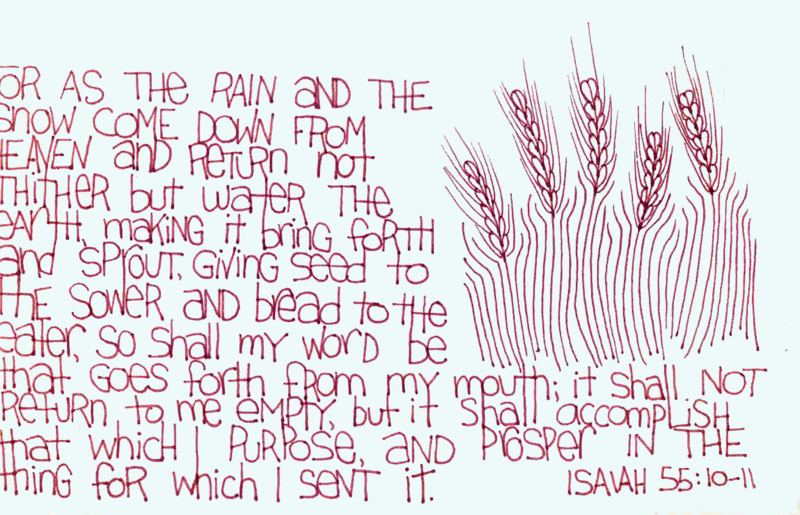
isaiah55As you probably know, this summer we have been taking a look at the people, events and issues of the Protestant Reformations of the 16th century. Among the Reformers there was a far greater emphasis placed on Scripture and preaching the Word. John Calvin’s typical Sunday homily seems to have been about 2 hours. John Knox’s homilies often had intermissions. Hard to imagine, heh? But it was a different era – not just because Sunday was dedicated to church, worship, and little else – but because for that generation of people, Scripture was coming alive for the first time. When the Zurich reformer Zwingli first began to preach he started at the beginning of the Gospel according to Matthew. Sunday after Sunday he worked his way through the whole Gospel, proclaiming, teaching, cajoling, and encouraging people to embrace and be embraced by God. The Word of God set people ablaze. Continue reading

Stories we tell; stories we hear

red-appleThank you to all who have asked about my mom. She is doing well physically, still plays a mean game of gin rummy, but her memory – or at least her access to her memories – lays somewhere between fuzzy and random with spots of complete clarity. Visits with her are a wonderful mix of storytelling and sometimes making a connection. Makes you wonder how memory works? Continue reading

Speaking in parables

parable_SowerThe Purpose of the Parables. Verses 10-17 are formally an interlude between the first parable and its explanation, but they are essential to the understanding of the chapter as a whole, as they set out the division between the enlightened disciples and the unresponsive crowd which is the focus both of the structure of the chapter and of much of its contents. Continue reading

What did they hear?

parable_SowerCommentary. Matthew 13 is a “day of parables.” The parable of the sower is spoken in public to great crowds (vv. 1–3), but its explanation and the teaching about parables are spoken only to the disciples (vv. 10–11). More parables are then spoken to ‘the crowds’ (v. 34), but the crowds are again left behind (v. 36), and the second explanation and further parables are spoken to the disciples in ‘the house’ (which Jesus had left in v. 1). The unresponsive crowds are thus clearly distinguished from the disciples to whom alone explanation is given, and this distinction is spelt out in vv. 11–17. Continue reading

A sower went out to sow…

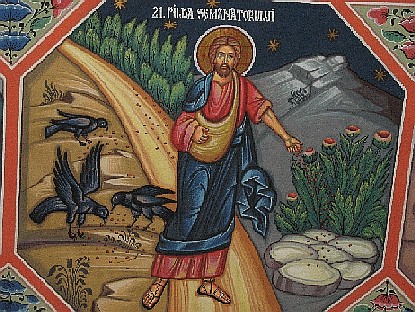
parable_SowerMatthew 13:1–23 1 On that day, Jesus went out of the house and sat down by the sea.2 Such large crowds gathered around him that he got into a boat and sat down, and the whole crowd stood along the shore.3 And he spoke to them at length in parables, saying: “A sower went out to sow. 4 And as he sowed, some seed fell on the path, and birds came and ate it up.5 Some fell on rocky ground, where it had little soil. It sprang up at once because the soil was not deep,6 and when the sun rose it was scorched, and it withered for lack of roots.7 Some seed fell among thorns, and the thorns grew up and choked it.8 But some seed fell on rich soil, and produced fruit, a hundred or sixty or thirtyfold.9 Whoever has ears ought to hear.” Continue reading

Parables

parable_SowerWhat is a “Parable”? Definition: “At its simplest a parable is a metaphor or simile drawn from nature or common life, arresting the hearer by its vividness or strangeness, and leaving the mind in sufficient doubt about its precise application to tease it into active thought.” (C. H. Dodd, The Parables of the Kingdom, New York: Charles Scribner’s Sons, 1961, p. 5) Less accurate, but perhaps more to the point – when heard, a parable should give you pause and turn your world upside down. Continue reading