
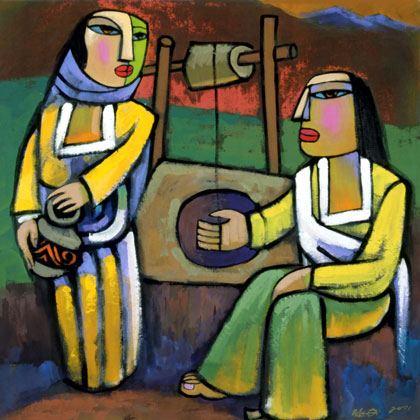
 Arrival of the disciples and departure of the woman. 27 At that moment his disciples returned, and were amazed that he was talking with a woman, but still no one said, “What are you looking for?” or “Why are you talking with her?” 28 The woman left her water jar and went into the town and said to the people, 29 “Come see a man who told me everything I have done. Could he possibly be the Messiah?” 30 They went out of the town and came to him. 31 Meanwhile, the disciples urged him, “Rabbi, eat.” 32 But he said to them, “I have food to eat of which you do not know.” 33 So the disciples said to one another, “Could someone have brought him something to eat?” 34 Jesus said to them, “My food is to do the will of the one who sent me and to finish his work. 35 Do you not say, ‘In four months the harvest will be here’? I tell you, look up and see the fields ripe for the harvest. 36 The reaper is already receiving his payment and gathering crops for eternal life, so that the sower and reaper can rejoice together. 37 For here the saying is verified that ‘One sows and another reaps.’ 38 I sent you to reap what you have not worked for; others have done the work, and you are sharing the fruits of their work.” Continue reading
At the well: one sows another reaps
Reply
 “And he was transfigured before them; his face shone like the sun and his clothes became white as light.” (Mt 17:2) Transfigured, metamorphoo – to change the visible appearance; I used to think that maybe Epiphany would have been a better title for what happened on the mountain top. Epiphany meaning the revealing or the unveiling. Then again, I don’t think the full glory of God was revealed; just a single layer was pealed back. Perhaps transfigured is the better word. How much more could the apostles have seen and heard – and, more importantly, to begin to comprehend? The Book of Exodus 33:20 says that if we saw God face-to-face we would not survive the encounter. It would be too much for our mortal being. So, maybe it is better that only a single layer was peeled back.
  Back in the day when I was working in the world and spending way too much time on airplanes accumulating way too many frequent-flyer miles, it seemed to me business travelers did three things on longer flights: sleep, work, or read Stephen’ Covey’s “The 7 Habits of Highly Effective People.” The book argues that one should align universal and timeless principles with one’s values. Covey sees principles as external natural laws, while values remain internal and subjective. Covey asserts that values govern people’s behavior, but principles ultimately determine the consequences. If sales volume is measure of the usefulness of this self-help book, then 25 million copies sold says something. Maybe there are some possibilities for a parallel book about the best practices and habits for Catholics. Might be a Lenten best seller!
 From
From  friarmusings