
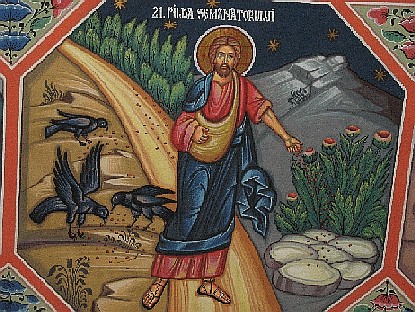
 “This is how it is with the kingdom of God; it is as if a man were to scatter seed on the land and would sleep and rise night and day and the seed would sprout and grow, he knows not how. Of its own accord the land yields fruit, first the blade, then the ear, then the full grain in the ear.” (Mark 4:26-28)
Sometimes I think we are too quick to be comforted by the Scriptures we hear in church and consider in Bible Study, like the parable above. Maybe it is about the wonder of faith or the need to be ready to bring in the harvest. Or it might be about our complete inability to control the coming kingdom as though our believing (or not) affects its coming. This second possibility is uncomfortable because it leaves us vulnerable. God’s kingdom comes apart from our efforts, cannot be controlled or influenced, and can only be received as a gift. In this sense, faith is apparently a lot more like falling in love than making a decision. Because faith, like love, is something that comes from the outside and grabs hold of you, whether you want it to or not. Continue reading

 This week, we celebrate The Solemnity of the Sacred Heart of Jesus, our church’s namesake. The Sacred Heart of Jesus is a devotional with long and historic provenance within Christianity, and in modern times has been established as a Solemnity for the universal Church.
 The great thing about being a child is that you can grow up to be a fire truck (my ambition at one point in life), not be concerned with gravity and the laws of physics, and your world in not limited by “that is not just the way things work.” It is a world of imagination and wonder that sometimes befuddles babysitters, teachers, and parents. It consumes lazy summer afternoons, creates space adventures, and can conjure up a most challenging collection of wisdom and insight. Nothing captures it better than my favorite comic strip of all time, “Calvin and Hobbes.” Calvin is a preternaturally bright six-year-old; Hobbes is his stuffed toy who, in Calvin’s imagination becomes into his best friend, the innocently wise Hobbes. To read Calvin and Hobbes is to be infused into wondering and wandering on a cosmic scale; to engage the innate human capacity to be surprised, to imagine, and be absorbed into mystery. No topic in the universe is closed to such capacity – not even the theological arts. Calvin mused how predestination is molded by procrastination, finally concluding, “God put me on this earth to accomplish a certain number of things. Right now, I am so far behind that I will never die.”
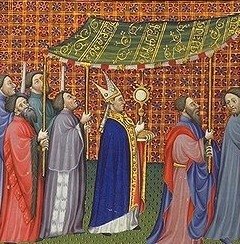
  I would wager that most people would guess that in Francis’ own writings he spoke at length about poverty, his love of nature and animals, and other topics for which Francis is so well known in the modern world. Yet, in his own writings, there is perhaps no other topic that he addresses more than the Eucharist. In his Eucharistic writings, Francis expresses a deep view of the continuing Incarnation of Christ in the world, and in that vision is an entire way of life. These writings represent part of the movement of Francis’ mystical life from prayer and devotion in solitude before the cross, to a pattern of communal prayer and devotion in the Mass as well as a devotion to the Eucharist apart from Mass.
  The Promise. Jesus’ words of promise were confirmed with a solemn oath that he would not share the festal cup until the meal was resumed and completed in the consummation. The sober reference “no more” indicates that this is Jesus’ final meal and lends to the situation the character of a farewell. The purpose of his vow of abstinence was to declare that his decision to submit to the will of God in vicarious suffering was irrevocable. Forswearing feasting and wine, Jesus dedicated himself with a resolute will to accept the bitter cup of wrath offered to him by the Father. Yet there is here a clear anticipation of the messianic banquet when the Passover fellowship with his followers will be renewed in the Kingdom of God. Then Jesus will drink the wine “new,” where in this context newness is the mark of the redeemed world and the time of ultimate redemption. The reference to “that day” envisions the parousia and the triumph of the Son of Man (see above on Ch. 13:24–27, 32; cf. 1 Cor. 11:26). Thus, in the context of reflecting upon his violent death on behalf of the many, and just prior to the impending events of the passion, Jesus clearly affirmed his vindication and the establishment of an uninterrupted fellowship between the redeemed community and its Redeemer through the experience of messianic salvation.
  friarmusings