Sending: message

The Message. 12 So they went off and preached repentance. 13 They drove out many demons, and they anointed with oil many who were sick and cured them.

The New American Bible (NAB) offers a translation that seems minimally functional – merely reporting that they set out on mission and what they did when they got there. A more literal translation of the verse is: “And the went out and proclaimed so that all might repent.” The second part of the verse is a hina clause in Greek, normally indicating purpose, aim, or goal. The purpose in their proclaiming is that people might repent, that is, have a change in mind/heart. Such preaching will include the demands from God and our failure to live up to them. It also includes the grace of God that accepts the law-breakers. It includes the mandate to speak the truth in such a way that it leads people to repent, to have a change in mind about their own sinfulness and about God’s gracefulness. Continue reading


Sent: provisions

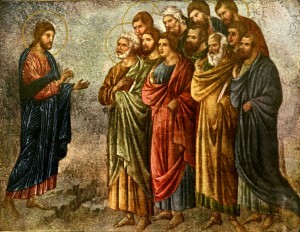
Christ-sending-His-ApostlesCommentary. Rejected by his own family and home crowd, Jesus preaches elsewhere and sends his twelve disciples out with special instructions and powers. It is good to remember that the apostles are not sent out as a reaction to the rejection. The mission of the apostles is part of a larger plan. First, Jesus had call them personally (1:16–20). Then he selected twelve special ones to accompany him (3:13–19). The Twelve, tutored by Jesus and present with him as he healed many from sickness and evil (chapters. 3–5), are now ready to become apostles, in Greek, literally the “ones sent out.” Continue reading

Sent: context

Christ-sending-His-Apostles7 He summoned the Twelve and began to send them out two by two and gave them authority over unclean spirits. 8 He instructed them to take nothing for the journey but a walking stick—no food, no sack, no money in their belts. 9 They were, however, to wear sandals but not a second tunic. 10 He said to them, “Wherever you enter a house, stay there until you leave from there. 11 Whatever place does not welcome you or listen to you, leave there and shake the dust off your feet in testimony against them.” 12 So they went off and preached repentance. 13 They drove out many demons, and they anointed with oil many who were sick and cured them. (Mark 6:7-13) Continue reading

On Pilgrimage

May the grace and peace of Christ be with you. I will be off-line for two weeks as I am on pilgrimage to the Holy Land. I have daily posts queued up and ready to go – but will not be around to respond to queries and questions. Know that I will keep you all in prayer.

Native place: the carpenter’s son

Jesus-who-is-thisIs not this the carpenter, the son of Mary?”  The rhetorical question, “Is not this the carpenter, the son of Mary?” deserves careful attention both to the text and its meaning. At least in modern American, small towns generally celebrate the success of their native sons and daughters. In the Marcan account, the comments of crowd are generally seen as derogatory. What might be the thought behind such a reaction? Continue reading

Native place: miracles

Jesus-who-is-thisMiracles and Unbelief. As Mark’s readers would expect, Jesus responds to what people are thinking about him. The proverbial saying “Prophets are not without honor, except in their hometown” (v. 4) has been expanded with two clauses: “among their kin” and “in their own house.” The original proverb spoke about the “homeland” (patris). The qualifying clauses narrow the region down to the prophet’s household and relatives. If this retort is understood as an insult, then Jesus has responded to his critics in kind. Since the miracles in the previous chapter emphasize the importance of faith in those who approach Jesus for healing, the conclusion that Jesus is unable to work many miracles in Nazareth is hardly surprising. Continue reading

Native place: hometown

Jesus-who-is-thisJesus left Capernaum and traveled southward into the hill country until he came to the village where he had spent his youth and the early years of his maturity. While Mark does not name Nazareth, he has earlier indicated that this was the village from which Jesus came, and it is undoubtedly in view under the phrase “his own country.” Jesus returned to Nazareth as would a rabbi, accompanied by his disciples. The reference to the disciples is important, for during this period Jesus had been concerned with their training in preparation for the mission which Mark reports in 6:7–13. Continue reading