
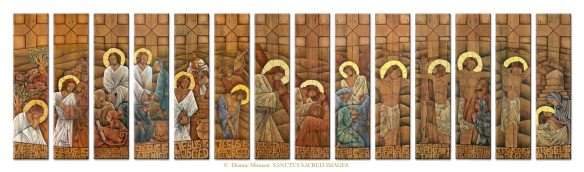
 When Holy Land pilgrims returned home, they often brought back a bit of Palestine. In addition to relics, the pilgrims also brought back the desire to re-create scenes from the Holy Land in order to share their experiences with those unable to visit the holy places firsthand. When the Holy Land was closed to western visitors, European replicas of the sacred sites became increasingly popular. Outside of Jerusalem, the tradition of walking the via sacra in commemoration of Christ’s passion, death, and burial with “stations” is mentioned as early as the twelfth century and all of the references point to an outdoor celebration. There was no standard celebration of the via sacra. Depending on the location there were as few as seven and as many as 42 stations. Interestingly, in the beginning, the customary route apparently was the reverse of ours, starting with Calvary and ending at Pilate’s house – and included many other stops that are no longer considered part of the Via Dolorosa (“Sorrowful Way”).
Franciscans and the Stations of the Cross
4
 In most commentaries there are discussions focused on the unity of composition (i.e., were there later editors?), date and purpose of the writing, questions of text preservation (consistency among known copies), underlying theology, and the “Sign of Jonah” from
  Ash Wednesday, the first day of the penitential season of Lent in the Catholic Church, is always 46 days before Easter Sunday. It is a “movable” feast that is assigned a date in the calendar only after the date of Easter Sunday is calculated. How is it calculated? I’m glad you asked.
 In
In 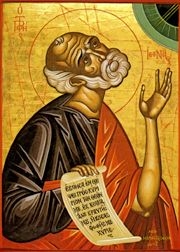 Before we dive into the Book of Jonah, we need to understand what we are reading, in other words, the literary genre. Why? Simply put, you read a newspaper differently than a novel. You read poetry different than history. It is good to understand what the literary genre of Jonah is because there are many different literary types in the OT, including laments, love songs, parables, apocalypses, and histories. Jonah is generally included with the so-called “Minor Prophets” such as Joel, Obadiah and Micah, so perhaps it straight-up prophecy?
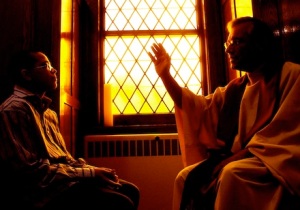 Lent is a penitential season when we’re encouraged to receive the Sacrament of Reconciliation: to go to confession. Some people look forward to doing this – others, not so much! Many just don’t think they need to go – for lots of reasons. Don’t plan to celebrate the sacrament this Lent? Here are a dozen reasons you can choose from!
 Today’s
  friarmusings