This coming Sunday is the 18th Sunday in Ordinary Time, Lectionary Cycle A. From the several weeks of parables we have heard over the previous several Sundays, the Gospel of Matthew returns to the narrative in which Jesus’ miracles increasingly become the source of controversies. R.T. France outlines this section as follows noting the varying response to Jesus’ teaching and miracles (13:54–16:20)
- Nazareth rejects Jesus (13:54–58) – questioning the source of his wisdom and deeds of power – and taking offense at him. “A prophet is not without honor except in his native place and in his own house.”
- Herod Antipas thinks Jesus is John the Baptist revived (14:1–12)
- Jesus feeds a large crowd (14:13–21) – our gospel reading this Sunday
- Jesus walks on the water (14:22–33)
- The popularity of Jesus as a healer (14:34–36)
- Dispute with Pharisees and scribes over defilement (15:1–20)
- A Gentile woman’s faith (15:21–28)
- Healing ministry among the Gentiles (15:29–31)
- Second feeding of a crowd (15:32–39)
- Jesus’ repudiation of Pharisees and Sadducees (16:1–12)
- Jesus is the Messiah (16:13–20)
Stories of the rejection of Jesus will be interrupted by three miracle stories, the first of which is the miraculous feeding of the 5,000. The narrative is introduced by Jesus’ suspicion concerning Herod’s interest in him causing him to depart to a deserted place, but the crowds follow. After curing some of the sick, Jesus provides enough food for five thousand men, plus women and children (vv. 15–21). There is a pattern to Matthew’s narrative in which miracle and confrontation ebb and flow – and in the midst are accounts of faith and disbelief. The narrative plays out the parables that preceded it: the net is indeed cast wide and all kinds of fish, wheat, weeds, and more are caught in the net of the Kingdom.
The parables that are especially notable in Matthew 13 (a day of parables) are focused and revolve around the phrase, “the kingdom of heaven is like…”, making clear it is in contrast to the kingdom of this world. That contrast between the two kingdoms continues and this time using the setting of the banquet. In the passage immediately preceding our gospel, King Herod presides over a banquet whose excess results in the death of John the Baptist. Herein Jesus presides over a banquet, not in a palace but in the wilderness, not among the powerful but rather the weak and poor, and results in life.
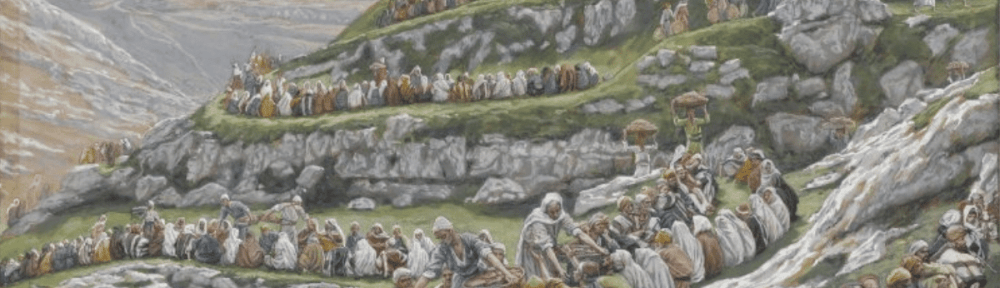
Image credit: James J. Tissot, ‘Miracle of the Loaves and Fishes’ (1886-94), Brooklyn Museum, NYC | PD-US
Discover more from friarmusings
Subscribe to get the latest posts sent to your email.

