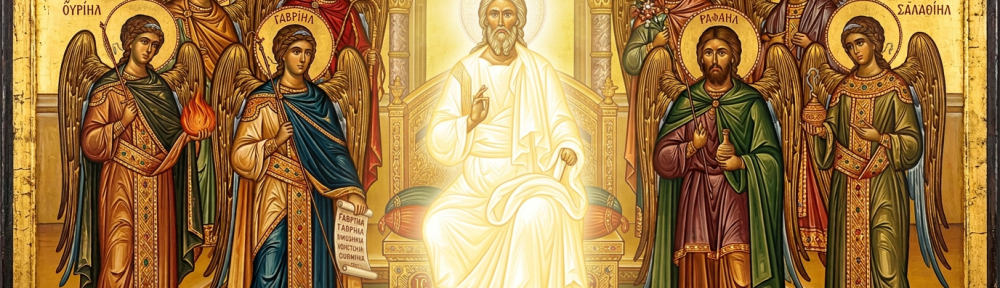
In yesterday’s post about the opening chapter of the Book of Job, we encountered an opening scene of the heavenly court of the Lord. Present were God, the son of God and the Satan. As noted yesterday, in the Old Testament they are the servants and attendants of God. To imagine them as angels, in the sense of later Christian theology, is probably an anachronism for the divine author of Job. Today is different. Today we celebrate the Feast of the Archangels Michael, Gabriel, and Raphael.
The date of September 29 originally marked the dedication of the Church of St. Michael in Rome built by Emperor Constantine. By the middle ages the day, known as Michaelmas, became a major celebration and a holy day of obligation in medieval Europe. For centuries, September 29 remained solely dedicated to St. Michael. Meanwhile, in 1921 Pope Benedict XV added universal feast days for the other two archangels named in Scripture: St. Gabriel on March 24 (the day before the Annunciation) and St. Raphael on October 24. During the liturgical reforms following the Second Vatican Council, Pope Paul VI combined the celebrations into our present celebration.
The Archangels
The Archangel Michael (who is like God) is biblically portrayed as a Protector and Warrior. In the Book of Daniel, Michael is described as “one of the chief princes” and the special protector of the people of Israel (Daniel 10:13, 12:1). In the Letter of Jude he disputes with the devil over the body of Moses, declaring “May the Lord rebuke you!” (Jude 1:9). Lastly, in the Book of Revelation, Michael leads the heavenly armies in a climactic battle to defeat Satan (the dragon) and cast him down to earth (Revelation 12:7-9).
The Archangel Gabriel (God is my strength) appears as the Messenger of God. In the Book of Daniel Gabriel explains prophetic visions to Daniel, specifically interpreting the vision of the ram and the goat, and predicting the timeline of the Messiah (Daniel 8:16, 9:21). In the Gospel of Luke He announces the upcoming birth of John the Baptist to the priest Zechariah (Luke 1:11-20). And at the Annunciation, Gabriel delivers the most famous message in human history to Mary, announcing that she will conceive and bear Jesus, the Son of God (Luke 1:26-38).
The Archangel Raphael (God heals) appears as Healer and Guide. In the Book of Tobit Raphael appears disguised as a human named Azarias to guide young Tobias on a dangerous journey. He protects Tobias and his new wife, Sarah, by driving away and binding the demon Asmodeus and he provides the instructions to cure Tobias’s father, Tobit, of his blindness using fish gall. He ultimately reveals his true nature by stating, “I am Raphael, one of the seven angels who stand and serve before the Glory of the Lord.” (Tobit 12:15).
Of course now we have to ask: who are the other four angels “who stand and serve before the Glory of the Lord”?
The Other Archangels
While the canonical Bible only names Michael, Gabriel, and Raphael, ancient Jewish and early Christian traditions reference a council of seven archangels. The concept of seven chief angels is hinted at in Scripture such as the Tobit reference above but also when the Book of Revelation mentions the “seven spirits who are before his throne.“
The earliest and most influential list defining all seven archangels comes from the Book of Enoch (Chapter 20), an ancient Jewish text dating to the 3rd century BC. While non-canonical for most Western churches, it remains part of the official scriptural canon of the Ethiopian Orthodox Church. Enoch names the remaining four as:
Uriel (Oriel): His name means “God is my light.” In apocryphal texts like 2 Esdras, he serves as an angel of wisdom who instructs prophets and guards the gates of Eden with a fiery sword.
Raguel: His name means “Friend of God.” Enoch describes him as the angel who “takes vengeance on the world of the luminaries,” acting as a celestial coordinator who ensures that other angels and cosmic laws remain in harmony.
Saraqael (Sariel / Zerachiel): His name means “God’s command” or “God has helped.” He is tasked with overseeing the spirits of humans who fall into sin, guarding against spiritual corruption.
Remiel (Ramiel / Jerahmeel): His name means “Thunder of God” or “Mercy of God.” He is designated as the angel responsible for those who rise from the dead, serving as a guide for holy souls awaiting resurrection.
At a later date, drawing upon ancient liturgies and the 5th-century writings of Pseudo-Dionysius, the Eastern Orthodox Churches, offered these as the name of the seven archangels: Michael, Gabriel, Raphael, Uriel,
- Selaphiel (Sealtiel): “The Prayer of God,” depicted in icons with his hands crossed over his chest in a posture of deep, contemplative prayer
- Jegudiel (Jhudiel): “The Praise of God,” seen as the defender of people working in positions of leadership or spiritual responsibility.
- Barachiel: “The Blessing of God,” often depicted holding white roses or scattering flower petals, representing the distribution of divine blessings.
The Unnamed Archangels in Western Christianity
Both of these sources are “eastern” which raises the question of why the remaining four archangels remained “unnamed” in Western Christianity. In the early western Church, the popular naming of dozens of unbiblical angels led to a rise in folk magic, superstition, and unauthorized angelic worship. To curb this, Pope Saint Zachary enacted a decree at the Council of Rome in 745 AD. The Church officially banned the invocation of any angel names not explicitly recorded in the recognized books of Sacred Scripture. Consequently, the West restricted its official focus strictly to Michael, Gabriel, and Raphael, leaving the other four hidden to history and folklore.
The reason for the ban was, in part, adherence to the canonicity of Sacred Scripture, an unhealthy aspect of angelology, but the “tipping point” leading to the ban was when St. Boniface reported to Rome the unauthorized preaching of Aldebert of Soisson, France. He claimed that the Archangel Raphael personally delivered a letter to him from Jesus authorizing his preaching, his evangelization (which amounted to a cult of personality) and a whole rash of actions. Adelbert’s most egregious act was his prayer: “I pray to you, angel Uriel, angel Raguel, angel Tubuel, angel Adinus, angel Tubuas, angel Sabaoc, angel Simiel…” When the Roman analyzed this list, the theologians recognized that apart from Uriel and Raguel several of the other names had distinct roots in Gnostic magic and occultism. The Church came to a chilling conclusion: Adalbert was not speaking to holy protectors; he was unknowingly (or knowingly) entering into pacts with demons. As a whole, his movement centered around a type of angelology that seemed to move certain angels into lateria worship, that due to God alone. While Boniface wanted him excommunicated, the local councils held him to be insane and removed him from public life.
Despite the Council of Rome’s 745 AD ban that removed him from official Catholic liturgy, Archangel Uriel maintained a vibrant presence in Western literature, art, and high culture. He did this by transitioning from a figure of strict religious dogma into a powerful symbol for humanists, poets, and Protestant traditions. During the Renaissance, European scholars became deeply fascinated by classical antiquity, Jewish mysticism (the Kabbalah), and early Christian texts. Because Uriel’s name translates to ‘God is my Light,” artists and humanists adopted him as the unofficial patron saint of the arts, sciences, and divine wisdom. In da Vinci’s masterpiece, Virgin of the Rocks, the angel guiding the infant John the Baptist alongside Mary is traditionally identified as Uriel, drawing from apocryphal legends.
When the Church of England broke away from Rome in the 16th century, it discarded many medieval Catholic decrees and recognized Uriel as the fourth Archangel, placing him right alongside Michael, Gabriel, and Raphael. Across the UK and the United States, Episcopal and Anglican churches feature stained-glass windows of Uriel holding a solar orb or a scroll of wisdom. He is uniquely venerated within Anglicanism as the patron saint of the Sacrament of Confirmation, guiding the faithful into the light of spiritual maturity
In Paradise Lost, Milton, a Protestant, was completely unbothered by medieval Catholic bans. He cast Uriel as a major character, naming him the “Regent of the Sun” and the sharpest-sighted spirit in all of Heaven.
Probably more than you wanted to know, but interesting nonetheless!
Image credit: WordPress AI based on the text of the article
Discover more from friarmusings
Subscribe to get the latest posts sent to your email.


Why are the the archangels referred to as “he”? Just wondering….