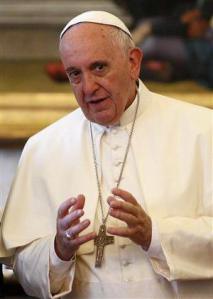
 From Pope Francis’ homily on the Solemnity of Saints Peter and Paul:
“It is pointless, even tedious, for Christians to waste their time complaining about the world, about society, about everything that is not right. Complaints change nothing. Let us remember that complaining is the second door that closes us off from the Holy Spirit, as I said on Pentecost Sunday. The first is narcissism, the second discouragement, the third pessimism. Narcissism makes you look at yourself constantly in a mirror; discouragement leads to complaining and pessimism to thinking everything is dark and bleak. These three attitudes close the door to the Holy Spirit. Those Christians did not cast blame; rather, they prayed.
We today can ask: “Are we protecting our unity, our unity in the Church, with prayer? Are we praying for one another?” What would happen if we prayed more and complained less, if we had a more tranquil tongue? The same thing that happened to Peter in prison: now as then, so many closed doors would be opened, so many chains that bind would be broken… (cf. Acts 12:10-17).
Let us ask for the grace to be able to pray for one another. Saint Paul urged Christians to pray for everyone, especially those who govern (cf. 1 Tim 2:1-3). “But this governor is…,” and there are many adjectives. I will not mention them, because this is neither the time nor the place to mention adjectives that we hear directed against those who govern. Let God judge them; let us pray for those who govern! Let us pray: for they need prayer. This is a task that the Lord has entrusted to us. Are we carrying it out? Or do we simply talk, abuse and do nothing? God expects that when we pray we will also be mindful of those who do not think as we do, those who have slammed the door in our face, those whom we find it hard to forgive. Only prayer unlocks chains, as it did for Peter; only prayer paves the way to unity.


 Next Sunday is the celebration of the 15th Sunday in Ordinary Time. You can read a complete commentary on the Gospel here.
 I used to camp and backpack in the wilds of Virginia and West Virginia. Generally, it was just for a weekend – maybe two or three days – along with a group of friends. We would carry everything in/out. I remember having fun, enjoying it all, but I always felt like I needed a day to recover. Perhaps it was the infrequency of carrying a load, the hiking, and all that goes with the adventure, but come Monday, there was always a stiffness about my neck, arms, shoulders, upper back and all the rest that is connected to those parts. I could still feel the aftereffects of the pack’s burden. “Come to me, all you who labor and are burdened, and I will give you rest.” It sounded like the perfect scripture for the post-camping Monday mornings.
  Forgive him (or her)? Forgive myself? How could God forgive me? These are all questions we have asked ourselves at some point. We who were raised in the Christian tradition in which forgiveness is intrinsic to our faith. We, who as children, freely asked for and so easily received forgiveness. Sometime between our childhood and our teen/adult years, we learned to savor and recall moments of hurt or regret. Regrets that continue to haunt us and enter our lives, our dreams unwelcomed. Memory of hurt too often recalled, nursed, leading to thoughts of how such egregious actions can be balanced out in an uncaring universe. “Revenge is a dish best served cold.” Sounds like a quote from a Shakespearean tragedy, but it is all too modern, a blithe saying speaking to something as old as humankind.
  This week’s we’re looking at the character of God as revealed to Moses in Exodus chapter 34. We see in this passage that though God is first and foremost a loving and merciful God, he will not ignore injustice or evil. God is willing to put up with a lot of human failures. But our choices matter, and God will maintain a balance between mercy and justice, which at times means handing us over to the consequences of our decisions. As followers of Jesus, we may be wondering what God is going to do in the world in response to this time of deep unrest and upheaval. But the better question may be to ask ourselves, what are we going to do to carry out God’s will in the world?
 Last week’s first readings were like an
  Next Sunday is the celebration of the
  The readings from daily Mass this week past should have been labeled “King and Prophet week.” Every day the first readings was a narrative about one of the Kings of Israel or Judah, a summary of their reign, and the proclamation of the prophets which came before them with the living Word of God. Prophets like Amos, Isaiah, and Jeremiah; as well as prophets whose names are unfamiliar to us; and prophets whose names were not recorded in Sacred Scripture. Kings that might not be familiar to you, but are a cast of the Good, the Bad, and the Ugly. Two of the best were part of the narrative: Hezekiah and Josiah – kings held in almost the same esteem as King David – godly men who understood their role as leader – to lead the people of God more deeply into the covenant life and promises of God. Two of the worst were recounted: Hoshea the last of the northern kings and Zedekiah, the last of the Kings of Judah. They ruled with iniquity as had most of their predecessors. When they disappeared into exile, the time of Kings passed and all of Israel and Judah followed int exile, the promised land lost.
  Here is an interesting link to an AP-wire story by Lolita Bador on how the pandemic is affection naval deployments: “The two U.S. warships in the Middle East weren’t aiming to break a record. But when the coronavirus made ship stops in foreign countries too risky, the USS Dwight D. Eisenhower and the USS San Jacinto were ordered to keep moving and avoid all port visits. On Thursday, as they steamed through the North Arabian Sea, they notched their 161st consecutive day at sea, breaking the previous Navy record of 160 days. And they’re on pace to crush it, since they won’t hit land again until they get home to Virginia later this year.” You can find the entire article
  friarmusings