Bearing Fruit. The OT prophets envisioned a time when Israel would “bud and blossom and fill all the world with fruit” (Isa. 27:6; cf. Hos. 14:4–8). What is the “fruit” that the gardener expects from the branches? When chapter 15 is read in context of John 14 it is evident that loving Jesus (vv.15, 21, 23) forms part of the answer. When read in the context of John 13, loving each other (vv.34-35) forms another part of the answer. In the light of the what is understood as the two greatest commandments, “love” is the expected fruit. If so, then the unproductive branches of 15:2 are the people who are in Jesus, in the community of faith, who are not loving, who are not seeking the good of the whole body. Continue reading
Author Archives: Friar Musings
True Vine: the grower
The Vine Grower. Like the song of the vineyard in Isaiah 5, John 15:2 depicts the role of God as the grower who spades, clears, plants and takes care of the vineyard only to be rewarded with wild/sour grapes (Isa. 5:1–7; cf. Ps. 80:8–9). According to 15:2, the vinedresser does two things to ensure maximum fruit production (“he takes away … he prunes”; cf. Heb. 6:7–8): (1) in the winter he cuts off the dry and withered branches, which may involve pruning the vines to the extent that only the stalks remain; (2) later, when the vine has sprouted leaves, he removes the smaller shoots so that the main fruit-bearing branches receive adequate nourishment Continue reading
True Vine: I AM
The ancient Old Testament allegory of Israel as Yahweh’s vine becomes deeply Christianized at this point. Jesus is the true vine of which the Father takes personal care, pruning the barren branches, trimming clean the fruitful. These latter are the disciples who have accepted Jesus’ life-giving word. They are invited, encouraged to live on, to abide in Jesus. The Greek word for “abide/remain,” menō, occurs eleven times in these few verses, a repeated insistence on the return of Jesus by indwelling. The other all-important word is “love.” Just as “abide/remain” is the essential word of verses 1–8, so “love” becomes essential in vv.9–17. Consider how the “Vine and Branches” metaphor concludes: “It was not you who chose me, but I who chose you and appointed you to go and bear fruit that will remain, so that whatever you ask the Father in my name he may give you. This I command you: love one another.” (John 15:16-17) Continue reading
True Vine: context
John 15:1-8 “I am the true vine…”
1 “I am the true vine, and my Father is the vine grower. 2 He takes away every branch in me that does not bear fruit, and everyone that does he prunes so that it bears more fruit. 3 You are already pruned because of the word that I spoke to you. 4 Remain in me, as I remain in you. Just as a branch cannot bear fruit on its own unless it remains on the vine, so neither can you unless you remain in me. 5 I am the vine, you are the branches. Whoever remains in me and I in him will bear much fruit, because without me you can do nothing. 6 Anyone who does not remain in me will be thrown out like a branch and wither; people will gather them and throw them into a fire and they will be burned. 7 If you remain in me and my words remain in you, ask for whatever you want and it will be done for you. 8 By this is my Father glorified, that you bear much fruit and become my disciples. Continue reading
50 Years Ago
Depending on your age, this column is either a walk down memory lane or a “history” lesson — 50 years in the making. So, if you look over at someone reading this column and nodding their head up and down in phantom agreement, you can take a guess at their age.
The Year 1968 was a year in which a manned spacecraft first orbited the moon, the Boeing 747 made its first commercial flight, average monthly house rent was $130, gas was $0.34/gallon, Dr. Martin Luther King Jr. and Robert Kennedy were assassinated, Intel Corporation was founded, the Beatles released the “White Album,” the first Big Mac went on sale (…for $0.49), Ziplock sandwich bags were introduced, the “hip” products of the year were bean-bag chairs and lava lamps, and you will want to burn any remaining Polaroid pictures of what you thought was high fashion. Continue reading
The Voice: summary
Verses 17-18 form the conclusion to the discourse. In these verses, the shepherd metaphor is abandoned completely and Jesus speaks directly about his death and relationship with God. These verses focus on three theological themes that are essential to understanding the death of Jesus in John.
First, these verses place Jesus’ death fully in the context of his relationship with God. Verse 17 contains the first linkage of “love” (agapaō) with Jesus’ death in the Fourth Gospel. God’s love for the world (3:16) and for Jesus (3:35) are already known to the reader, and this verse adds a new dimension to that love. God loves Jesus because Jesus lives out God’s commandment fully (v.18). In the Fourth Gospel, the core commandment that Jesus gives his disciples is that they love one another just as he has loved them (13:34). The sign of Jesus’ love for them is that he is willing to lay down his life for them (cf. 13:1; 15:13). Jesus thus obeys the same commandment from God that he passes on to his disciples, to live fully in love. It is wrong to read the these verses as saying that Jesus wins the Father’s love through his death; rather, his death is the ultimate expression of the love relationship that already exists and defines who he is and how he enacts God’s will for the world. Continue reading
The Voice: Jesus
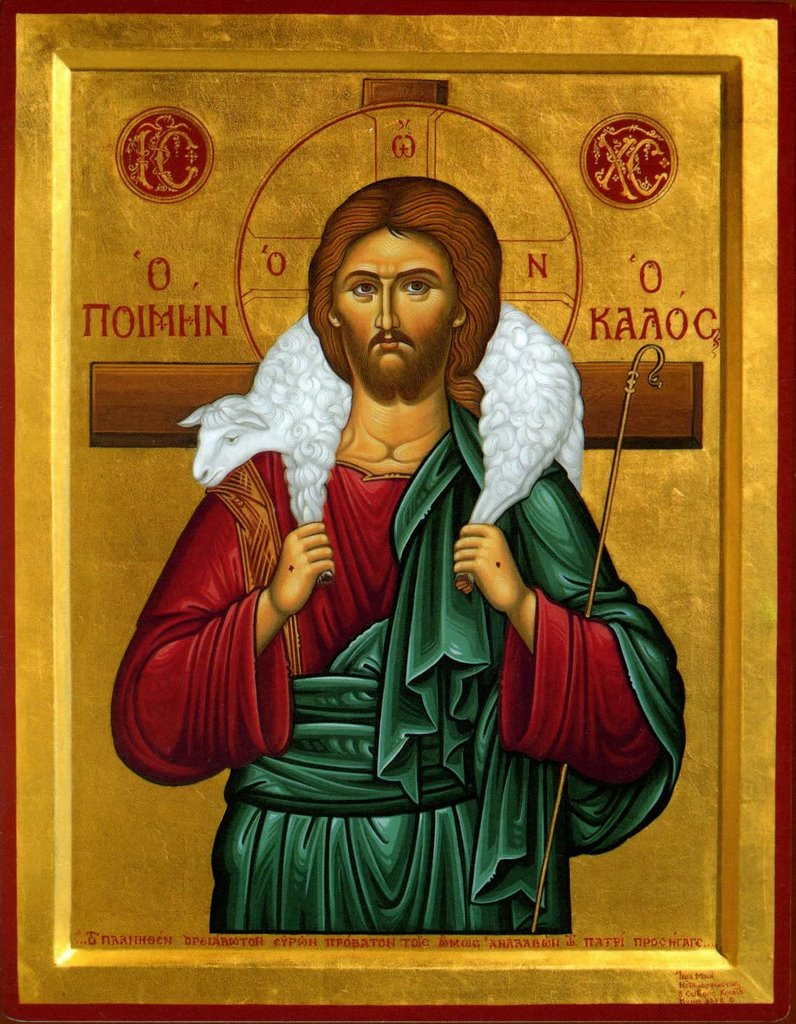
The Good Shepherd. At v.11, the focus shifts to Jesus’ self-revelation as the good shepherd. The identification of Jesus as the shepherd was implicit in the figure of speech in vv.1-5, but it is made explicit for the first time here. As before, the positive image of the good shepherd (vv.11, 14-16) is contrasted with a negative image, that of the hired hand (vv.12-13).
The “I am” saying of v.11a is explained exclusively in metaphorical language in vv.11b-13. That is, after the initial use of a first-person singular pronoun, Jesus never refers to himself directly again. Instead, he draws on images derived from the OT to explain what he means by “good shepherd.” The adjective “good” (kalos) also has the meaning “model” or “true,” and the reference point for what constitutes a model shepherd is set by the image of God as the good shepherd in Ezekiel 34. According to Ezek 34:11-16, God the good shepherd cares for the sheep, rescuing them from the places to which they have been scattered, feeding them, and tending to the weak, the injured, and the lost. By identifying himself as the good shepherd of Ezekiel 34, Jesus thus identifies himself as fulfilling God’s promises and doing God’s work (cf. 4:34; 17:4). Continue reading
The Voice: the flock
The Sheep. The latter part of v.3 (the sheep hear his voice) literally translates as “the sheep the sounds (phōnēs) his hear.” While voice might be part of the range of calls the shepherd might use, perhaps when one considers the use of whistles, “sounds” is the better translation. In any case, the key is the link between recognition of the proper phōnēs and the resulting movement: lead-follow. The movement is also twinned: call-answer, lead-follow, stranger-run away. In one, the movement it towards intimacy (v.4); in the other, the movement is towards separation (v.5). Continue reading
The Voice: contrasts
Commentary. Moloney [301]outlines this narrative by the following schema:
- 9:39-41: Introduction. Jesus is questioned by the Pharisees (among whom there is a division) and he condemns them for their blind ignorance
- 10:1-6: Jesus tells a parable about entering the sheepfold and the Pharisees cannot understand. This section is marked with the unique, “Amen, Amen…”
- 10:7-13: Jesus contrasts himself, the door and the Good Shepherd, with others who are thieves, robbers and hirelings. This section is also introduced with “Amen, Amen…”
- 10:14-18: Jesus the Good Shepherd, out of union with the Father, lays down his life for the sheep
- 10:19-21: Conclusion: A division among “the Jews.”
The Voice: about
Some thoughts about shepherds. Fr. James Martin, SJ, in his book Jesus: A Pilgrimage notes that most of Jesus’ parables are agricultural in nature, with some nod toward those who harvest the seas for their living; very few are rooted in his own livelihood, carpentry (or more specifically, tecton, a general term for one who works in the building/craft trades). Yet Jesus grew up in Nazareth amongst his neighbors who labored in those areas. Thus, Jesus, while himself not a farmer or fisherman would be familiar through his extended relationships. We are left to speculate the “common knowledge” about shepherds and the care of sheep and what ideas Jesus might have held. Continue reading